
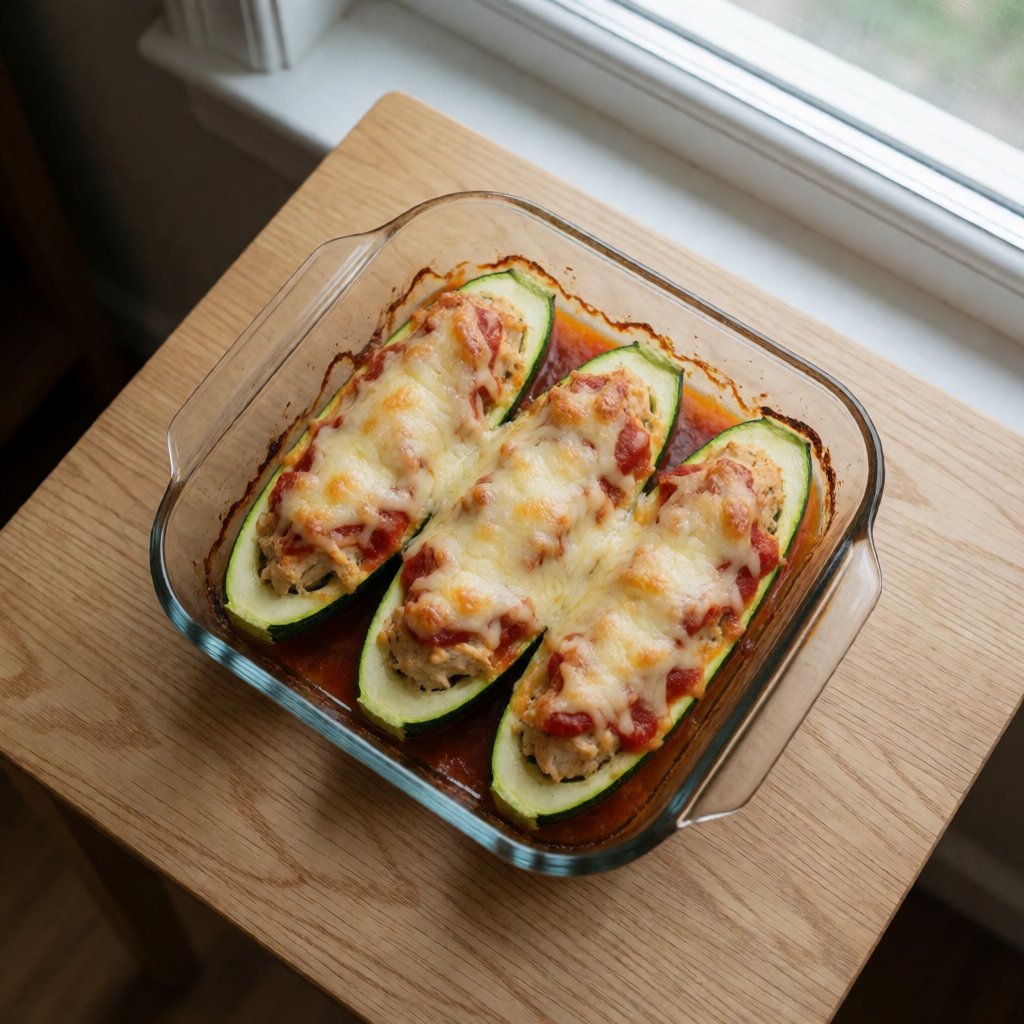
 AI photo
Stuffed Courgettes
Courgette boats filled with chicken mince and baked until golden.
Labels are worked out automatically from the ingredients and can be wrong. Check the packaging if it matters to you.
Ingredients
- 400 g Courgettes small, 2 pcs
- 250 g Chicken mince
- 0.5 pcs Onion finely chopped
- 1 tbsp Tomato paste
- 40 g Mature cheddar grated
- 1 pinch Salt to taste
- 1 pinch Black pepper to taste







Steps
Halve the courgettes lengthways, scoop out the centres, finely chop and mix with the chicken mince, onion, tomato paste, salt and pepper.
Fill the courgette boats, place in a baking dish and cover with foil.
Put the dish in the oven at 200°C for 30 minutes.
30 minRemove the foil.
Sprinkle with mature cheddar and bake for another 10 minutes, until the centre reaches 74°C.
10 minTake the dish out of the oven.
What was changed
We swapped the plain hard cheese for Mature cheddar, the everyday grating cheese in British kitchens.
This is a courgette doing two jobs at once — it's the dish and it's dinner. Halve it, scoop it, and you've got a boat that holds a lean chicken filling while slowly giving up its own moisture into that filling. What decides whether this works isn't the oven's heat, it's whether that heat reaches the middle of a fairly thick parcel — vegetable wall, then meat — before anything on the outside dries out or seals over.
The foil is doing more than "keeping it moist," though that's the usual way people describe it, and it's not wrong, just incomplete. What the foil really does is trap steam around the courgette boats so the whole dish cooks in a damp, even heat rather than a dry one. Without it, 200°C would start drying and lightly colouring the surface of the mince long before the heat has worked its way through the courgette wall into the centre — you'd get a browned top sitting over a filling that's still raw underneath. The foil buys the dish time to heat through evenly, like a steam bath, before you ever expose it to dry air.
The courgette itself has one job beyond flavour: structural. Small ones, firm-fleshed, hold a scooped-out shape. Let the courgette grow big and watery — the kind that's gone soft and seedy in the middle — and the walls collapse under their own moisture once baked, the boat slumps, and you end up with soup in a skin. When you hollow it out, leave a proper wall, not paper-thin. Too thin and it tears when you lift it; too thick and there's no room for the filling that's the actual point of the dish.
Chicken mince is lean, and lean mince dries fast once it's exposed to direct heat — that's the defect this whole method is built to avoid. By packing it inside a courgette and sealing the dish under foil, you're cooking the mince gently, in its own steam, rather than roasting it exposed. If you swap in turkey mince, same logic applies, same handling. Pork mince has more fat and forgives you a little more. Beef changes the flavour entirely and is fattier still, so it's the most forgiving of the lot if you're worried about dryness — just know you're making a different dish, not a substitution in the strict sense.
Don't throw away the scooped-out courgette centre — chopping it into the filling isn't a garnish, it's doing real work. It adds back moisture and bulk cheaply, so the mince goes further and the texture inside stays tender rather than dense and meat-heavy. This is the old logic behind stuffed vegetables generally, going back a long way across several cuisines: meat was the expensive part of a meal, vegetable was not, so you stretch the costly ingredient with the cheap one and the vegetable becomes the serving dish as well, saving you a plate too.
Onion goes in raw and finely chopped, straight into the mix — no pan, no pre-frying. That's not laziness, it's arithmetic: forty minutes in a sealed, steamy oven environment is enough to soften onion that's chopped small, so there's no need to dirty a second pan on the hob first. Chop it coarse, though, and you'll get a crunchy, raw bite sitting inside a dish that's otherwise soft all through — wrong texture, wrong signal to the tongue that something's unfinished.
Tomato paste, not fresh tomato, because it's concentrated — colour, a little acid to cut the fattiness of chicken, umami, with almost no extra water. This dish is already managing moisture carefully inside a sealed foil parcel; adding fresh tomato's water content would work against that, diluting instead of seasoning. If paste is what you're short of, a long-reduced tomato sauce would do the same job, but it has to be reduced, not just chopped tomato straight in.
The cheese stage only happens once the foil comes off, and that's deliberate — you want the last ten minutes to be dry, direct heat, the opposite of the first thirty. Mature cheddar is sharp enough to cut through the mildness of chicken and courgette, and firm enough to hold its shape and brown a little rather than just weep oil everywhere. Any hard, well-aged cheese with low moisture does the same job — a mature gouda, for example. Save the soft, fresh cheeses for dishes where you want melt without colour; here you want a bit of both.
You already own the dish for this — it's the one your Sunday roast potatoes go in, just smaller, something that holds the courgette halves snugly without a lot of empty space around them. Too roomy and the little juice that escapes spreads thin and catches at the edges before the middle's done; too tight and there's no air movement for the uncovered stage to brown properly. And once it's out of the oven, give it a few minutes before you cut in — the filling is still settling, and cutting too soon just lets everything you cooked so carefully to keep moist run straight out onto the plate.
·