
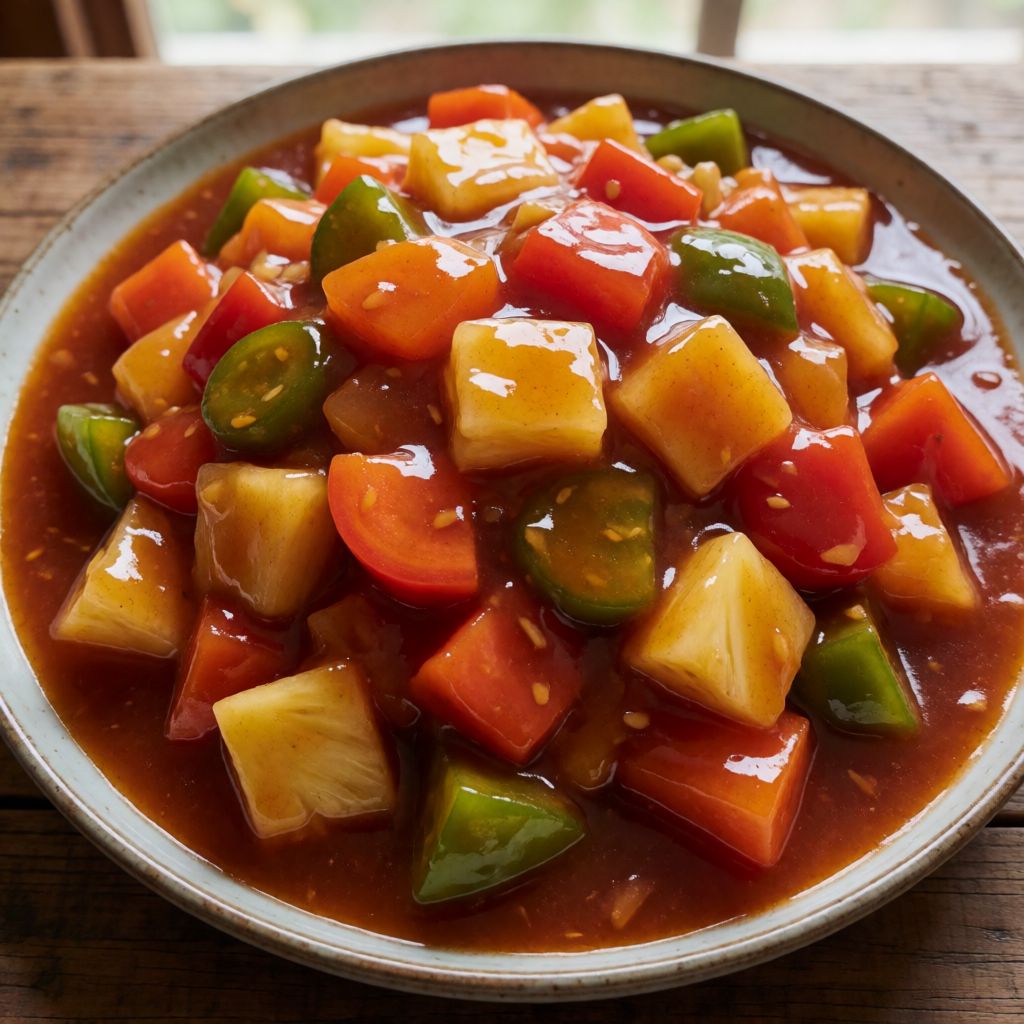
 AI photo
Sweet and Sour Vegetables
A quick sweet and sour vegetable stir-fry served with rice, bright with pineapple and ginger.
Labels are worked out automatically from the ingredients and can be wrong. Check the packaging if it matters to you.
Ingredients
- 200 ml pineapple juice
- 1 tbsp rice vinegar
- 2 tbsp ketchup
- 1 tbsp brown sugar
- 1 tbsp ginger finely grated
- 1 tbsp soy sauce
- 1 tbsp cornflour
- 250 g mushrooms sliced
- 1 pcs onion cut into wedges
- 2 pcs leek sliced
- 0.5 pcs pointed cabbage roughly chopped
- 1 pcs bell pepper diced
- 1 pcs broccoli cut into florets
- 100 g sugar snap peas sliced
- 100 g edamame beans shelled
- 2 tbsp sesame oil for frying
- 300 ml basmati rice cooked according to pack instructions
- 25 g sesame seeds toasted
- 1 bunch coriander finely chopped














Steps
Mix the ingredients for the sweet and sour sauce in a saucepan, bring to the boil while stirring, and let it bubble for a few minutes.
Remove the sauce from the heat and let it cool slightly in the saucepan.
Heat a wok or large frying pan with oil and fry the mushrooms over high heat until golden brown.
Add the onion, leek, pointed cabbage, bell pepper and broccoli and cook the vegetables, stirring constantly, for 4–5 minutes.
Add the sugar snap peas and edamame along with the sweet and sour sauce to the vegetables and stir well for a minute.
Serve the sweet and sour vegetables with rice, sprinkled with sesame seeds and coriander.
This is a stir-fry wearing a sauce it didn't earn through hours of simmering — and that's fine, that's the whole point of the dish. Sweet and sour as a flavour was never a slow thing. It's a quick acid-sugar balance built to cut through fried food, invented because frying leaves everything tasting of itself and nothing else, and someone needed a way to wake the palate back up between bites. Here you make it from pineapple juice, vinegar, ketchup and sugar — in ten minutes, in a saucepan, while the vegetables are still sitting on the chopping board.
What decides whether this works isn't the sauce, though. It's heat and timing on the vegetables, and whether you resist the urge to crowd the pan. A domestic hob doesn't throw the kind of heat a wok burner does — no commercial kitchen has that at home either, so don't chase it. What you can do is keep the pan properly hot and add things in the order they need: mushrooms first, alone, until they stop weeping water and start taking on colour. That's the test — not a clock, not "a few minutes", but the sound changing from a hiss to something closer to a crackle, and the colour going from pale and wet to golden at the edges.
Pineapple juice does the sugar's job and the acid's job at once, which is why it's there instead of plain water and sugar — it brings fruit acid along with sweetness, the two things sweet-and-sour sauce is actually built from. Rice vinegar sharpens it further; any mild vinegar works if that's what's in the cupboard, but reach for one without a loud flavour of its own, because its job is lift, not personality. Ketchup is doing something most people don't credit it for: it's already vinegar, sugar, tomato and spice in one bottle, so it shortcuts half the sauce-building in a single spoonful — this is why Western "sweet and sour" recipes lean on it so hard, it's not a cheat, it's an economy.
Ginger, grated fine rather than sliced, needs surface area to give up its oil quickly into a sauce that's only simmering for a few minutes — a few minutes isn't enough time for a chunk to release much, so fine grating is doing real work, not just tradition. Soy sauce brings the salt and the savoury backbone that stops the whole thing tasting like fruit punch. Cornflour mixed into a liquid sauce, not thrown in dry, is the only way to avoid lumps — mix it with a little of the cold liquid first if you're nervous, then stir it through the rest.
For the vegetables, the principle is: anything that holds its shape under high heat and doesn't drown the pan in water. Mushrooms go first and alone because they're mostly water themselves, and if they share pan space with onion and cabbage from the start, none of it browns — it all steams. Onion, leek, cabbage, pepper, broccoli go in together because they're closer in density and cooking speed. Sugar snaps and edamame go in last, with the sauce, because they want to stay crisp — a sugar snap that's been fully cooked has lost the one thing it had going for it, the snap.
Sesame oil for frying is an odd choice if you think of it as a flavour oil only, and worth knowing: toasted sesame oil scorches and turns bitter at real stir-fry heat, so if you're using the dark, strong-smelling kind, you want a splash for aroma at the end, not the frying medium. For the actual frying, any oil with a high smoke point and no smell of its own does the job without a fight — sunflower, groundnut, light vegetable oil, all fine stand-ins.
Basmati rice cooked separately, not sat under the vegetables, keeps its grains apart instead of turning to stodge in the sauce's liquid — rice absorbs sauce fast, and sauce was meant for the vegetables, not for making risotto by accident. Sesame seeds toasted in a dry pan for a minute, watching for colour rather than counting seconds, go from pale to golden brown quicker than feels fair — look away and they're burnt. Coriander goes on at the very end, off the heat, because its whole value is in the leaf still being alive, so to speak — cook it and you've paid for an herb and got grass.
Patience here isn't about long cooking — there isn't any — it's about not rushing the pan. Give the mushrooms their minute alone. Let the sauce sit while the vegetables get their turn. Twenty minutes of a stir-fry rushed is a soggy plate; twenty minutes done in the right order is dinner.