
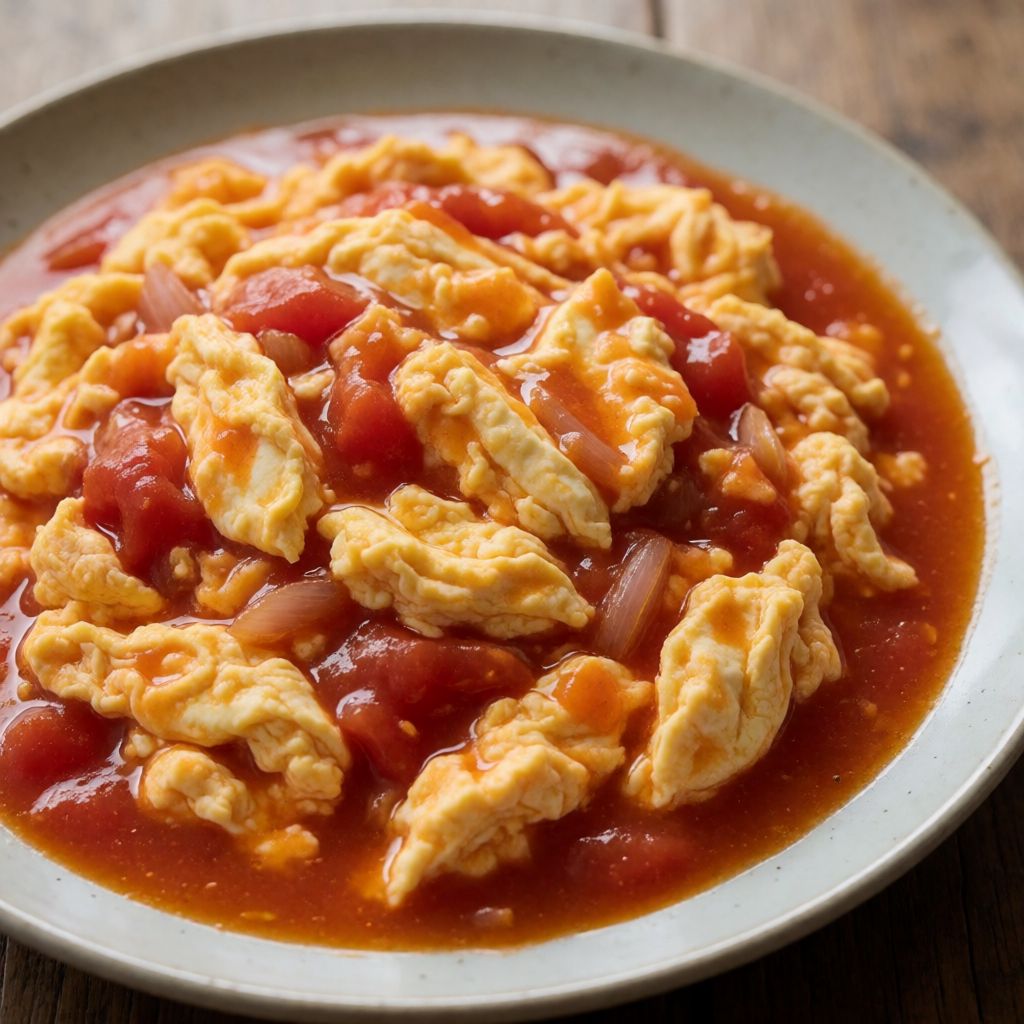
 AI photo
Mum's Eggs with Tomatoes
A quick, comforting dish of eggs stirred into a tomato sauce, just as Mum used to make it.
Labels are worked out automatically from the ingredients and can be wrong. Check the packaging if it matters to you.
Ingredients
- 1/2 pcs Shallot
- 400 ml Tomato passata
- 4 pcs Eggs
- 3-4 tbsp Olive oil
- Parmesan to taste
- Butter to taste
- Salt to taste
- Black pepper to taste






Steps
Finely chop the shallot and fry it in a saucepan with the olive oil.
Add 400 ml tomato passata and bring to the boil.
Add the eggs and stir vigorously for 10 minutes. Season with salt and pepper to taste.
10 minStir in the Parmesan and butter until smooth.
Serve with toasted bread.
What was changed
The pomegranate listed at the top did not match the cheese stirred in at the end, so it was replaced with Parmesan, which is what the dish actually uses.
This is shakshuka's quieter, less spiced cousin — eggs cooked straight into a tomato sauce, no oven, no fuss, built for one person who wants something warm and slightly indulgent without washing three pans. What decides whether it works is the sauce itself: it has to be reduced and concentrated before the eggs go in, not thin and watery, because thin passata just boils the eggs into rubber instead of binding into a sauce around soft curds.
The shallot is step one and it is not decoration. Frying it slowly in the oil until it turns from sharp white to a soft, sweetish gold is what removes the raw onion bite — if you rush this, every bite later will taste faintly of raw allium under the tomato, which nobody wants with their toast. You're listening for the hiss to quiet down and watching the pieces go translucent and limp; that's the cue, not a clock.
Then comes the part the recipe almost glosses over: "stir vigorously for 10 minutes" sounds like busywork but it's actually a technique with a name — it's closer to making scrambled eggs inside a sauce than frying fried eggs on top of one. You crack the eggs straight into the simmering passata and keep the whisk or spoon moving constantly, breaking the curds as they form so the yolk and white disperse through the tomato instead of sitting in it as islands. Stop stirring and you get poached eggs in red water; stir properly and you get a thick, custardy, rust-coloured sauce studded with soft curd — that's the actual dish.
Some say you should fry the eggs first and pour sauce over them, the way you'd do with a fried-egg-on-toast breakfast. No — because that gives you two separate textures sitting next to each other, a fried egg and a sauce, when the whole point here is one unified, slightly thickened, almost risotto-like consistency where you can't quite tell where egg ends and tomato begins. The vigorous stirring is doing the same job a whisk does in a carbonara: using egg protein as a thickener for a sauce, not as a garnish sitting on top of it.
On shallot versus onion: a shallot is sweeter and milder than a regular onion, with less of that sulphurous sharpness, which matters in a dish with almost no other aromatics — no garlic, no herbs listed, nothing to hide behind. If you only have a regular onion, use half a small one and give it longer over gentle heat, because it needs more time to shed its bite than a shallot does. Red onion works too, though it will bleed a little colour into the sauce — harmless, just know it's there.
Tomato passata is simply tomatoes that have been strained smooth and usually lightly cooked down already — no skins, no seeds, no big tomato chunks to deal with. It's the right choice here because it goes straight into a hot pan and starts reducing immediately; a tin of whole or chopped tomatoes would need blending or a lot more time boiling down to get the same thick, pourable-but-not-watery base. If passata isn't in the cupboard, chopped tinned tomatoes blitzed smooth are the closest stand-in, just expect to simmer them a bit longer before the eggs go in — you want the sauce visibly thicker and darker red, not the bright thin orange of a just-opened tin.
The oil's job in step one is just a neutral medium for softening the shallot — "olive oil" here isn't asking for anything extra-virgin and precious, since it's about to be boiled hard with tomato and lose any delicate flavour anyway. Any oil with no strong smell of its own works: a light olive oil, a plain vegetable or sunflower oil, even the butter from later split into two portions if you'd rather not buy a separate bottle for this.
Parmesan and butter are both finishing fats — one salty and savoury, one rich and rounding. Parmesan's hard, aged, intensely salty character is what lets a small amount season the whole pan; a soft young cheese would just melt into stringy nothing without adding the same punch. If you're out of Parmesan, a strong hard cheese like a mature Cheddar or Grana Padano does similar work — just taste your salt again afterwards, since hard cheeses vary a lot in how salty they are. Butter at the end isn't there for cooking at all; it's there to coat the sauce in a bit of shine and silkiness, the same reason a risotto gets a knob of butter stirred in right before serving and not at the start.
Four eggs for one person sounds like a lot until you remember they're not frying whole — they're dissolving into 400ml of sauce, so the yield is really "sauce for one hungry person with toast," not "four eggs on a plate." If that's too much food, halving everything keeps the ratios honest; don't just drop to two eggs with the full 400ml, or you'll have a thin tomato soup with egg flecks in it rather than the dense, custardy sauce you're after.
Patience sits mainly in two places: letting the shallot actually turn gold rather than staying raw-white, and giving the full stir time rather than snatching it off heat the moment the eggs look "done enough." Ten minutes of steady stirring is the lower bound, not a target to beat — judge it by the sauce thickening around the spoon and clinging rather than running off it. And since there's a British kitchen behind this: toasted bread for dipping matters as much as the sauce itself, so pick a bread sturdy enough to hold its shape when it goes in — a good crusty white loaf or sourdough toasts and holds up far better than soft supermarket sliced bread, which tends to collapse the second it meets a wet sauce.