
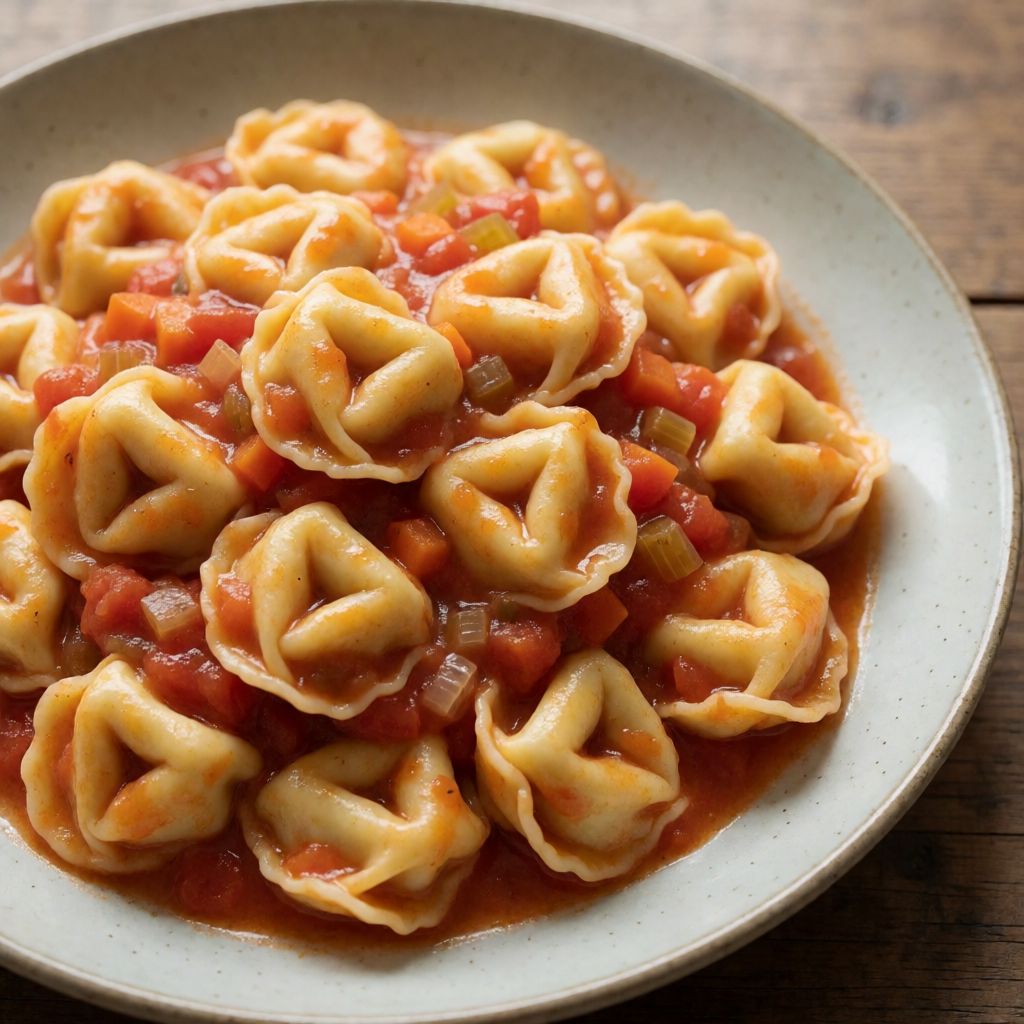
 AI photo
Tortellini in Tomato Sauce
Homemade tortellini filled with beef and prosciutto, served in a fresh tomato and basil sauce.
Labels are worked out automatically from the ingredients and can be wrong. Check the packaging if it matters to you.
Ingredients
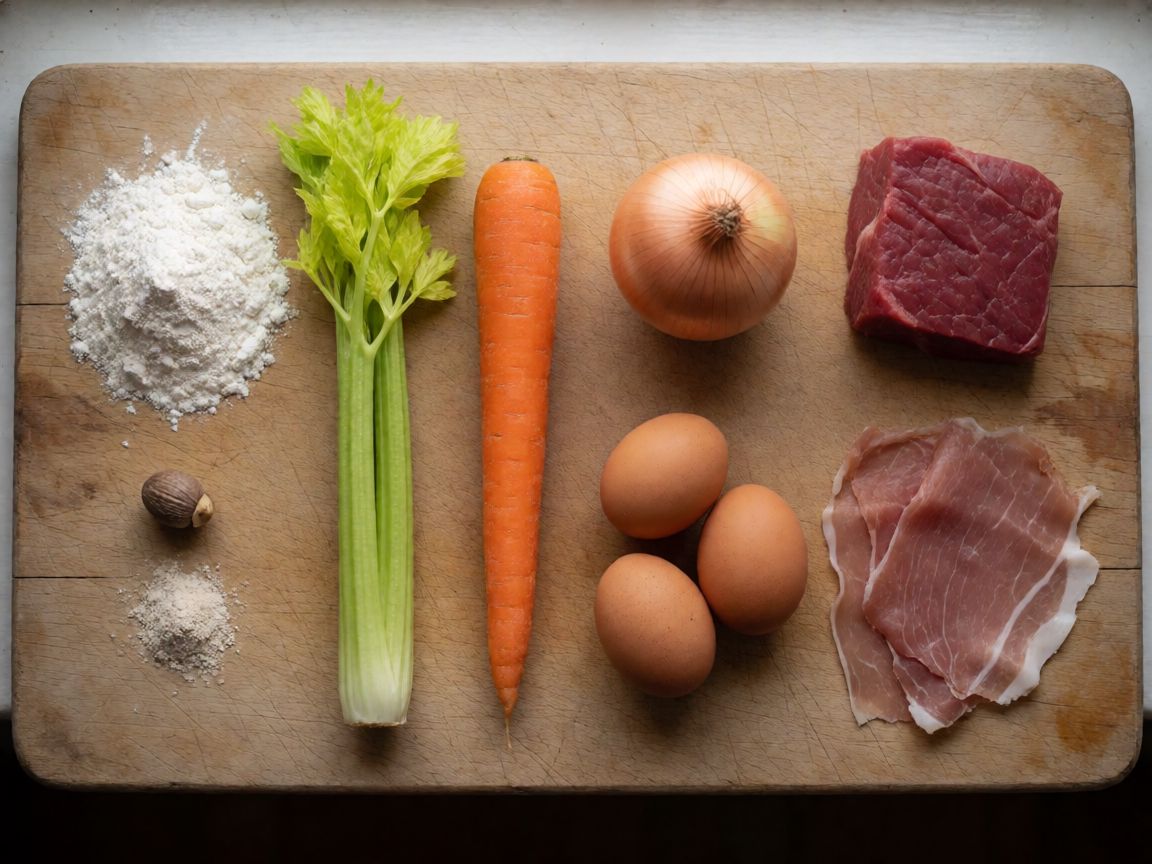
- 300 g Plain flour
- Salt to taste
- Water as needed
- 1 pcs Celery stick
- 1 pcs Carrot
- 1 pcs Onion
- 3 pcs Eggs
- 300 g Beef
- Prosciutto to taste
- Nutmeg to taste
- 40 g Parmesan
- 350 g Tomato
- Basil to taste
- Olive oil to taste
- Black pepper to taste












Steps
Wash the celery stick, carrot and half the onion, and cut them into small pieces.
Transfer the vegetables to a large pot, add a ladle of salted water and cook over low heat.
30 minAdd the diced beef to the vegetables, stir and continue cooking.
60 minOn a work surface, form a mound with the flour, add a pinch of salt and gradually pour in the water.
Knead the dough energetically by hand until it forms a smooth, even ball.
Let the dough rest for about half an hour.
30 minWash the tomatoes and blanch them in water for a few seconds, then peel and remove the seeds.
Fry the finely chopped remaining onion in olive oil, then add the fresh tomato flesh.
Flavour with basil leaves, add a pinch of salt and cook the sauce for about 20 minutes.
20 minTransfer the beef and vegetables to a blender together with the prosciutto and blend into a soft mixture.
In a large bowl, combine the eggs and Parmesan, add the minced meat mixture and season with salt, black pepper and nutmeg.
Roll out the dough thinly and cut into 5 cm squares.
Using a teaspoon, place a little filling in the centre of each square.
Fold the dough into a triangle and join the ends together to form the tortellini.
Cook the homemade tortellini in salted boiling water for about 4 minutes.
4 minDrain, generously dress with the tomato and basil sauce, and sprinkle with Parmesan.
Tortellini is a boiling exercise disguised as a folding exercise. The thing that actually decides whether it works is the filling — and the filling is decided an hour before you touch the dough, in a pot of beef quietly turning into stock with celery, carrot and onion. If that beef isn't cooked soft and slow, you don't get tortellini filling, you get mince with ambitions. So the "pasta" part — 300g flour, egg-less here, just salt and water — is almost the easy half. It gives you a dough that's elastic because you worked it hard, not because you added eggs to it; the eggs go into the filling instead, binding the meat and cheese so it holds its shape inside a 5cm square of dough.
Some say tortellini needs a kazan-sized pot of simmering broth and a grandmother's wrist for the fold. No — you need a wide pan of water that's properly boiling, and a fold that just closes the parcel without trapping air. A domestic hob manages this fine; what it won't manage is pretending a 60-minute braise can be rushed to 20, because the beef needs that long low cook to give up its toughness and pick up the celery-carrot-onion flavour before it goes into the blender.
The sauce is the simplest honest thing here: blanch tomatoes to slip the skin off without fighting it, deseed so the sauce doesn't go watery and thin, cook it down until it's a sauce and not a soup. Basil goes in for scent, not decoration — bruise it, don't chop it to dust.
Flour: 300g plain flour, nothing fancy, because the dough's job is structure, not flavour — the flavour lives entirely in the filling and sauce. No eggs in this dough, unlike the usual Italian egg pasta you might expect; that's deliberate, since the eggs are needed inside, in the filling, to bind the meat-and-cheese mixture so it doesn't collapse into mush when it hits boiling water. Knead it properly — "energetically," as the recipe says — because gluten only develops with real working, not gentle stirring; skip this and your squares tear the moment you try to fold a triangle. The half-hour rest isn't optional either: it lets the gluten relax after you've stressed it, so the dough rolls out thin without springing back and tearing. If you've only got strong bread flour in the cupboard, it'll work, just needs a touch more water and more resting — more gluten, more resistance.
Beef: 300g, diced, destined for the blender, so don't buy a prime cut you'd roast on a Sunday — a cheaper, tougher cut with some connective tissue is actually better here, because that long gentle simmer with celery, carrot and onion is exactly what breaks down collagen into something soft and savoury. This is the same logic as a stock pot: low heat, patience, and the vegetables aren't a side dish, they're flavour infrastructure that gets blended straight into the filling with the meat. Any red meat that benefits from slow cooking substitutes fine — pork shoulder, veal — the mechanism is the same: tough protein, low heat, time breaks it down.
Prosciutto: not there for bulk, but for the salt-cured depth that plain boiled beef lacks on its own — a little goes into the blender with the meat. If you haven't got prosciutto, any dry-cured ham does the same job; what you're replacing is the saltiness and umami, not the specific pig.
Eggs and Parmesan: the eggs bind the filling into something that holds a shape when squeezed into a triangle of dough; the Parmesan (40g, plus more to finish) adds salt and sharpness that cuts through the fattiness of the meat. Nutmeg is traditional here for a reason that's more history than magic — it was the Renaissance way to signal a filled pasta was a special-occasion dish, nutmeg being expensive and imported. Use it sparingly; it should register as warmth, not as "what's that smell."
Tomatoes: 350g fresh, blanched briefly so the skin slides off without cooking the flesh, then deseeded — seeds carry a lot of the watery, bitter liquid that would thin your sauce and dull its colour. If fresh tomatoes are pale and unconvincing, which happens often enough outside summer, a tin of good plum tomatoes drained of excess liquid does the job better than a sad fresh one. Basil is for scent, added toward the end so the heat doesn't cook the aroma out of it — bruise or tear the leaves, don't chop them into dust.
Oil: olive oil, specified because it needs its own quiet flavour, not because "oil" is interchangeable — but if you're out, any neutral oil with no smell of its own will carry the onion and tomato without arguing with them, just won't add that faint grassy note at the end. Celery and carrot are there in the braise for the same reason they're in any good stock — sweetness and a vegetal backbone that plain meat and water don't have on their own.
On the UK kitchen itself: you don't need a kazan or a pasta machine graduating to paper-thinness. A wide pan for the boiling water, a rolling pin and a sharp knife for the 5cm squares, and patience for two separate clocks — the beef braising for an hour, the dough resting for thirty minutes — running at the same time, not one after the other. That overlap is where you save real time, not by rushing either process.