
 AI photo
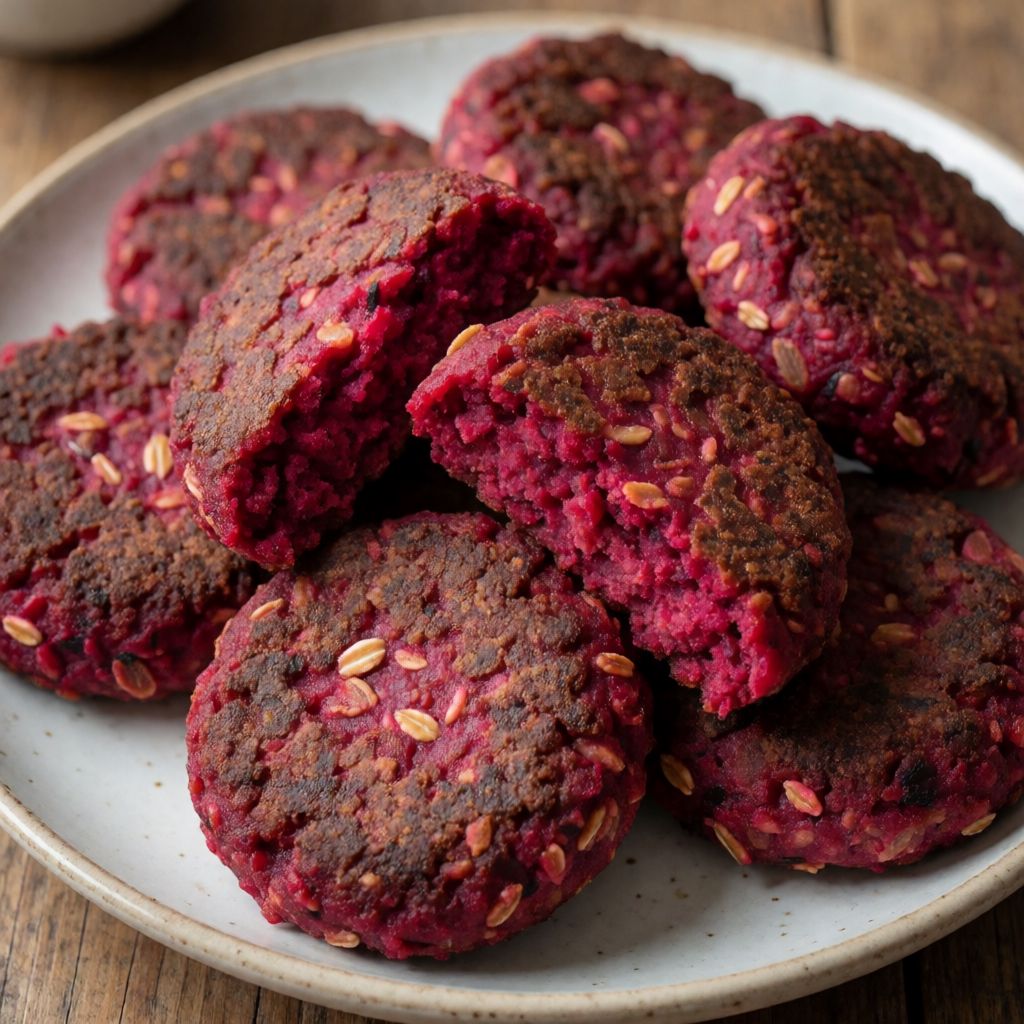
Vegetarian Beetroot Patties
Hearty beetroot patties, oven-baked and served on bread with poached eggs, capers and gherkins.
Labels are worked out automatically from the ingredients and can be wrong. Check the packaging if it matters to you.
Ingredients
- 250 g Beetroot coarsely grated
- 50 g Porridge oats
- 25 g Plain flour
- 1 pcs Onion finely chopped
- 2 clove Garlic finely grated
- 2 pcs Eggs
- 1 tsp Dijon mustard
- Salt
- Black pepper freshly ground
- 1 tbsp Olive oil for frying
- 4 pcs Eggs
- 1 tbsp Apple cider vinegar
- 4 pcs Bread slices
- 25 g Horseradish finely grated
- 1 pcs Red onion sliced into thin rings
- 8 pcs Capers
- 50 g Pickled gherkins
- 100 ml Chives finely chopped

















Steps
Put the grated beetroot, oats, flour and onion in a bowl, add the eggs and mustard, mix and season with salt and pepper. Adjust the consistency if needed with a little more oats or flour so the patties hold together easily.
Shape the patties, place on a lined baking tray, drizzle with oil and bake in the oven at 200°C for about 5 minutes.
5 minPut each patty on a slice of bread and bake for a further 10 minutes.
10 minBring a pan of water to the boil, add the apple cider vinegar, remove from the heat and swirl with a spoon and whisk to form a vortex in the centre.
Slide an egg into the centre of the vortex, return to the heat and poach for about 3 minutes, then remove with a slotted spoon.
3 minRepeat poaching the eggs with the remaining eggs.
3 minServe the patties topped with the poached eggs, sprinkled with chives, salt and freshly ground pepper, with capers and gherkins.
This is a beetroot patty built to sit under a poached egg on toast — basically beetroot Benedict. The whole dish works or fails on two unrelated things: whether the patty holds its shape without an oven-ready crust of egg glue, and whether the poached egg is a soft dome and not a ragged cloud of white threads. Everything else is seasoning noise around those two facts.
Grated beetroot is mostly water held in cell walls. Cook it raw inside a patty and it weeps that water the second it hits heat, and the patty slumps into mush on the tray. The oats and flour aren't filler for cheapness — they're there to soak up exactly that water as it escapes, so the starch swells and sets instead of pooling underneath your patty. This is why the recipe tells you to adjust with "a little more oats or flour" rather than giving you a fixed weight: beetroots vary in how much water they're carrying, and a dry winter beetroot behaves differently from a wet one. Trust what the mixture feels like in your hand — it should hold a shape without sticking to your palm — not a number on a scale.
The two-stage bake is the other quiet mechanism. Five minutes alone lets the outside firm up and lose a bit of surface moisture so it won't immediately soak the bread into a sog. Then it goes onto the bread for the second stage, and the heat from underneath crisps the bread's surface rather than letting raw vegetable moisture wick straight into it. Skip the first bake and put a wet patty straight onto bread, and you get soup on toast.
Beetroot: grate it coarsely, not finely — fine shreds turn to paste and lose the texture that tells you you're eating a vegetable patty rather than a dyed veggie burger. If raw grating and the stained hands put you off, cooked and cooled beetroot (the vacuum-packed kind from any UK supermarket) works too, but squeeze it first — it's already released its water once and holding more of it, and a wet mix here is the single most common reason these patties fall apart in the pan or on the tray.
Oats: rolled porridge oats, not jumbo — jumbo oats stay too intact and leave the patty lumpy instead of binding. Any oats will absorb moisture, but porridge oats are milled fine enough to do it fast, before the beetroot water has a chance to pool. If you're out of oats, use more flour, or fine breadcrumbs — the job is moisture absorption and light structure, not a particular grain.
Eggs in the mix: this is the actual glue, the protein that sets under heat and holds everything together once the oats have done their water-management job. Two eggs for 250g beetroot is a working ratio — go lighter and the patty crumbles when you lift it; there's no need to add more, egg in excess just makes the inside rubbery.
Mustard: not for heat, for emulsifying and for cutting through the earthy, slightly sweet flatness beetroot has on its own. A teaspoon of Dijon does this without announcing itself. English mustard is sharper and smaller amounts go further — halve it if that's what's in your fridge.
Horseradish and gherkins and capers: these three are doing the same job from different angles — sharp, sour, salty counterpoints to the sweetness of cooked beetroot, which left alone reads as one-note. This is not decoration; without an acid note on the plate, the whole thing tastes like beetroot soup set into a patty, pleasant for one bite and tiring by the third. Fresh horseradish loses its bite fast once grated, so grate it last, straight onto the plate if you can; the jarred creamed version is milder and fine as a substitute, just use more of it.
Bread: the recipe doesn't specify, and that's deliberate — any bread that can take a damp patty and ten more minutes of oven heat without collapsing into wet cardboard. Something with a firm crumb, a day-old sourdough or a dense wholemeal, holds up better than a soft white sandwich slice, which tends to go gummy underneath where the patty sits.
On the vinegar for poaching: it's doing a specific chemical job — lowering the pH so the egg white's proteins coagulate faster and tighter, not flavouring the water. Any vinegar with reasonable acidity does this; apple cider vinegar is named because it's what's in most UK kitchen cupboards already, not because the flavour matters once it's diluted into a pan of water and mostly discarded with the cooking liquid.
Patience here is specific and short-lived: don't rush the first five-minute bake by skipping straight to assembling on bread, and don't crowd the pan with all four eggs at once hoping to save time — crowd them and they collide and tear. One at a time, lifted out with a slotted spoon the moment the white's gone from translucent to matte white but the middle still gives under the spoon, is the whole trick.