
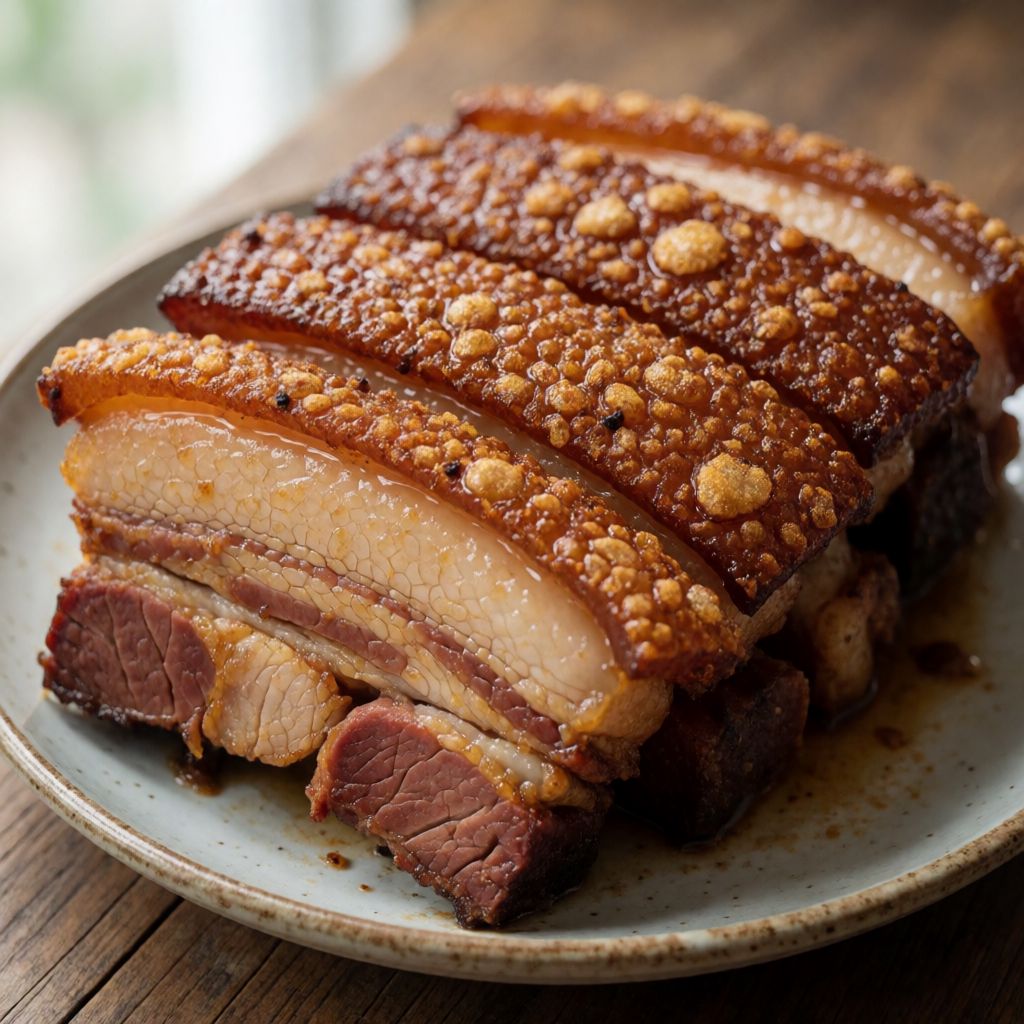
 AI photo
Vietnamese-Style Crispy Pork Belly
A Vietnamese-inspired pork belly with crackling skin, wrapped in rice paper with fresh herbs, noodles and hoisin sauce.
Labels are worked out automatically from the ingredients and can be wrong. Check the packaging if it matters to you.
Ingredients
- 800 g Pork Belly
- 1 tsp Five Spice
- 1 tsp Brown Sugar
- 1 pcs Lemon finely grated zest
- 0.5 tsp Salt
- 0.5 tsp Black Pepper freshly ground
- 1 pcs Shallot finely chopped
- 1 tsp Sesame Oil
- 1 pinch Salt for the skin
- 16 pcs Rice Paper
- 1 bunch Coriander fresh
- 1 bunch Mint fresh
- 1 bunch Thai Basil
- 2 pcs Carrot cut into matchsticks
- 1 tsp Chilli Flakes
- 150 g Noodles cooked according to pack instructions
- 100 ml Hoisin Sauce













Steps
Remove any bones and place the pork belly on a board, skin-side down. Score the meat side (not the skin) with 1 cm deep cuts.
Mix the five spice, brown sugar, lemon zest, salt and freshly ground black pepper in a bowl and rub well into the cuts. Then tuck the finely chopped shallot into the cuts.
Turn the pork belly over and score the skin lengthways and crossways into roughly 1 cm squares, taking care to cut only the skin and fat layer, not the meat. Rub the skin with oil and salt.
Place the belly on a heatproof tray lined with baking paper and put it into a cold oven. Set the temperature to 125°C and roast for 2 hours at this low temperature.
Then raise the temperature to 230°C and continue roasting until the skin is crisp.
To serve, dip a sheet of rice paper in water and lay it on the table. Place salad, herbs, noodles and hot slices of pork belly in the centre of the rice paper.
First fold in the sides, then roll tightly into a spring roll.
Repeat until all the rolls are assembled.
Serve with hoisin sauce.
This is two dishes wearing one coat: a Chinese-style twice-cooked pork belly — soft meat, shattering skin — stuffed into a Vietnamese salad roll. The two halves don't fight. The fresh herbs and rice paper exist precisely because the meat is rich enough to need something cold and green cutting through it. Take the herbs away and you just have very good crackling.
What decides whether this works isn't the five-spice or the shallot or any of the aromatics — it's what happens to the skin and the fat underneath it. Pork belly has three layers: skin, a band of fat, and meat. Treat it as one piece and you get a predictable failure — either the meat is dry by the time the skin blisters, or the skin stays rubbery while the meat is already cooked through. The two-stage oven is how you get round that, and it's worth understanding why, because it's the whole dish.
The scoring is not decoration either. Cutting into the meat opens channels for the five-spice and sugar to actually reach past the surface — rubbed spice on an unscored belly just sits on top and burns before it seasons anything. Cutting the skin into a grid does something different: it breaks the skin's surface tension into small plates, so each square can blister and lift on its own instead of the whole sheet warping and staying tough in patches. Score too deep into the fat and the fat runs out during the slow cook, taking the puffing power of the skin with it — that's why step 3 insists on skin and fat only, not meat.
The slow stage, 125°C for two hours, is doing the unglamorous but decisive work. At that temperature the connective tissue in the belly — collagen — has time to break down into gelatine without the muscle fibres seizing and squeezing all their moisture out, which is what happens if you push heat too fast. At the same time, the fat layer under the skin is rendering, draining down through your scored squares, drying the skin from underneath. You're not cooking the skin at this point so much as drying it out — think of it as the same logic as leaving a joint uncovered in the fridge overnight before a Sunday roast, except here the oven does the drying while the meat also cooks. A cold oven start matters too: it lets the belly come up in temperature gradually alongside the oven itself, rather than hitting a hot blast of air on cold meat and tightening the skin before the fat beneath it has even started to move.
Then 230°C is the shock. Dried skin, suddenly surrounded by fierce heat, puffs and crisps because the little moisture left in it flashes to steam fast enough to lift each scored square — this is blistering, the same mechanism that makes good pork crackling or a well-made pork scratching. Watch it, don't time it: you're looking for the skin going from pale and leathery to deeply bubbled and the colour of strong tea, patches darkening unevenly because that's how real skin behaves, not a machine. If your domestic oven runs hot or has a hotspot at the back, turn the tray halfway through this stage — a UK fan oven is not shy about uneven heat.
The meat-side spice mix is a rub, not a marinade, so it needs contact and time rather than liquid — five spice brings its own warmth (star anise, clove, cassia, fennel, Sichuan pepper, roughly), the sugar helps it catch and caramelise rather than just taste raw, and the lemon zest is there to cut the richness with aromatic oil rather than acidity — you're not trying to make it taste "lemony". If you've no five spice to hand, a pinch each of ground cinnamon, star anise and black pepper gets you close enough; this isn't a spice that needs reverence, it needs balance.
Shallot tucked into the cuts rather than scattered on top matters for the same reason as scoring the meat — it sits where the heat and fat reach it slowly, softening and sweetening instead of burning on an exposed surface. A finely chopped small onion does the same job if shallot isn't in the fridge; the dish doesn't care which allium, only that it's cut fine enough to melt rather than crunch.
Rice paper wants water, not soaking — a quick dip, lay flat, and it finishes softening on the table while you fill it, because paper that's gone fully soft before you touch it just tears. This is the one place where speed matters more than patience: assemble while it's still slightly stiff, because it keeps softening in your hands.
The herbs — coriander, mint, Thai basil — aren't garnish, they're the acid-and-freshness side of the equation against fat; use whichever of the three you can actually get hold of rather than treating the trio as fixed law, though mint is the one I'd fight hardest to keep, it's the one that cuts pork fat most cleanly. Carrot matchsticks give the only textural crunch in the roll once the pork is soft and the noodles are soft, so don't cut them so fine they go limp in the roll — you want the bend, not the snap, when you fold the wrapper round them.
And the two hours at low heat is the ingredient people skip first when they're short on time — don't. There's no shortcut that renders fat and softens collagen in twenty minutes; that's patience doing actual chemical work, not tradition for its own sake.