
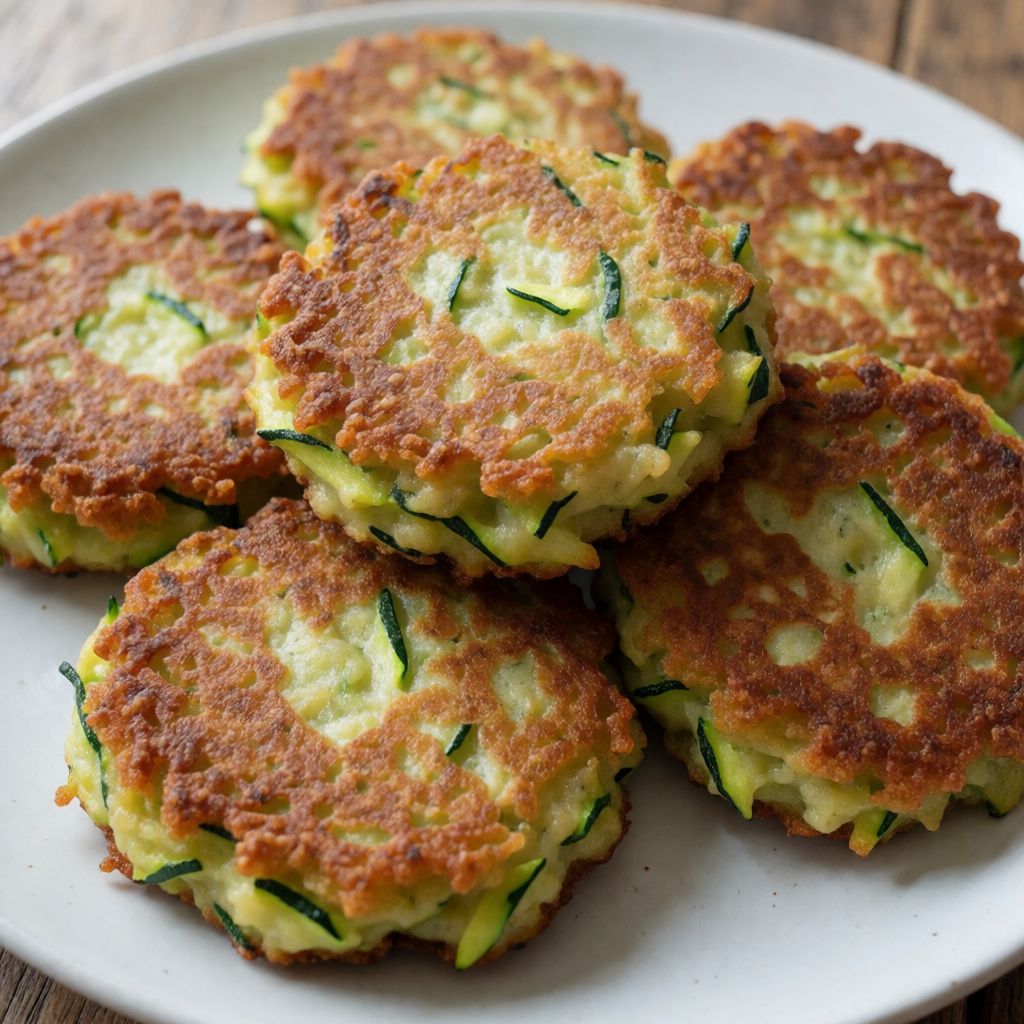
 AI photo
Courgette Fritters
A simple recipe for crispy courgette fritters made with a light yeasted batter, parmesan and fresh mint.
Labels are worked out automatically from the ingredients and can be wrong. Check the packaging if it matters to you.
Ingredients
- 250 g Plain Flour
- 120 g Water
- 5 g Salt
- 2-3 g Dried Yeast
- 2 pcs Courgette
- 40 g Parmesan
- 10-15 pcs Mint
- Black Pepper to taste
- Peanut Oil to taste








Steps
Wash, peel and dry the courgettes. Grate them and place in a sieve for at least 30 minutes to drain.
30 minIn a bowl, combine the flour and yeast. Gradually add the water, mixing as you go. Stir in the salt and remaining water, then knead into a dough.
Add the drained courgettes, mint, parmesan and black pepper. Mix well.
Cover the dough with cling film and leave to rise until doubled in size.
75 minHeat the peanut oil in a frying pan. Scoop up the batter with two spoons and fry the fritters, turning them, until golden.
Place the cooked fritters on paper towel to remove excess oil.
Serve immediately while hot.
Forget what you think a courgette fritter is. Most are thick pancake batter — egg, flour, grated courgette, fried till set. This one is bread dough. Flour, water, yeast, salt — knead it like you'd knead for a loaf — and only then fold in the courgette, mint and cheese. What you're frying isn't a pancake, it's a little piece of risen dough that happens to be full of vegetable and cheese. That's why it puffs the way it does, with air pockets inside, not just a crisp shell around a dense middle.
What decides whether this works is moisture, and it's decided long before the pan gets hot. A courgette is close to all water held in cell walls. Grate it and that water starts weeping out on its own — the sieve just gives it somewhere to go. Skip that half hour and the water goes into your dough instead, where it has no business being: it slackens the gluten you just built, and when it hits hot oil it turns to steam that fights the frying instead of helping it. Soggy courgette fritters aren't a mystery, they're an unemptied sieve.
The second thing that decides it is the rise, and here you can't cheat with a clock. "75 minutes" on the card is a floor, not a target — it tells you how long it took in somebody else's kitchen, at somebody else's room temperature. What you're actually waiting for is the dough doubling, because that's the yeast converting flour sugars into carbon dioxide, and that gas is the only thing that will make these light rather than stodgy. A cold flat means longer, near a radiator means shorter. Watch the bowl, not the watch.
Flour and water and yeast are the actual dish here; everything else is what you're folding into it. UK plain flour has less protein than the strong flour bakers reach for, so the dough will feel a touch slacker and the gluten takes a little longer to come together when you knead — that's fine, it still does the job, it's not bread you're plaiting, it just needs enough structure to trap the gas. If you only have strong or bread flour in the cupboard, use it; it'll hold the rise slightly better, nothing to worry about either way.
The order in step 2 — flour and yeast first, water added gradually, salt stirred in afterward with the rest of the water — isn't fussiness, it's protecting the yeast. Salt sitting directly against yeast granules draws water out of the cells by osmosis and slows them down before they've even started working. Mix the yeast into dry flour first, let water hydrate everything together, and the salt arrives diluted enough not to do damage. Skip this order and you can still get a rise, just a sulkier, slower one.
Courgette: pick ones that feel heavy and firm for their size, with skin that's taut, not wrinkled — a wrinkled one has already lost water to the air before it ever meets your grater, which won't help the batter but will mean less actual vegetable flavour. No courgette in the house, or it's out of season and tasteless — use grated marrow with the seedy centre discarded, or even grated cucumber with the seeds scraped out and extra draining time, since it's in the same watery-flesh family. The principle is the same: anything with that much water needs the same sieve treatment, longer if it's wetter.
Parmesan is doing two jobs: salt, and the kind of browning that only happens with protein and a bit of fat in the mix, helping the crust colour rather than just dry out. Any hard, aged cheese works on the same principle — pecorino, an aged cheddar, grana padano if that's what's in the fridge. A young, wet cheese won't do it; it'll just make the dough soggier, same problem as unwrung courgette.
Mint isn't garnish sitting on top at the end — it goes into the dough itself, because its job is to cut through the fried-dough-and-cheese richness from the inside. This courgette-and-mint pairing isn't invented for this recipe; it's an old Mediterranean habit, because the two happened to grow in the same gardens at the same time of year, and somebody noticed the sharp leaf balanced the bland watery vegetable. If mint isn't to hand, basil does a similar freshening job, though it reads sweeter rather than sharp — use less of it.
Peanut oil, called groundnut here on UK shelves, is picked for having no flavour of its own and a high point before it starts to smoke and turn bitter — you need both, because you're frying hot enough to seal the crust fast, and you don't want the oil's own taste competing with mint and parmesan. Sunflower or ordinary vegetable oil does the same job for the same reasons; olive oil doesn't, its smoke point is lower and it tastes of itself, which is wasted in a fritter you're about to season with cheese and pepper anyway — save it for dressing something cold.
Scooping with two spoons rather than piping or rolling by hand isn't just about keeping your fingers clean of sticky, risen dough — a dropped, craggy shape has more surface clinging to the oil than a smooth rolled ball would, and more surface means more crust, which is most of the point of frying something. And once they're out, onto paper towel and straight to the table — an ordinary flat doesn't have a warming drawer, and a fritter left standing starts steaming itself soft from the inside out. The patience in this dish belongs entirely to the rise. At the table, there isn't any — eat them while they're still talking back at you.