
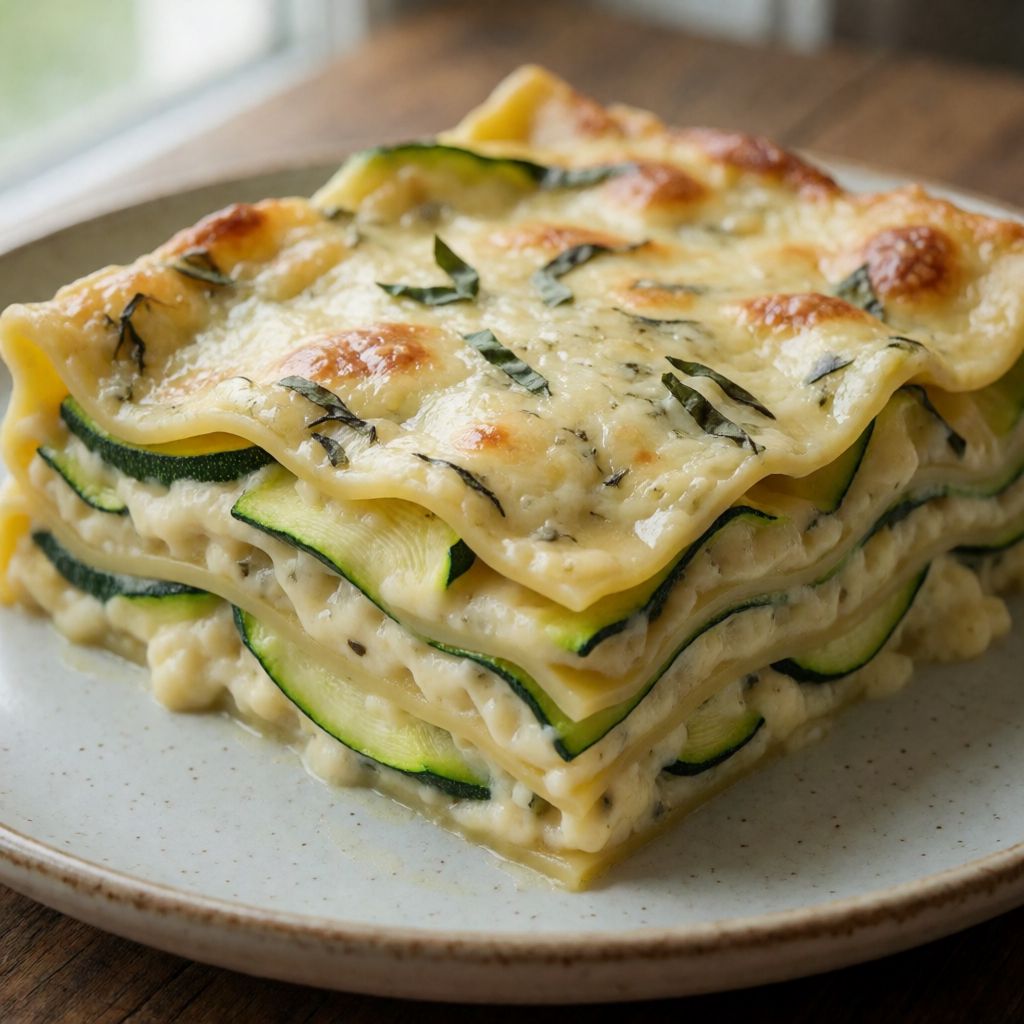
 AI photo
Courgette Lasagne
A comforting courgette lasagne layered with béchamel, stracciatella and parmesan.
Labels are worked out automatically from the ingredients and can be wrong. Check the packaging if it matters to you.
Ingredients
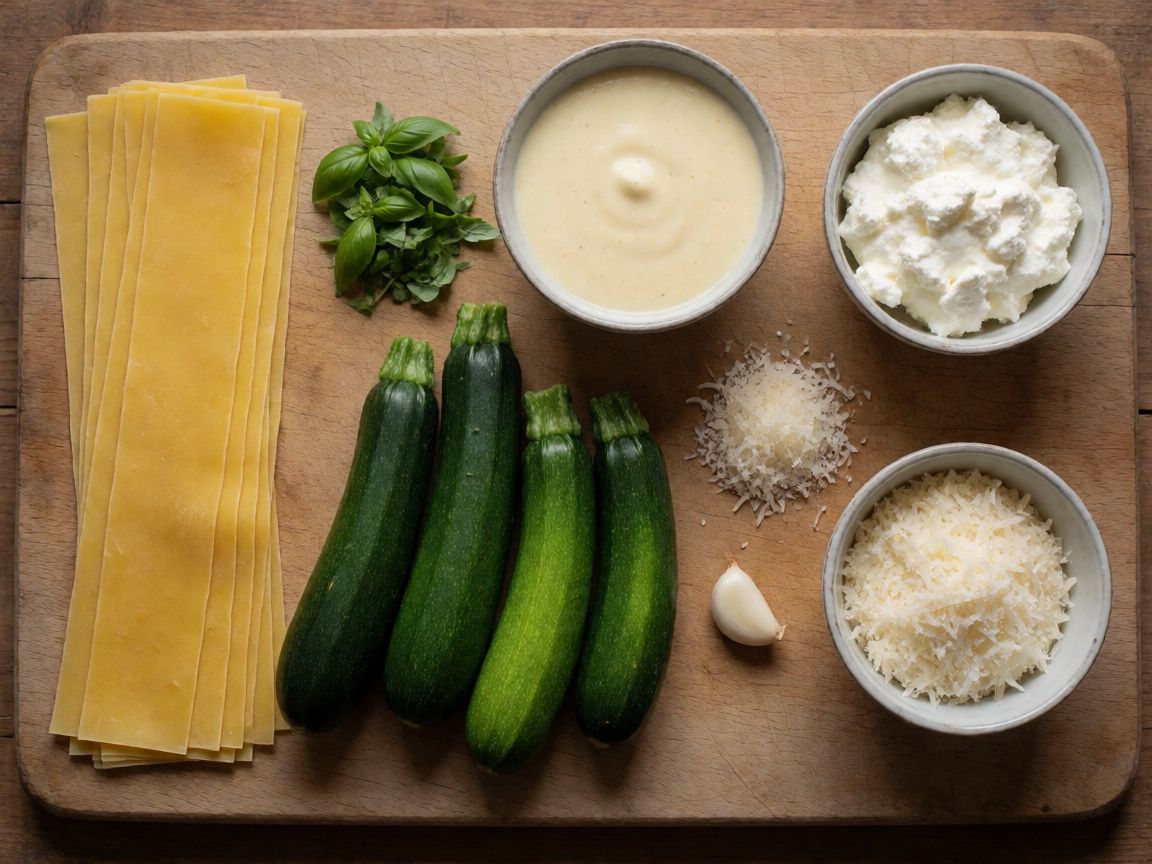
- 6 pcs egg pasta sheets
- 4-5 pcs courgettes
- 1 clove garlic
- olive oil to taste
- basil to taste, optional
- 500 g béchamel sauce
- 300 g stracciatella cheese
- salt to taste
- black pepper to taste
- 50 g grana padano or parmesan







For the béchamel
- 50 g butter
- 50 g plain flour sifted
- 500 ml milk cold
- nutmeg grated




Steps
Wash and dry the courgettes, then grate them on the coarse side of a grater.
Heat a little olive oil in a large pan, add the garlic and fry until golden.
Add the grated courgettes and fry over high heat for a few minutes, stirring often.
Season with salt and cook until the courgettes are soft.
Remove the garlic, add basil if you like, transfer the courgettes to a bowl and let cool slightly.
Add 200 g of béchamel to the courgettes.
In a saucepan, melt 50 g of butter over low heat, add the flour and stir to form a roux.
Add the milk to the roux, season with nutmeg and salt, and cook over medium heat.
20 minAdd the grated grana padano or parmesan and stir until smooth and creamy.
Boil the pasta sheets for less than a minute, then lay them on a towel to dry.
Butter a baking dish and place the first sheet of pasta.
Add a layer of courgettes with béchamel.
Add grated grana padano and pieces of stracciatella.
Continue layering pasta and filling until the ingredients are used up.
Top with the remaining béchamel and sprinkle with grated grana padano.
Bake the lasagne at 200°C.
30 minRemove from the oven and let it rest before serving.
12 min
A lasagne that's really a béchamel problem wearing courgette as a disguise. Take out the ragù, the slow red sauce that usually anchors the dish, and what's left has to be held together by something — here that something is a white sauce doing two jobs at once: one batch loosens the courgettes into a spreadable filling, the other blankets the top so it doesn't dry out in the oven. Get the béchamel wrong — too thin, too thick, lumpy — and the whole structure either slides apart when you cut it or sits like wallpaper paste. That's the actual fault line in this recipe, not the vegetable.
Courgette is a watery vegetable pretending to be a solid one. Ninety-plus percent of it is water held in cell walls, and heat breaks those walls open. That's why you fry the grated courgette hard and fast rather than stew it gently — high heat drives off water before it pools in the pan, so you get soft, cooked vegetable instead of a swamp. Some say courgette lasagne is naturally watery and there's nothing to be done — no, because the watering-down happens when you skip this step or crowd the pan so the courgette steams instead of frying. A wide domestic frying pan, not crowded, with the heat high enough that you hear real sizzle, not a quiet simmer, does the job a kazan or a big Italian pan would do on a bigger burner.
What decides whether this works: a béchamel smooth enough to pour but thick enough to hold its shape between the sheets, courgettes cooked dry rather than wet, and patience after the oven — cut it too soon and it's soup on a plate, not lasagne.
Start with the pasta sheets. Fresh egg pasta, the kind you buy as sheets rather than dried lasagne plates, cooks almost instantly — under a minute in boiling water — because it's thin and already has egg's protein holding it together. Some say you should skip boiling altogether and let the sheets soften in the oven from the sauce's moisture — that works with dried pasta made for it, but egg sheets this thin will stay chalky in the middle if you don't give them that brief dunk first. Dry them on a towel afterwards, not because tradition says so, but because wet pasta going into the dish adds water you don't want — you've only just fought to get the courgettes dry.
The garlic is there for the oil, not for itself. One clove, fried until it turns golden and perfumes the olive oil, then taken out — leave it in and by the time the dish is assembled and baked, that clove has gone from fragrant to bitter and sulphurous, the way garlic always does once it's pushed past golden into brown. Olive oil here can be any oil with no smell of its own that can take the heat of a quick fry — a neutral vegetable or sunflower oil works if olive oil isn't to hand, though you lose a little of the background flavour it leaves in the courgettes.
Stracciatella is the wet, shredded inside of burrata — soft curd and cream, no rind, nothing to melt down from solid. It's there to melt into pockets of richness between layers, different in texture from the smooth béchamel around it — one is sauce, one is curd breaking apart in the heat. If you can't get it, fresh mozzarella torn into shreds and mixed with a spoon of cream gets you close; ricotta loosened with a little cream is a second option, though it won't stretch the same way. Grana padano or parmesan is the salty, savoury backbone — a hard, aged cheese that's mostly flavour and little moisture, which is exactly why it goes into the béchamel and on top rather than as a wet layer: it seasons and browns, it doesn't melt into a puddle. Any hard aged grating cheese does the same job; a milder cheddar will change the flavour but won't ruin the structure.
The béchamel itself is just fat, flour, and milk — a roux that thickens liquid because flour's starch swells and traps the milk around it once it's heated enough. Cold milk added to a hot roux, stirred as it goes, stops lumps forming — pour it in too fast or too hot and the flour seizes into clumps before it can distribute evenly. The twenty minutes it needs on the heat isn't arbitrary waiting; it's the time for that raw-flour taste to cook out, which is also why nutmeg goes in near the end rather than the start — it's a top note, not something that needs the full cooking time to make its point.
200°C in a domestic oven is hot enough to colour the top layer of cheese and béchamel before the inside has any chance to dry out, and thirty minutes is your lower bound — stop watching the clock and watch the top instead: when it's gone from pale and wet-looking to freckled gold-brown, with a few darker spots where the cheese has caught, it's done. Pull it any earlier and the top stays flabby and pale, which is the usual complaint people have about vegetable lasagnes being "sad" — not the courgette's fault, the oven's.
Last thing, and it's the one everybody skips: the twelve minutes of rest after the oven. Straight out, the béchamel is still loose from heat, still moving. Cutting then means every slice collapses sideways. Let it sit, uncovered or loosely under a plate rather than sealed under foil — sealing it traps steam that will soften the top you just spent thirty minutes browning — and the sauce firms up enough to hold a slice together when the knife goes through. That rest isn't optional politeness. It's the difference between a lasagne you can lift onto a plate and one you have to spoon out.