
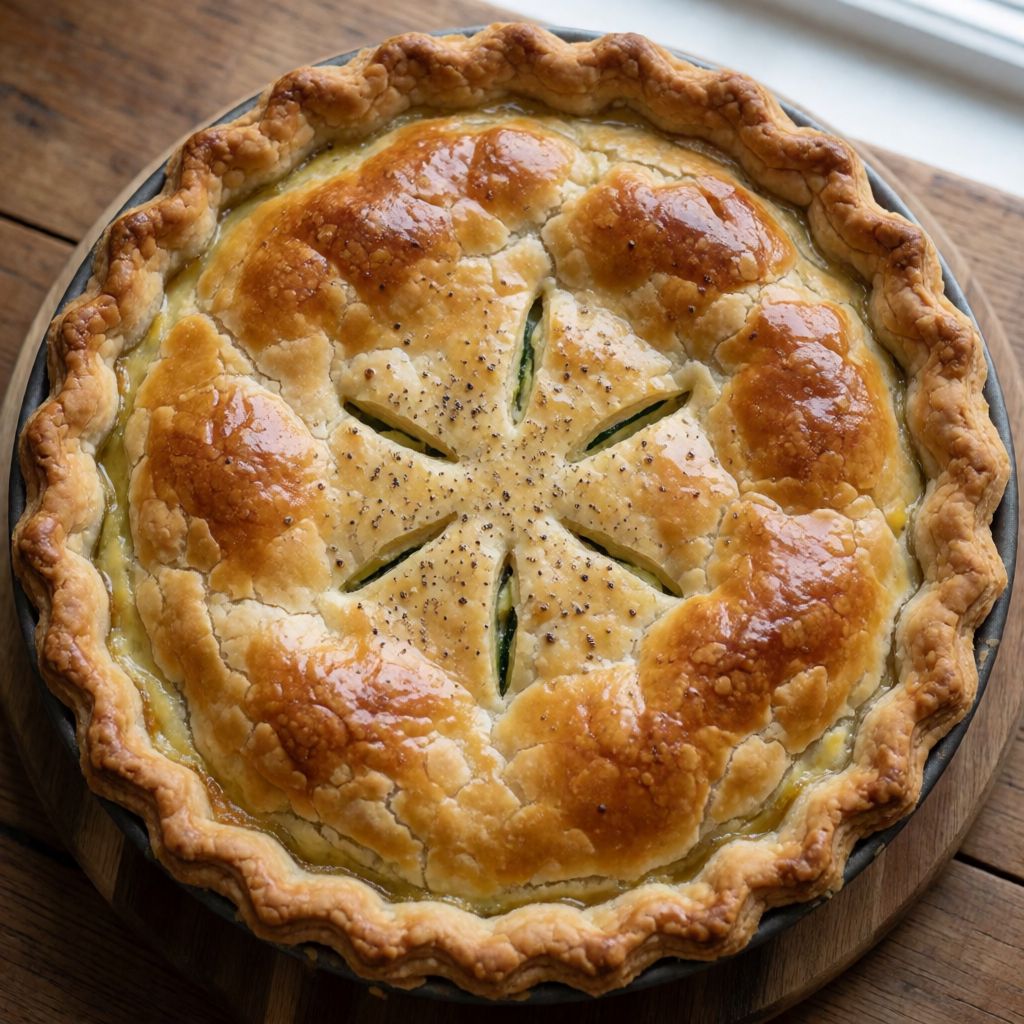
 AI photo
Courgette Pie
A savoury shortcrust pie filled with courgette, smoked scamorza and parmesan in a creamy egg custard.
Labels are worked out automatically from the ingredients and can be wrong. Check the packaging if it matters to you.
Ingredients
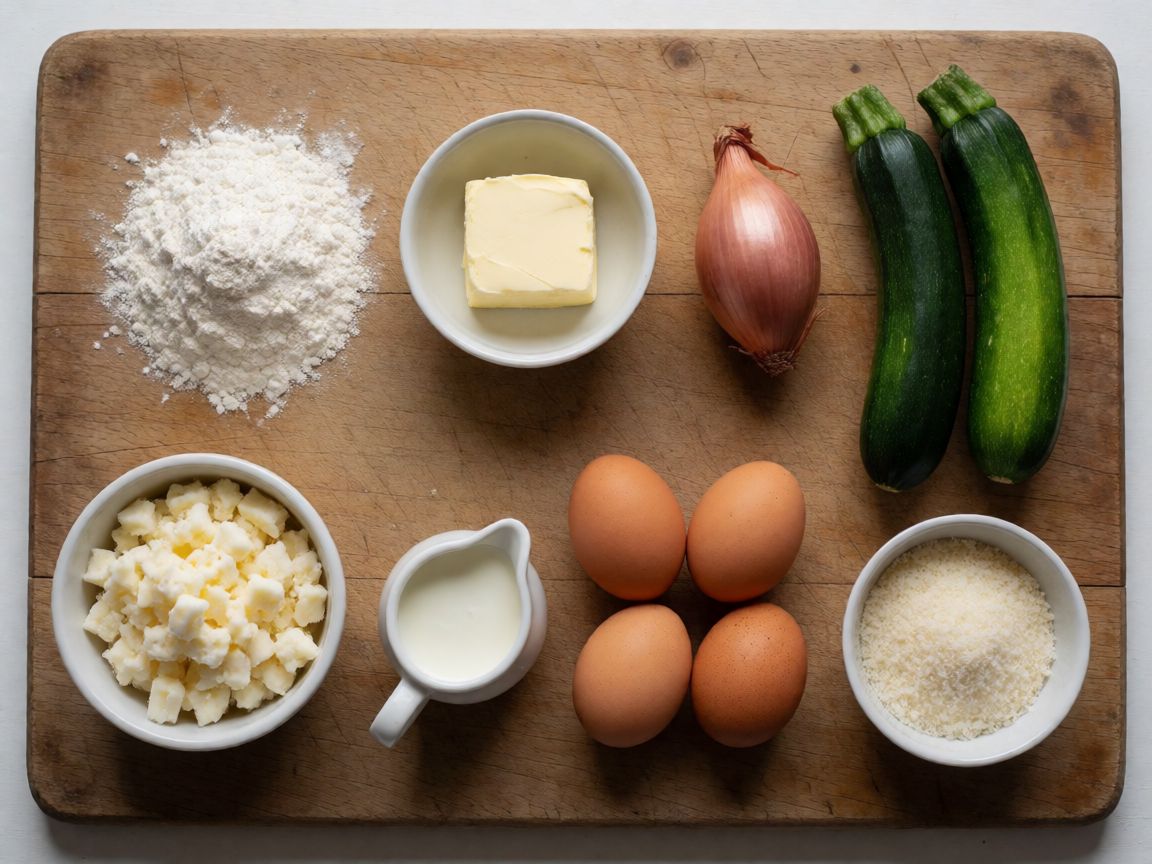
- 300 g Plain flour
- 150 g Butter
- 100 ml Water
- Salt to taste
- Black pepper to taste
- Olive oil to taste
- 1 pcs Shallot
- 450 g Courgette
- 200 g Smoked scamorza
- 400 ml Double cream
- 4 pcs Eggs
- 50 g Parmesan











Steps
In a food processor, mix the flour, butter and a pinch of salt, blitz for a few seconds, gradually adding cold water
Dust the work surface with flour, knead the dough by hand, shape into a ball, wrap in cling film
Put the dough in the fridge to rest
30 minIn a pan, fry the sliced shallot in olive oil, add the courgette cut into rounds
10 minTake out the dough, roll it out with a rolling pin to a thickness of 4-5 mm, roll it onto the pin and transfer to a greased 28 cm tin
Trim off the excess dough around the edges
In a bowl, mix the eggs with the double cream, add the parmesan, salt and black pepper, and stir
Lay the courgette over the pastry base, add the smoked scamorza cut into pieces, then pour over the egg and cream mixture
Bake in a fan oven preheated to 170°C
42 min
This is a quiche in all but name — a pâte brisée shell holding courgette, smoked scamorza and a parmesan custard. Call it a tart if you like, the French will not mind, and the mechanism does not care what you call it. What decides whether it works is not the filling, it is the water content you let into that shell before the custard ever goes in.
Courgette is mostly water held in a loose cellular sponge. Fry it, and it gives that water up into the pan — you can see it as the slices go from matte and firm to glassy at the edges, releasing steam that thins out. Skip that step, or rush it, and the raw water migrates straight into the custard during baking, and into the pastry underneath. The result isn't sliceable — it's wet dough and a custard that never quite sets to that soft, trembling solid. Some say courgette tarts are always a bit watery — no, because the vegetable was never given anywhere to put its water before it got trapped in a sealed tin.
The custard itself is the other half of the engine: eggs are the setting agent, cream is the fat and smoothness, parmesan is salt and savour baked into the structure rather than added at the table. Four eggs to 400ml cream is a ratio that sets softly but firmly — fewer eggs and you get something closer to a sauce that never fully holds.
The pastry is blind of nothing — no baking it empty first — which only works because the filling below (courgette, cheese) is dense enough and the custard poured on top doesn't flood the base the way a thin liquid would.
Flour and butter at a near 2:1 ratio by weight, bound with ice-cold water — that's pâte brisée, the workhorse French short pastry, not puff and not sweet shortcrust. The butter stays in flat, unmelted flakes through mixing (that's why the water is cold and the processor only runs "a few seconds") so that in the oven those flakes melt and leave gaps — that's your flake, your short crumble instead of a biscuit-hard slab. Overwork it, or let the butter go soft and greasy before it's cut into the flour, and you lose that structure; you get a dense, tough base instead. The 30 minutes' rest in the fridge isn't laziness built into the recipe — it lets the gluten you developed by kneading relax, so the dough doesn't shrink back and fight you when you roll it, and it re-firms the butter so it survives the warmth of your hands on the rolling pin.
Any neutral fat with no flavour of its own works for frying the shallot and courgette — olive oil here, but a flavourless vegetable or sunflower oil does the identical job; you're not building flavour with the oil, you're just conducting heat into the vegetables evenly, so save the good extra-virgin stuff for the salad you're not making here. Shallot rather than onion is a question of sweetness and gentleness: it caramelises faster and milder, so it won't fight the delicate smoked cheese for attention.
Smoked scamorza is doing a specific job: a semi-firm, stretchy cheese that holds its shape in cubes rather than melting into a puddle, with a smoke note that courgette — which has almost no flavour of its own, it is mostly texture and water — badly needs. If you can't get scamorza, any firm, smokeable mozzarella-family cheese, or a smoked provolone, covers the same ground. Parmesan plays a different role entirely: it's not for melting, it's for salt and umami baked directly into the custard, so don't try to swap it for a blander hard cheese without adding salt back some other way.
Double cream rather than single or milk is about fat content holding the custard together under heat without curdling or weeping — milk alone will give you a custard with the texture of scrambled egg sitting in liquid, because there isn't enough fat to keep the proteins from seizing into tight curds. If you want lighter, go halves with whole milk, not all the way.
On a British fan oven, 170°C for 42 minutes is a bet on the custard setting through without the top scorching — but ovens lie about their own temperature more than almost any other appliance in your kitchen, so trust the look over the clock: the filling should have stopped wobbling in the centre like liquid and instead move as one soft mass, slightly puffed, with the edges just colouring. If your tin is glass or ceramic rather than metal, give it longer — glass is a poor conductor and the base will lag behind what the top looks like.
This isn't a dish that needs a kazan or specialist kit, which is lucky, because most flats don't have one — a food processor, a rolling pin, a 28cm tin and a fan oven are the whole toolkit, and that's exactly the democratic appeal of a quiche in the first place: it was never grand food, it was Lorraine farmhouse food that used eggs, cream and whatever vegetable needed using up. Treat it the same way — six people, a decent slice each, nothing more mysterious going on than water, fat and protein doing what they always do under heat.