
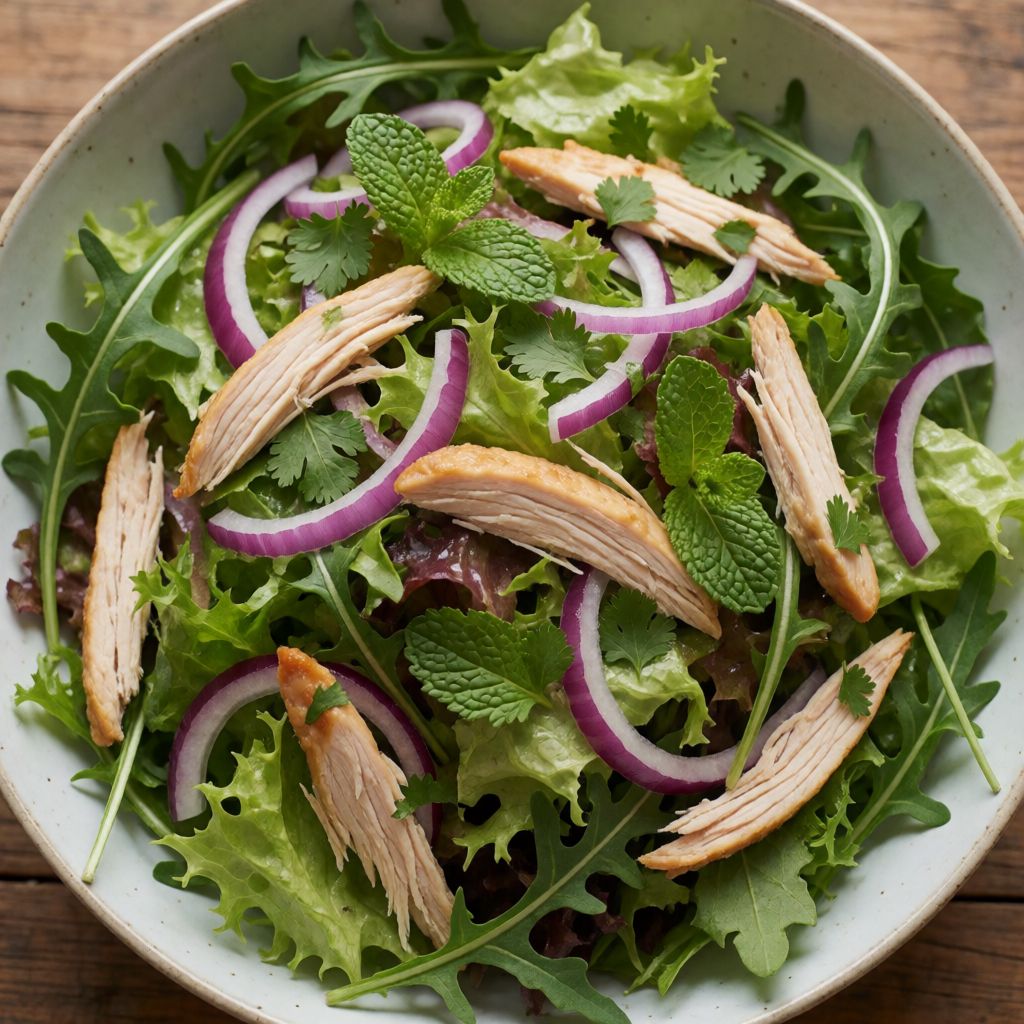
 AI photo
Asian Chicken Salad
A fresh Asian-style salad with crispy-skinned chicken, herbs, lime and a savoury-sweet dressing.
Labels are worked out automatically from the ingredients and can be wrong. Check the packaging if it matters to you.
Ingredients
- 4 pcs Chicken breast skin on
- 250 g Salad mix
- 2 pcs Red onion sliced
- 2 bunch Rocket fresh
- 2 bunch Mint fresh, roughly chopped
- 1 bunch Coriander fresh, roughly chopped
- 1 pcs Red chilli thinly sliced
- 6 tbsp Sesame seeds
- 10 ml Sesame oil for frying
- Salt
- Black pepper freshly ground
- 60 ml Fish sauce
- 2 pcs Lime juiced
- 2 tsp Sugar
- 2 tbsp Ginger finely grated
- 2 tsp Garlic finely chopped
- 1 pcs Chilli finely chopped















Steps
Mix the dressing (fish sauce, lime juice, sugar, ginger, garlic, chilli) and leave to infuse for 30 minutes.
30 minScore the chicken skin with a sharp knife and sprinkle with salt and pepper.
Fry the chicken pieces skin-side down in a pan over low-medium heat for 30 minutes.
30 minTurn the chicken over once the skin is well crisped, and cook the other side for about 5 minutes.
5 minSlice the chicken into strips.
Toss the salad with the dressing along with the mint, coriander and chilli.
Arrange the chicken over the salad, sprinkle with sesame seeds and freshly ground pepper, and serve while the chicken is still warm.
This isn't really a salad with chicken on top — it's crispy-skinned chicken with a salad built to survive sitting next to it. The whole dish hangs on two separate things working at once: the skin going from rubber to glass in the pan, and a dressing that's been given time to stop tasting like its four separate jars.
What decides whether this works is the skin. Everyone wants to flip the chicken early because low heat for thirty minutes feels like nothing's happening — no sizzle you can brag about, no steam cloud. That's the point. Fish sauce dressing and a sad flabby skin is a worse dish than plain poached chicken, so the whole first half of cooking is just patience, no technique.
Second thing: the dressing is not a sauce you make and pour, it's a solution you brew. Fish sauce, lime, sugar, raw garlic and ginger thrown together taste like four fights happening in the same bowl. Thirty minutes of sitting lets the sugar round off the fish sauce's sharpness and the garlic stop being raw garlic and start being part of the liquid. Skip the wait and you've got a dressing that announces each ingredient instead of speaking as one.
Feeds four, assuming people eat this as a main and not a side — it's substantial enough, with a whole breast each.
Start with the chicken skin, because that's where people usually go wrong, and it's not a timing problem, it's a heat problem. "Low-medium" here means: enough heat that fat renders out of the skin steadily, not so much that the outside seizes and scorches before the inside of the skin has given up its fat. Score the skin first — this isn't decoration, it's drainage. Unscored skin shrinks and curls as it cooks, pulling away from the meat and trapping fat underneath in blisters instead of letting it run off into the pan. Scored skin stays flat, in contact with the metal, rendering evenly. You're listening for a steady, quiet hiss, not a crackle — crackle means the pan's too hot and you're about to burn the surface while the middle layer of fat sits there unrendered, chewy, grey. You'll know it's ready to turn not by the clock but by colour and resistance: the skin goes from pale and loose to deep amber and taut, and when you nudge it with a spatula it releases from the pan on its own instead of tearing. If it's sticking, it's not done — fat still binds it, so leave it.
Some say you should fry chicken skin-side down on high heat to "seal" it. No — there's no sealing, that's a myth left over from people trying to explain why browning tastes good without understanding the browning itself (the Maillard reaction, if you want the name). High heat on skin just burns the surface sugars and proteins before the fat underneath has melted out, leaving you a dark, bitter crust over a rubbery interior. Slow and patient is what actually crisps it, because crisping is dehydration of the skin's surface as fat leaves it — that takes time, not fire.
The dressing's five ingredients each do one job, and if you understand the job you can swap freely. Fish sauce is the salt and the savoury backbone — if you can't get it or can't stand the smell, use light soy sauce with a pinch extra salt, though you lose some depth, there's no faking fish sauce's fermented funk exactly. Lime juice is the acid that cuts through the fish sauce's saltiness and the chicken fat; any sharp citrus with real acidity works, lemon at a pinch, though lime's floral note is part of the point. Sugar isn't for sweetness as such — it's a buffer, rounding the sharp edges off the fish sauce and lime so neither one dominates; palm sugar if you have it, white sugar if you don't, the amount matters more than the type. Ginger and garlic, both raw and grated/chopped fine rather than sliced, are there to perfume rather than flavour outright — fine grating matters because large pieces stay raw and harsh even after the thirty-minute rest, while fine pieces have more surface area exposed to the acid, which softens their bite the way a quick pickle would.
Sesame oil for frying is a small, deliberate flourish rather than a necessity — it's there for aroma, not for heat tolerance, since sesame oil scorches and turns bitter well before a neutral oil would. If your pan runs hot or uneven (most domestic hobs do, there's always one side that's fiercer than the other), use a flavourless oil for the actual frying — anything with no smell of its own, sunflower, groundnut, rapeseed — and that's fine, because the sesame seeds scattered at the end are doing the sesame job anyway, toasted and crunchy against the soft leaves.
The greens are three different textures doing three different jobs, not just "salad": the mix is bulk and crunch, rocket brings a peppery bite that stands up against the fish sauce, and mint and coriander are the perfume layer, meant to be tasted in mouthfuls rather than chewed as a base. Toss them with the dressing only once the chicken's nearly ready — dressed leaves sitting around go limp and weep water into the fish sauce, diluting it, which is the actual reason "dress just before serving" exists in every recipe like this; it's not superstition, it's osmosis. Chilli, both the thin-sliced one on top and the chopped one in the dressing, is heat you can calibrate to your own tolerance — deseed if you want warmth without real fire, or skip one of the two uses if your household's sensitive.
On a UK hob, be honest about the thirty minutes — a thin-based pan heats unevenly, and you may need to nudge the heat down from where the dial says "medium" to keep the middle of the pan from racing ahead of the edges. No lid needed; a loose-fitting plate over the pan for the last stretch, if you want to keep spatter down, but don't cover tightly or you'll steam the skin instead of crisping it — steam is the enemy here, same reason you don't wrap crisps in a tea towel.