
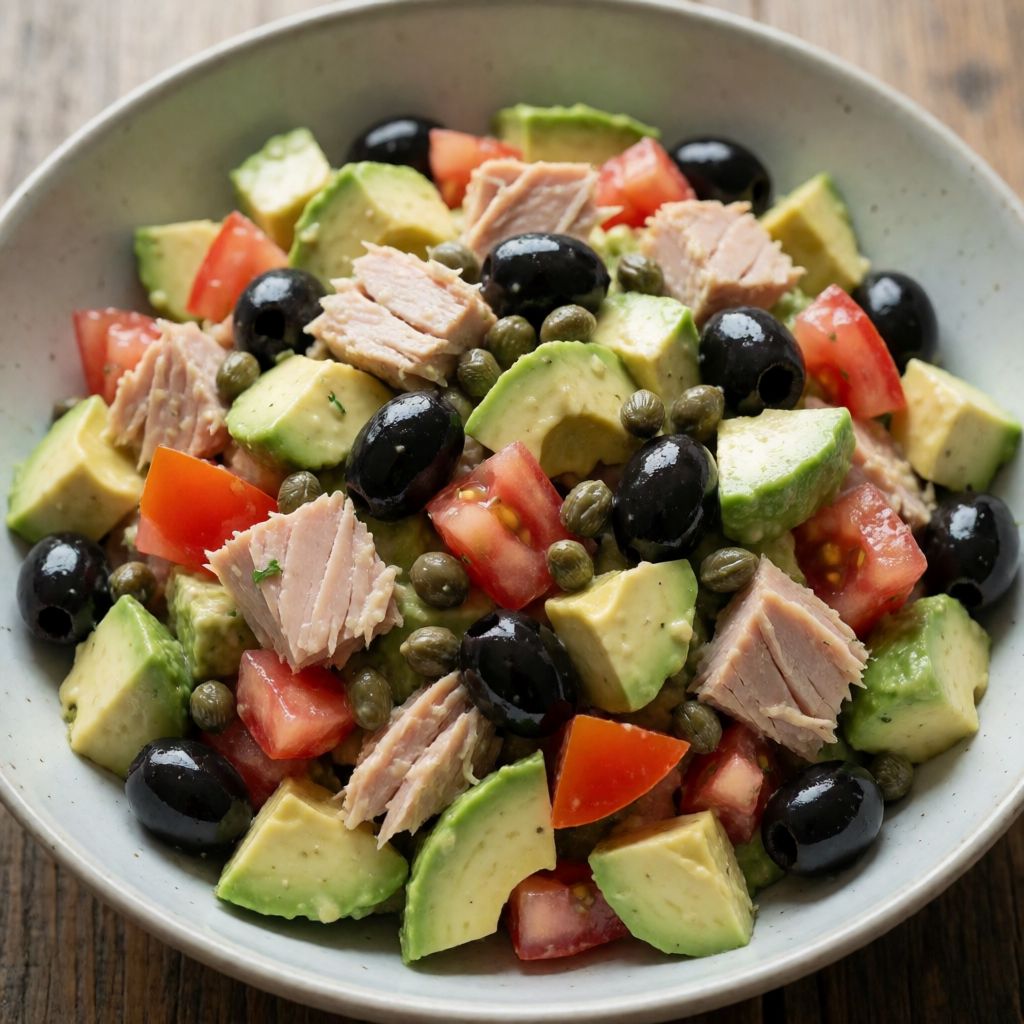
 AI photo
Avocado and Tuna Salad
A fresh salad of tuna, avocado, cherry tomatoes, olives and capers, dressed with lemon and balsamic vinegar.
Labels are worked out automatically from the ingredients and can be wrong. Check the packaging if it matters to you.
Ingredients
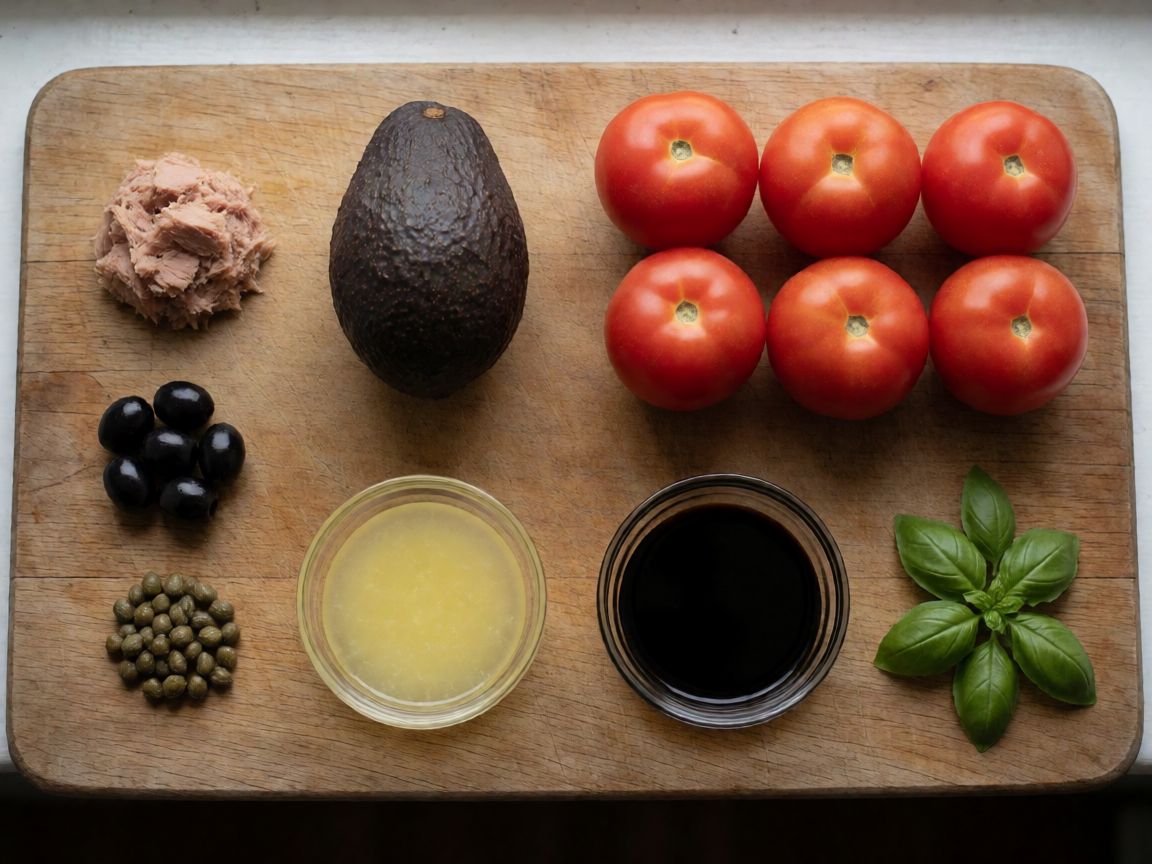
- 150 g Tuna
- 1 pcs Avocado ripe
- 6 pcs cherry tomatoes
- black olives to taste
- Capers to taste
- Salt to taste
- Black pepper to taste
- Olive oil to taste
- Lemon juice to taste
- Balsamic vinegar to taste
- Basil to taste










Steps
Check that the avocado is ripe, cut it in half, remove the stone, peel and cut into slices or chunks.
Place the avocado in a bowl and sprinkle with lemon juice.
Wash the cherry tomatoes thoroughly and cut them into wedges.
Drain the oil from the tuna and flake it with a fork.
Mix the tuna, tomato wedges, avocado slices, black olives and capers.
Season with salt, black pepper, olive oil, balsamic vinegar and basil leaves.
Serve the salad chilled.
This is a salad with no cooking in it at all — the only real decision is ripeness, and it happens before you pick up a knife. An avocado that isn't ready will sit in the bowl like a pale, bitter vegetable doing an impression of itself. You want it to give under gentle thumb pressure near the stem end, the way a ripe plum does — not mushy, just yielding. Rock-hard means wait a day on the counter; if it's already soft enough to dent with a fingernail, it went too far and will turn to paste the moment you cut it.
What actually makes or breaks this dish is contrast — soft avocado against the bite of tomato, salt-cured olives and capers against the oil-rich tuna. If everything in the bowl has the same texture, you've made a mush, not a salad. That's the whole mechanism here: balance of textures and acidity, not a recipe you can get wrong by mistiming anything, because nothing in it is timed.
Some say avocado should be mashed into the salad for a "creamier" result — no, because then you lose the contrast that makes the dish work, and you end up with something closer to guacamole with tomatoes in it. Keep it in slices or chunks; let it be its own texture next to the others.
The lemon juice on the avocado right after cutting isn't a flavour flourish — it's there to stop the flesh browning, because avocado oxidises on contact with air almost as fast as a cut apple does. Toss it as soon as you slice, don't wait until the bowl is full.
Tuna from a tin, drained — the oil-packed kind, not the stuff in brine or spring water, because the oil is doing seasoning work here, carrying fat and a bit of richness that a dry, watery tin can't give you. If you've only got tuna in water, drain it the same way and make up the fat deficit with an extra glug of olive oil when you dress the bowl — same job, different source.
Cherry tomatoes get cut into wedges rather than halves because wedges release some juice without flooding the bowl, and that juice becomes part of the dressing by accident, mixing with the oil and lemon at the bottom. Any small, dense tomato works if cherry ones look sad in a British supermarket in February — the test is firmness and a tomato smell when you tear the vine, not the label.
Black olives and capers are both doing a salt-and-sharpness job, not a bulk job — "to taste" here really does mean start light, because both are concentrated and it's much easier to add more than to rescue an over-salted bowl. If you've no capers, a few finely chopped cornichons or even a small pinch of chopped pickled onion from the Sunday roast jar gives a similar sharp, briny jolt — not identical, but it does the same work in the mechanism.
Olive oil should have no strong personality of its own beating the other flavours — any oil without a loud smell will do, extra virgin olive oil is just the traditional choice because the Mediterranean kitchens that built this kind of salad had it to hand cheaply, not because it's mystically correct. A light rapeseed oil, common on British shelves, is a perfectly honest substitute if your olive oil is the cheap, flavourless supermarket kind anyway.
Balsamic vinegar and lemon juice are both acid, doing two different jobs — lemon stops browning and brightens the avocado specifically, balsamic sweetens and darkens the dressing as a whole. Don't swap one for the other wholesale; if you're out of balsamic, a splash of good wine vinegar with a pinch of sugar gets you close enough.
Basil at the end, torn rather than chopped with a knife, because a knife bruises the leaf and you lose aroma to the blade — tearing with your fingers keeps the cell walls more intact until the last second, so the smell hits the bowl rather than the chopping board. Patience here is really just restraint: don't dress the bowl too early, don't walk away and leave the avocado sitting out too long before serving, and let the whole thing sit in the fridge the ten minutes it asks for so "chilled" means something instead of being room temperature with ice-cold plates underneath it. This feeds two as a light lunch — if it's going on the table as a side for the Sunday roast instead, it stretches further, maybe four, since nobody eats much of it next to a joint of beef.