
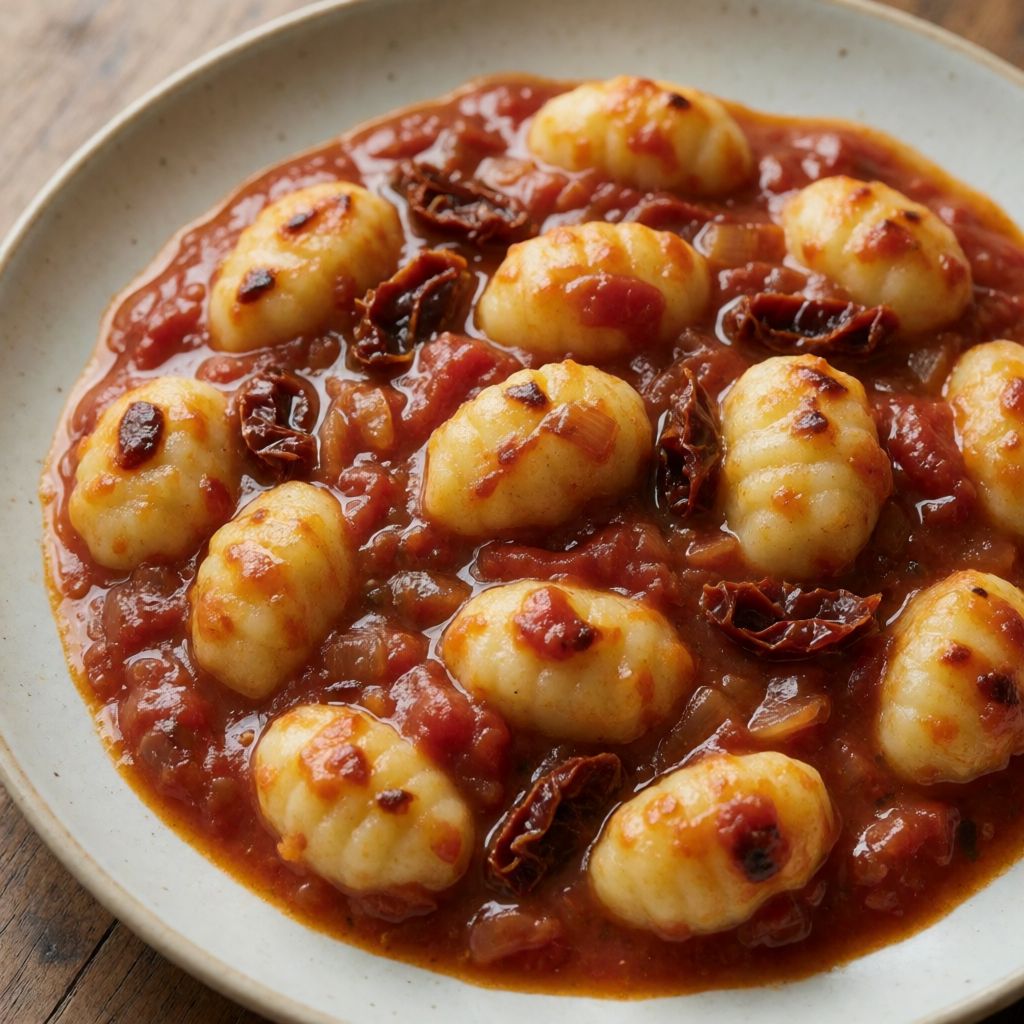
 AI photo
Baked Gnocchi in Spiced Tomato Sauce
A comforting bake of gnocchi in a rich, spiced tomato sauce, finished with ricotta, mozzarella and parmesan.
Labels are worked out automatically from the ingredients and can be wrong. Check the packaging if it matters to you.
Ingredients
- 1 pcs Onion finely chopped
- 3 clove Garlic crushed
- 50 g Sun-dried tomatoes finely chopped
- 1 bunch Basil fresh
- 1 tsp Fennel seeds
- 1 tsp Dried rosemary
- 250 g Courgette coarsely grated
- 100 ml Stock
- 800 g Chopped tomatoes canned
- 125 g Ricotta
- 500 g Gnocchi
- 125 g Mozzarella fresh
- 50 g Parmesan freshly grated
- 1 tbsp Olive oil for frying
- Salt
- Black pepper fresh
- 25 g Parmesan freshly grated
- 1 bunch Basil fresh















Steps
Fry the onion in a saucepan with the oil over medium heat until soft.
Add the garlic, sun-dried tomatoes, basil, fennel seeds, rosemary, courgette, stock and chopped tomatoes, bring to the boil and simmer uncovered for 10 minutes to thicken slightly.
10 minStir in the ricotta, then the gnocchi. Gently mix and season well with salt and pepper. Transfer to a greased ovenproof dish.
Tear the mozzarella into smaller pieces and scatter over the top. Sprinkle with parmesan (or another hard cheese) and bake in a preheated fan oven at 180°C for about 15-20 minutes, until the cheese has melted and starts to turn golden.
18 minServe with freshly grated parmesan and a scattering of basil.
This is a dish built on a sleight of hand: it looks like you've slaved over a ragù, but you haven't. Gnocchi, which normally sees nothing more than a pot of boiling water for ninety seconds, goes raw into a tomato sauce and finishes cooking inside the oven, swelling as it soaks up liquid instead of shedding starch into it. That's the whole trick, and it's why the sauce needs to be slightly wetter and looser than you'd want for a pasta sauce you're about to drain and toss — the gnocchi will drink some of it down as it bakes, and if you've made the sauce thick and jammy already, you'll pull out a dish that's dry and stuck to the dish.
What decides whether it works is restraint at two points. First, don't fry the onion to brown — you want it soft and sweet, translucent at the edges, because everything that follows (garlic, sun-dried tomato, rosemary, fennel) is going to simmer in with it for only ten minutes, not long enough to fix a scorched or bitter base. Second, don't over-reduce that ten-minute simmer. "Thicken slightly" is the instruction, and it means exactly that — simmered uncovered so some water escapes, not reduced to a paste. Think of the sauce at that stage as what you'd want on a plate of pasta a touch too wet; the oven corrects it.
The onion is the base note and almost any onion will do it — a bog-standard brown or white onion, finely chopped so it melts rather than stays crunchy underneath the final bake. What matters is the cut, not the variety: too coarse and you get bitter, undercooked fragments sitting under melted mozzarella where you can't fix them.
Garlic crushed, not sliced, because you want it to disperse into the sauce within that short ten-minute window rather than sit as distinct pieces that could scorch on a hot pan edge later in the oven. Sun-dried tomatoes bring a concentrated, almost raisined sweetness that fresh or canned tomato can't — they've lost their water to drying, so their sugars and acids are doubled up. If you've only got the oil-packed kind, drain them well; the extra oil will just float on top of the finished bake.
Courgette grated coarsely and stirred straight into the simmering sauce isn't there for flavour so much as bulk and moisture management — it breaks down as it cooks, releasing water that thins the sauce slightly even as the tomatoes thicken it, which is part of why you don't need to add much stock. If courgette's out of season or you don't fancy it, any quick-cooking vegetable that grates and softens fast works on the same logic — a carrot grated fine, or even spinach stirred in at the end — the job is moisture and bite, not a particular taste.
Ricotta stirred in gives the sauce a creamy backbone without becoming a cream sauce — it breaks apart into curds rather than melting smooth, so you get pockets of richness through the dish rather than a uniform sauce. Cottage cheese blitzed smooth is the honest substitute if ricotta isn't to hand; a bought "cream cheese" will behave differently, melting flatter and greasier, so it's not quite the same move.
Gnocchi here should be the shelf-stable, vacuum-packed kind most UK supermarkets sell by the pasta aisle — dense enough to survive twenty minutes of baking without disintegrating. Fresh, delicate gnocchi from a deli counter is softer and more likely to turn to mush under that much heat; if that's what you have, it wants less time in the oven, not more, so watch the cheese rather than the clock.
Mozzarella torn rather than sliced matters for the same reason you tear basil rather than chop it — torn edges are rough, and rough surfaces melt and catch colour unevenly, giving you the mix of molten and faintly golden-brown that a neat slice, which melts in one smooth sheet, won't give you. Buy the ball in water, not the dry block meant for pizza toppings elsewhere — the water-packed kind has more give and melts softer. Parmesan grated fresh, both in the bake and at the table, because pre-grated parmesan from a tub is cut with anti-caking starch and won't melt the same way or taste as sharp — any hard, aged cheese with a similar bite stands in fine if parmesan's dear that week.
Patience here isn't about standing over the pan — it's about not rushing the oven stage. The recipe says fifteen to twenty minutes, but the real marker is the cheese: melted and starting to go gold at the edges, not fully browned, because a fan oven at 180°C will keep tightening that colour even after you pull the dish out. Twenty minutes is the lower bound of patience, not a deadline you're racing against.