
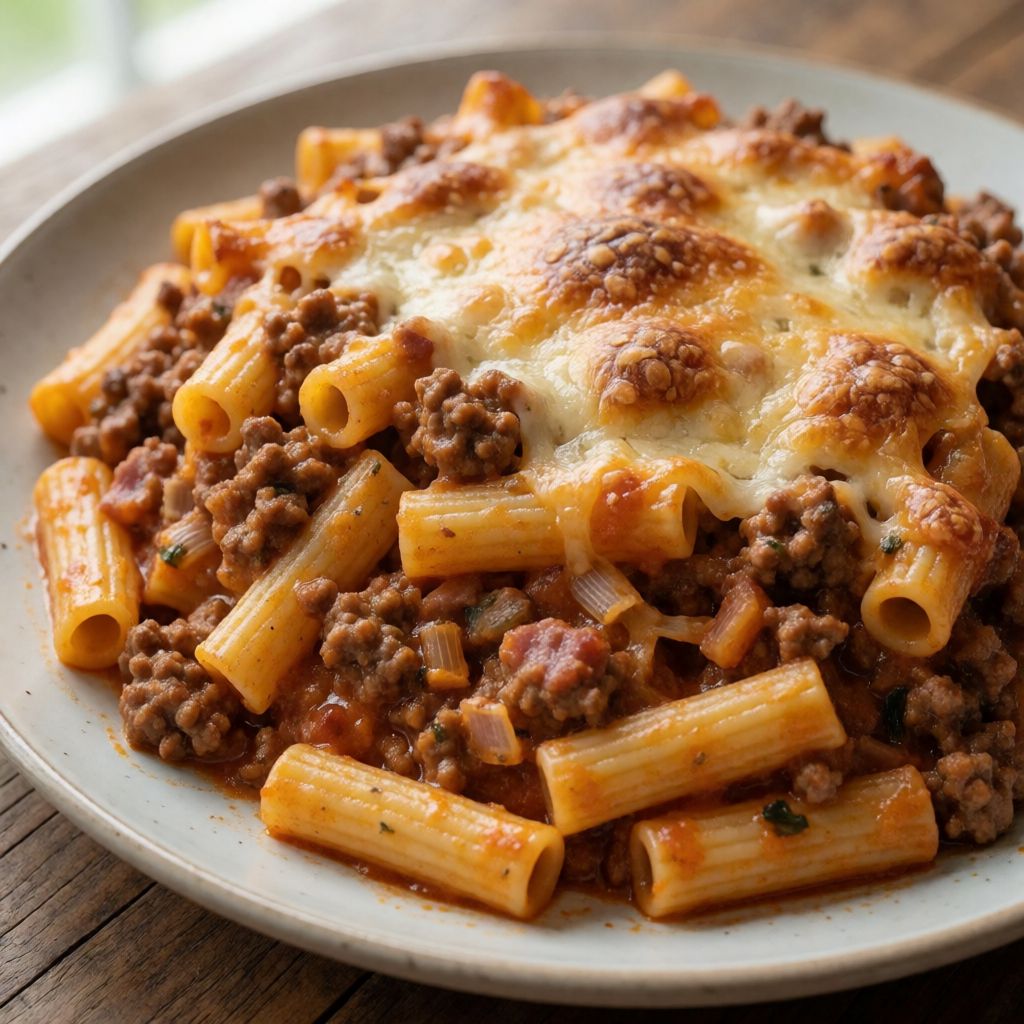
 AI photo
Baked Pasta Bolognese
A hearty baked pasta bolognese with bacon, beef and a bubbling layer of mozzarella and parmesan.
Labels are worked out automatically from the ingredients and can be wrong. Check the packaging if it matters to you.
Ingredients
- 50 g Bacon sliced thinly
- 2 pcs Onion finely chopped
- 3 clove Garlic finely chopped
- 1 tsp Oregano
- 1 tsp Dried Thyme
- 400 g Beef Mince
- 800 g Tinned Chopped Tomatoes
- 2 pcs Celery stalks, coarsely grated
- 1 pcs Courgette coarsely grated
- 3 tbsp Tomato Purée
- 4 tbsp Red Balsamic Vinegar
- 600 ml Vegetable Stock
- 400 g Pasta
- 250 g Mozzarella fresh
- 75 g Parmesan freshly grated
- 2 tbsp Olive Oil for frying
- Salt to taste
- Black Pepper to taste, freshly ground


















Steps
Fry the bacon in a large pan in olive oil on both sides until crisp. Drain on paper towel.
Add the onion, garlic, oregano and thyme to the same pan and fry, stirring, until the onion softens. Add the beef mince and brown it.
Add the chopped tomatoes, celery, courgette, tomato purée and red balsamic vinegar and bring to the boil.
Dice the fried bacon finely and return it to the sauce. Season with salt and pepper, add the vegetable stock and the pasta. Stir well so everything heats through.
Cover the pan with a lid and leave to simmer for 5 minutes.
Spoon half the sauce into a greased baking dish, sprinkle with half the parmesan and torn mozzarella.
Spoon the rest of the bolognese with pasta on top and finish with the remaining parmesan and freshly grated mozzarella.
Bake in a preheated oven at 175°C with fan assistance for about 30 minutes or until the pasta is al dente.
Let it rest for 5-10 minutes before serving.
This isn't really bolognese and it isn't really baked pasta — it's a sauce that gets interrupted halfway through cooking and finished under a lid of cheese in the oven instead of in the pan. The trick that makes the whole thing work is stealing the pasta's last five minutes of cooking and handing them to the oven, so the noodles finish swimming in sauce rather than in water, and pull in flavour instead of just carrying it.
What decides whether this succeeds or turns into a dry brick is one thing: how wet the sauce is when it goes into the dish. The pasta keeps drinking liquid in the oven — it doesn't stop just because you've moved it from hob to rack — so the sauce has to look almost too loose, almost soupy, at the point you tip it in. Some say a baked pasta should be thick before baking, like a lasagne filling. No — a lasagne sheet is already cooked and just needs warming through; this pasta is still raw-ish and starchy and it will eat your stock for breakfast. Underestimate the liquid and you get al dente apology instead of al dente.
The second thing is the mince and how far you push it before the tomatoes go in. Brown it properly — not grey, not boiled, actual browning with contact on the base of the pan — because that's where the savoury depth comes from, not from the stock or the vinegar. Skip that and the whole dish tastes like tinned tomato with meat floating in it rather than meat with tomato around it.
Beef mince: look for something with visible fat running through it, not lean mince sold as "healthier" — fat is what lets it brown instead of steam. If all you've got is lean, add a spoon of the bacon fat back before it goes in. No beef mince, no problem: pork mince works, even a mix of pork and beef, because what you're after is meat that renders fat and takes colour, not a specific animal.
Tomatoes, tinned and chopped, do more lifting here than fresh ones ever could in a British kitchen in February — tinned tomatoes are picked ripe and canned within hours, a supermarket tomato in winter was picked green and ripened in a lorry. This is economics, not snobbery: tins are the reliable, cheap, consistent base, which is exactly why every nonna-adjacent sauce in Italy that isn't peak-August uses them too.
Celery and courgette, grated rather than diced, aren't there to be noticed as vegetables — they're there to melt into the sauce and add body and a faint sweetness without you ever biting into a chunk of either. If you hate courgette's wateriness, salt it and squeeze it in a tea towel first, or just leave it out and add an extra tomato — the sauce will be a touch less rounded but it won't fall apart.
Red balsamic vinegar and tomato purée are the acid-and-concentration pair: the vinegar cuts through the fat from the bacon and mince, the purée adds a dense tomato backbone the chopped tomatoes alone don't have. Any dark, fruity vinegar with real acidity will stand in for balsamic — red wine vinegar, even sherry vinegar in a pinch — just use less if it's sharper than balsamic, which is naturally sweetened by being reduced grape must.
Vegetable stock is doing double duty: seasoning and, more importantly, the extra liquid that the pasta needs to finish cooking in the oven without you adding a kettle's worth of water to a tray that can't hold it. Use whatever stock you'd use for a Sunday gravy — a cube dissolved in boiling water is entirely fine, nobody is checking your stock's provenance.
Mozzarella and parmesan split the job cheese always splits in Italian cooking: mozzarella melts and stretches, giving you that pull when you cut in, while parmesan browns and crisps at the edges and carries the salt and the savoury hit. Buy the freshest mozzarella you can — the ball in water, not the pre-grated bag meant for pizza, which is dried out precisely so it won't turn the fridge watery, and that dryness means it won't melt the same way here. If mozzarella's not available, a mild melting cheese like a young cheddar will cover the texture, though you lose that specific milky stretch.
Use any oil with no flavour of its own for the frying — sunflower, a neutral vegetable oil, nothing that argues with the tomato and cheese later. Olive oil is named because it's common in a British cupboard and it's reasonably neutral once hot, not because the dish demands Tuscan extra virgin.
And give it its ten minutes resting out of the oven before anyone touches it — the cheese is molten lava at 175°C and the sauce is still thickening as it cools slightly. Patience here isn't a virtue tacked on at the end; it's the difference between a slice that holds together on the plate and one that slides off the serving spoon into a puddle.