
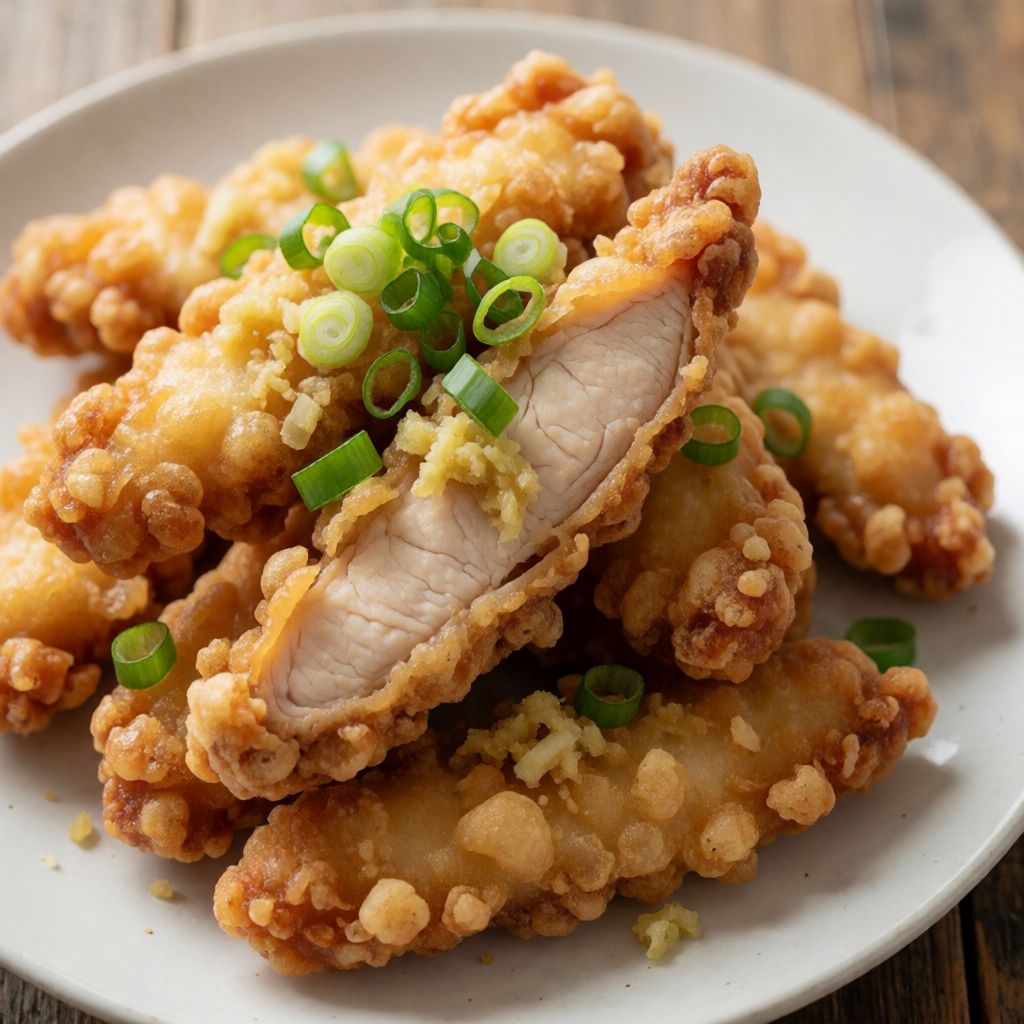
 AI photo
Battered Ginger Chicken Strips
Crispy chicken strips in a light ginger batter, served with a soy, spring onion and ginger sauce.
Labels are worked out automatically from the ingredients and can be wrong. Check the packaging if it matters to you.
Ingredients
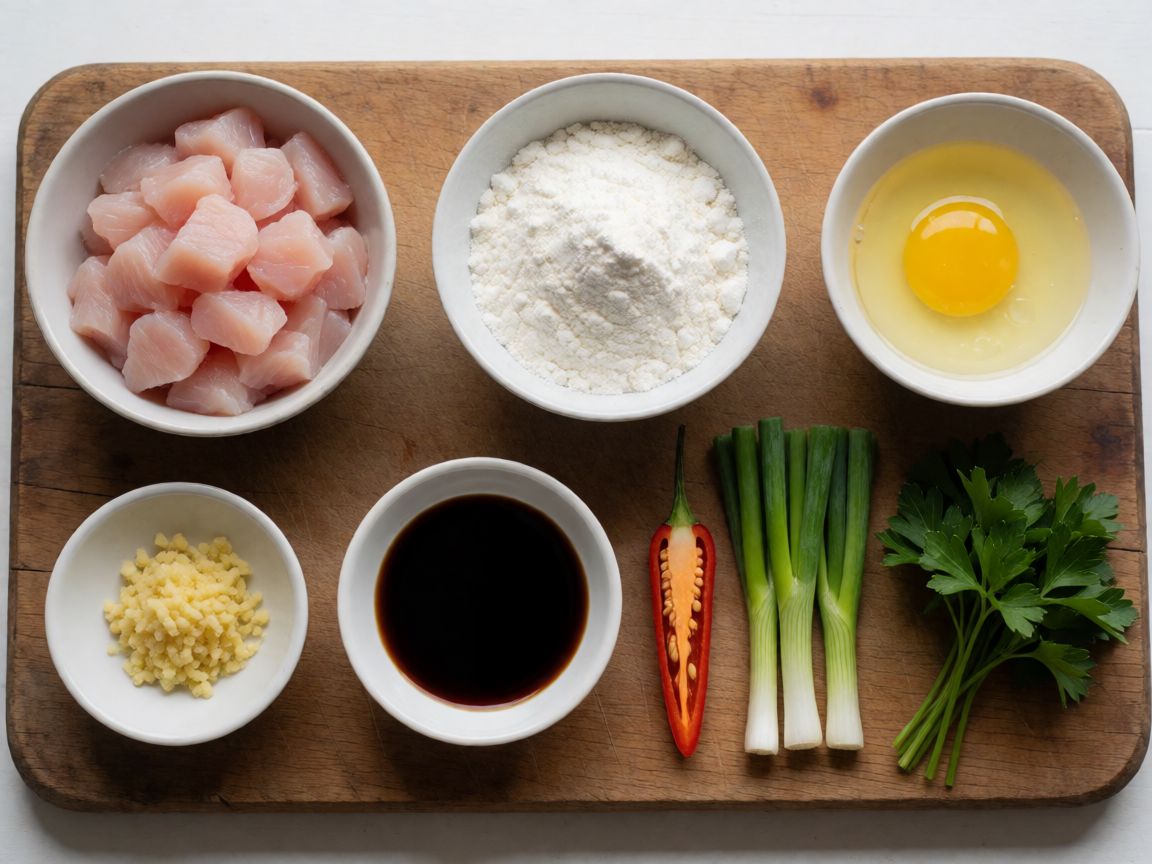
- 600 g Chicken breast
- 150 g Plain flour
- 1 pcs Egg white
- 1 tsp Ginger grated
- 3 tbsp Soy sauce
- 8 pcs Spring onion
- 1 pcs Fresh chilli only half is used
- 1 bunch Parsley
- Olive oil to taste
- Vegetable oil to taste
- Salt to taste
- Black pepper to taste










Steps
In a bowl mix the flour, half a teaspoon of grated ginger, a pinch of black pepper and pour in 120 ml of water. Mix well.
Put the batter in the fridge to rest.
30 minFinely chop the spring onions and fry them in olive oil in a pan until soft.
Add half the fresh chilli, sliced, mix well and pour in the soy sauce.
Add another half teaspoon of grated ginger and transfer everything to a bowl.
Blend with a stick blender until smooth.
Finely chop the bunch of parsley and add it for aroma.
Whisk the egg white with an electric mixer to stiff peaks, adding a pinch of salt.
Gently fold the whisked egg white into the previously prepared batter.
Cut the chicken breast into long thin strips and coat them fully in the batter.
Fry the strips in hot vegetable oil in a pan, cooking until the centre reaches 74°C.
Place on a paper towel and let drain for a few minutes.
Serve on a plate, drizzle with the spring onion and ginger sauce and garnish with chilli.
This is tempura's cousin that wandered off to East Asia and picked up a soy-ginger sauce on the way. Chicken breast, cut into strips so it cooks through fast, gets dunked in a rested flour-and-water batter lightened with whisked egg white, then fried until the crust is crisp and the inside is just cooked. The whole dish hangs on two things: how light that batter stays, and whether you stop frying at the right moment rather than the right minute.
Everyone reaches for breast because it's lean and looks the part in strips. The trade-off is that breast has almost no fat to protect it — overshoot the centre by a few degrees and you get dry, stringy meat under a perfect crust, which is the single most common failure here. That's why 74°C in the thickest strip is the number to chase, not a clock. Pull one out, cut it open if you're not sure — that's allowed, this isn't a soufflé.
The sauce isn't a garnish, it's the seasoning you didn't put in the batter. Batter stays plain — flour, water, a little ginger, a little pepper — because its job is structure and crunch, not flavour. All the savour (soy, ginger, chilli, spring onion, parsley) lives in the sauce you pour on afterwards, so the crust never goes soggy from sitting in liquid before it hits the oil.
Start with the batter logic, because it explains everything else. Flour plus cold water plus rest gives you a smooth, elastic-free mixture — the 30 minutes in the fridge isn't idle time, it's letting the gluten that formed while you stirred relax back down. Skip the rest and the batter fights you: it clings in lumps, shrinks off the chicken in the oil, and fries patchy instead of in one even sheet. Some people think batter needs eggs and baking powder to crisp up — no, because the crispness here comes from a thin, cold-to-hot shock in oil, and from the egg white doing a separate job: whisked to stiff peaks and folded in gently (not stirred — folded, so you don't knock the air back out), it turns a dense paste into something closer to a mousse. That trapped air is what makes the fried coating feel light rather than like a doughnut skin.
Chicken breast: lean, mild, cooks evenly in thin strips — that's the brief. If you only have thigh, use it; it's more forgiving of a slightly overcooked moment because it carries its own fat, and the strips just want cutting a touch thinner since thigh meat is less uniform in thickness. Cut with the grain into long strips rather than cubes — length matters because a longer thin piece gets a higher crust-to-meat ratio, which is the whole point of battering something lean in the first place.
The flour just needs to be plain, nothing self-raising — you're building structure with water and egg white, not with chemical lift, so baking powder would only make the crust puff and then collapse. Ginger grated fresh, not from a jar, because its aroma is mostly volatile oils that fade fast once cut; splitting it between batter and sauce means both get a trace, rather than one getting all the pungency and the other none. Soy sauce: use a light one if you want the sauce to stay the colour of the spring onions rather than go dark brown — it's about appearance here as much as salt, since you've got no other seasoning doing visible work in that sauce.
Spring onion fried in olive oil until soft — not browned, soft — because this is sauce-building, not a stir-fry; colour change would mean sugars catching and turning bitter, and you don't want bitterness fighting the ginger. Olive oil is there for its own flavour in the sauce; vegetable oil for frying is chosen for the opposite reason — any oil with no smell of its own and a high smoke point works, sunflower or groundnut are the obvious stand-ins, because at frying heat a strong-flavoured oil would just add its own smell to a crust that's supposed to taste of the batter and the sauce, nothing else.
On a domestic hob, a wide pan with a few centimetres of oil does the job of a proper fryer, but you lose the thermometer's best friend: a deep bath of oil holds its heat when you add food, a shallow pan dips sharply. Fry in small batches, give the oil time to recover its heat between them, and don't trust your eyes on colour alone — a probe thermometer in the thickest strip, reading 74°C, is the only honest check you have without a kazan-depth of oil to keep things stable. A paper towel afterwards isn't fussing — it's stopping the crust from steaming itself soft in its own trapped oil while it sits.
This feeds four as a starter or light main, with rice or just the strips and sauce on their own — think of it the way you'd think of chicken dippers for someone who grew up on a Sunday roast and tea with milk: same comfort, different spice cupboard. Patience is the real ingredient twice over here — once while the batter rests, once while you wait for the oil to come properly hot before the first strip goes in, because a cold start is how sogginess gets written into the crust from the very first second.