
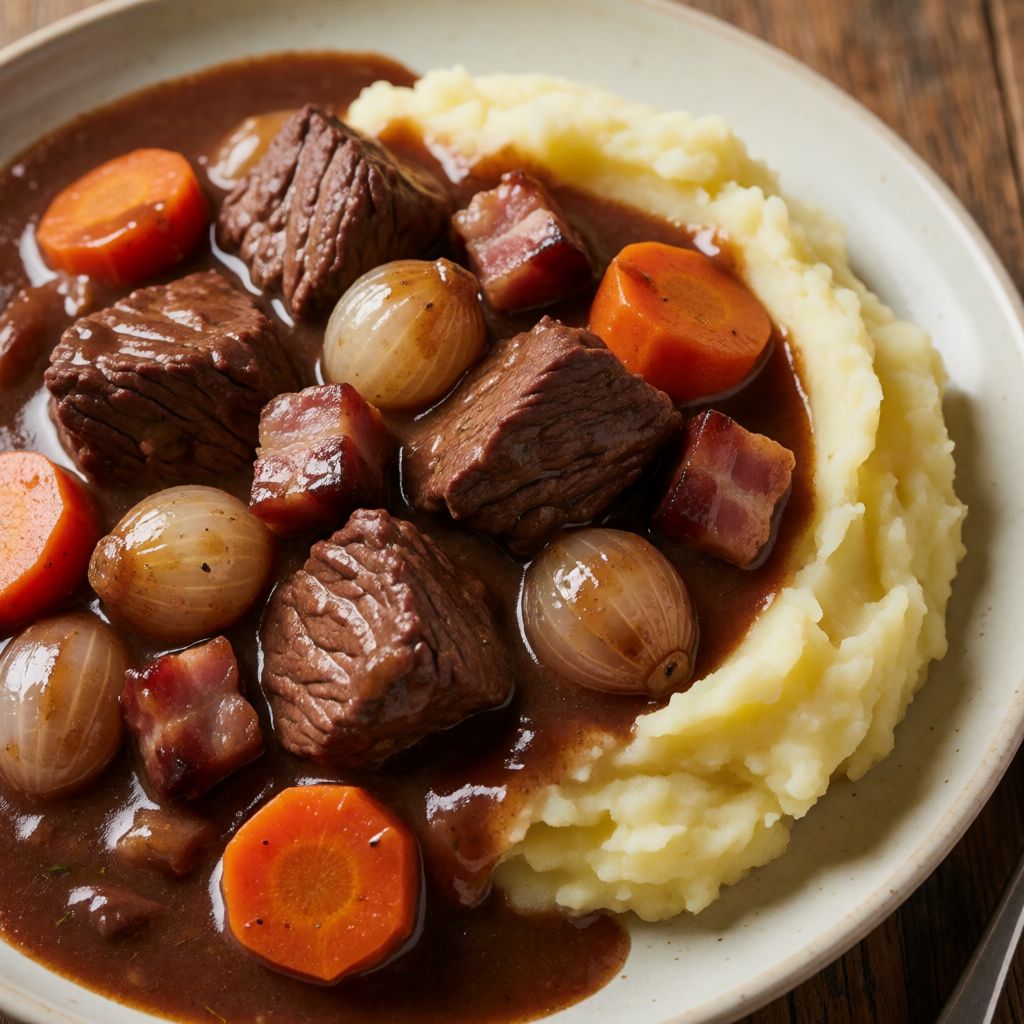
 AI photo
Beef Bourguignon with Mashed Potatoes
A classic French-style beef stew slow-cooked in red wine, served with creamy mashed potatoes.
Labels are worked out automatically from the ingredients and can be wrong. Check the packaging if it matters to you.
Ingredients
- 1.8 kg Beef e.g. chuck steak
- 2 tbsp Plain flour
- 150 g Bacon sliced
- 2 pcs Onion finely chopped
- 3 pcs Carrot diced
- 0.75 l Red wine preferably Pinot Noir
- 1 tbsp Dried thyme
- 6 pcs Bay leaf
- 200 ml Stock
- 400 g Mushrooms halved
- 200 g Pearl onions
- 1 tbsp Caster sugar
- 20 g Butter for frying
- 3 tbsp Parsley roughly chopped, for serving
- Salt
- Black pepper freshly ground
- 2 kg Potatoes
- 150 g Butter
- 300 ml Milk
- 1 pinch Nutmeg
- 1 tbsp Butter for frying















Steps
Cut the meat into roughly 3 × 3 cm cubes. Pat dry with kitchen paper and toss in flour.
Fry the bacon in butter until almost crisp. Place on kitchen paper and cut into cubes.
4 minBrown the meat in small batches in the pot and set aside on a plate. If needed, add a little more butter to the remaining bacon fat in the pot and fry the onion with the carrot until the onion is soft.
15 minReturn the meat and bacon to the pot, add the wine, thyme, bay leaf and stock.
3 minCover the pot with a lid and place in the oven at 125°C for 3-4 hours.
210 minWhen the dish has about 1 hour left to cook, quickly fry the mushrooms over high heat in butter.
60 minIn another pan, melt the sugar over low heat, add butter, let it come to the boil and caramelise the pearl onions in the sugar caramel.
10 minSeason the dish with salt and pepper before serving and add the mushrooms and pearl onions to the pot.
1 minServe the dish with chopped parsley.
1 minBoil the potatoes in unsalted water until tender. Warm the milk in a pan to about 50°C.
18 minLightly mash the hot, freshly boiled potatoes with butter, then whip with a mixer, gradually adding the hot milk, until the mash is creamy, light and silky.
5 minSeason with salt, pepper and freshly grated nutmeg.
1 min
This is a stew that cooks itself, if you let it. Beef bourguignon is a dish built around one fact: cheap, hard-working muscle — chuck, shin, the bits of the cow that did all the walking — is full of collagen, and collagen only turns to soft gelatine after long, gentle, wet heat. Nothing you do with technique can shortcut that. The onions, carrots, wine and bacon are there to flavour the liquid the meat sits in for three or four hours; the actual tenderising is done by time and a low oven, not by you standing at the hob.
What decides whether it works is restraint at the start and patience in the middle. Brown the meat properly, in batches, so the pan stays hot and the meat sears instead of stews in its own juice too early — crowd the pot and you get grey meat, because the water it releases cools everything down and boils rather than browns. Everything after that — the deglazing with wine, the slow braise — depends on that first sear being right.
The mash is the quiet half of the plate. It only has three real variables: dry potato, hot milk, and how gently you treat the starch. Get those right and it's silk; get them wrong — cold milk, a food processor instead of a mixer — and you get wallpaper paste, because you've burst the starch cells and released all their glue at once.
The beef: chuck is right because it's seam muscle, well marbled, loaded with connective tissue — exactly what needs hours at a gentle simmer to break down. Some say you need a tender cut for a "proper" dish — no, the opposite is true, a tender cut like fillet would turn to dry string under this treatment; it has no collagen reserve to melt into sauce. If chuck isn't on the shelf, shin or brisket do the same job. Cube it a decent size — about 3cm — because smaller pieces lose too much surface area to sauce ratio and dry out over three-plus hours.
The flour on the meat isn't there to crisp anything; in a wet braise it can't crisp. Its job is to thicken the sauce slowly as it cooks, and it gives the sear a little extra grip. Don't skip patting the meat dry first — wet meat plus flour just makes paste that burns in the hot fat instead of browning.
The bacon is the fat and the smoke, not a separate component — rendering it first gives you a well-flavoured fat to brown the meat in, which is doing double duty economically as much as culinarily; peasant cooking from Burgundy used what was cured and kept in the house, not fresh cuts. If you can't get streaky bacon, pancetta or even a few smoked lardons do the same work — anything cured and fatty that renders down.
The wine: you want something with enough acidity and tannin to stand up to three hours of reduction without turning flabby or sweet — Pinot Noir is traditional because that's what grows in Burgundy, not because of any mystical pairing rule. Any dry, medium-bodied red without heavy oak will do the same chemistry. Don't use "cooking wine" — if you wouldn't drink it, don't reduce it into the one sauce that's carrying the whole dish.
The oven at 125°C matters more than it looks: that's below a simmer, which means the liquid moves gently rather than rolling, so the meat tenderises without the fibres seizing and toughening the way a hard boil would. A domestic oven holds that temperature far more evenly than a hob ever will, which is the real reason this step belongs in the oven and not in a pot on the stove, lid rattling, heat spiking every time the burner cycles.
The mushrooms and pearl onions go in late and separately because they have their own cooking curve — mushrooms turn bitter and rubbery if they stew for hours in liquid, and pearl onions need a hot, dry caramelisation, not a braise, to get that golden-brown sweetness. The sugar-and-butter step isn't about making them sweet; it's about building colour fast on a small, round vegetable that would otherwise just steam in its own water.
For the mash, dry potato is the whole game — any potato labelled "floury" or "baking" works, because floury varieties have large starch granules that swell and separate cleanly when cooked, giving fluff rather than glue. Waxy potatoes (the kind good for salads) will go gluey no matter how carefully you treat them afterward. Warming the milk to around 50°C before adding it isn't fussiness — cold milk shocks the hot starch and makes the mash seize and go gummy, which is the usual cause of "my mash went stodgy," not the potato itself. And whip it, don't overwork it in a processor — a mixer on gentle speed incorporates air; a processor shears the starch cells open and you get exactly the paste people blame on the potato.
This feeds eight generously, which is Sunday-lunch territory rather than a weeknight dish, and that's honest: three to four hours in the oven is not something you build around a Tuesday. Set it going, go and do something else, and come back when the meat gives with no resistance under a fork — that's the only clock that matters here.