
 AI photo
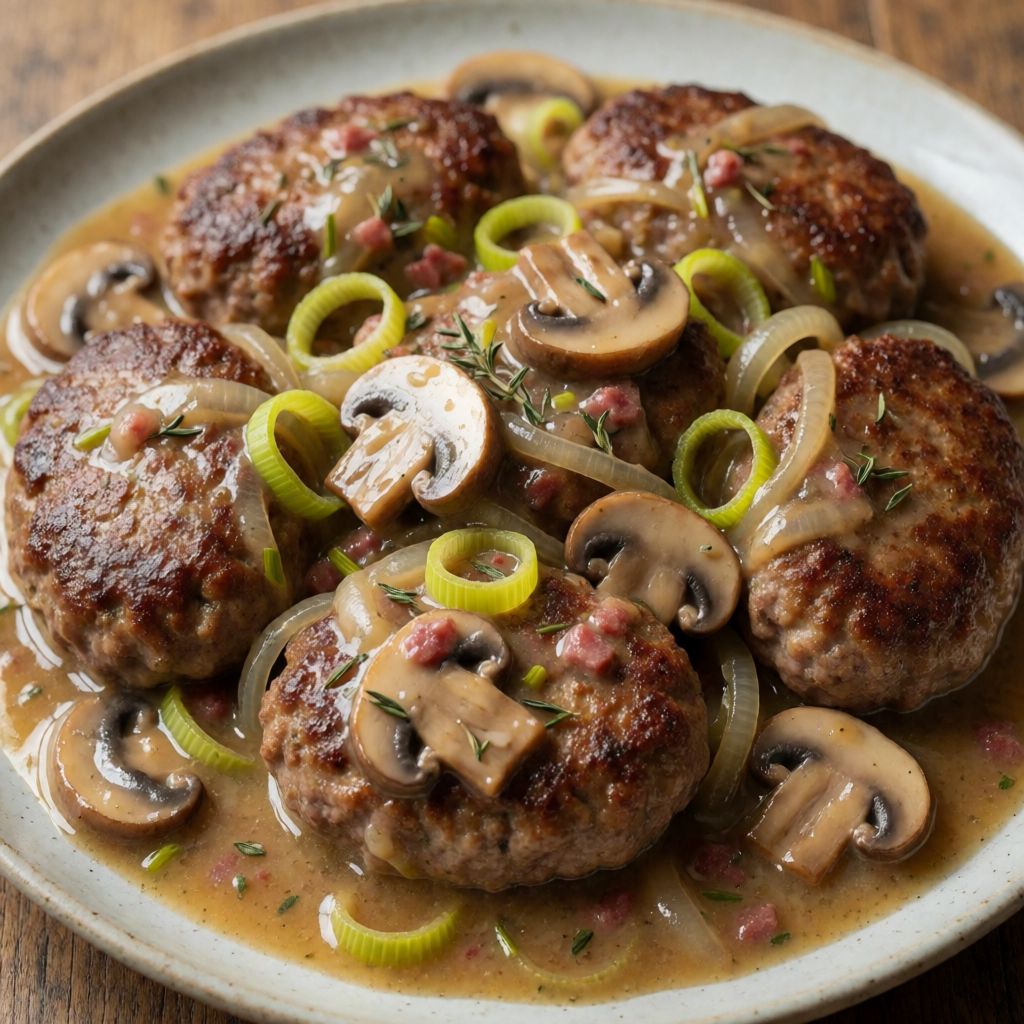
Beef Patties in Sauce
Juicy beef patties baked in a creamy mushroom and tomato sauce.
Labels are worked out automatically from the ingredients and can be wrong. Check the packaging if it matters to you.
Ingredients
- 400 g Minced beef
- 200 g Mushrooms quartered
- 2 pcs Onion finely chopped
- 2 pcs Leek thinly sliced
- 50 g Chorizo-style salami finely chopped
- 1 tsp Dried thyme
- 2 clove Garlic finely chopped
- 2 pcs Bell pepper diced
- 1 tsp Paprika sweet or smoked
- 100 ml Double cream
- 100 g Full-fat cream cheese
- 400 g Tinned chopped tomatoes
- 2 tbsp Olive oil for frying
- Salt
- Black pepper
- 300 ml Basmati rice cooked according to the packet instructions
- 1 bunch Parsley















Steps
Shape four patties of equal size and thickness — this is important for even browning.
Season with salt and pepper and fry over high heat in a pan with olive oil and butter for 1 minute on each side, until a crust forms but not cooked through.
1 minTransfer the patties from the pan to a greased ovenproof dish.
In the same pan, fry the mushrooms over high heat for a few minutes, adding a little more oil if needed.
Add the onion, leek, chorizo-style salami, thyme and garlic, and cook over medium heat until the onion and leek are soft.
Add the bell pepper, paprika, double cream, cream cheese and chopped tomatoes and stir together.
Season with salt and pepper and warm the sauce through for a few minutes.
Pour the sauce over the patties in the dish and bake in a preheated fan oven at 175°C for 10–15 minutes.
12 minBaking time may vary slightly, so check after about 10 minutes to avoid overcooking the patties.
10 min
What was changed
The recipe was adapted: Chorizo-style salami was replaced with a salami available in British shops, and Double cream was replaced with the cream used locally.
This is a beef patty braised — not stewed — in a tomato-cream sauce built from a fond you make on purpose. The whole dish turns on one decision: you sear the patties hard and fast and stop while the middle is still raw, then let the oven finish them inside the sauce. That's the mechanism. Get the sear wrong and you get two different failures: skip it, and the patties stew grey and watery, leaking their juices straight into the sauce instead of keeping them. Push it too far — cook them through in the pan — and the oven then dries them out, because you're reheating meat that's already done rather than finishing meat that's still cooking.
The sauce isn't a separate thing you make and pour on. It's built in the same pan, on the same fond the patties left behind — that dark sticky residue is flavour, not mess, and deglazing it with mushrooms and onions is the whole point of not washing the pan between steps. Mushrooms go in first and alone, over high heat, because they're mostly water: crowd them too early with onion and they'll steam instead of colour, and you lose the browning that gives the sauce its backbone.
What decides whether the finished dish works is restraint in two places: not over-searing the meat, and not over-reducing the sauce before it meets the oven — cream and cream cheese split if you boil them hard, so "warm through" means just that, not a rolling simmer. Rice is there to carry the sauce, nothing more; it doesn't need defending, just cooking properly and staying out of the way.
Minced beef for the patties wants some fat in it — 15–20% if you're choosing — because lean mince sears dry and the whole searing step is wasted on it. Some say use the leanest mince you can find, for health; no, because here fat is doing mechanical work, carrying heat into the crust and keeping the inside tender through a second cooking in the oven. If all you've got is very lean mince, work a spoonful of butter into it before shaping, or accept a slightly firmer patty.
Mushrooms, onion, leek, chorizo-style salami and garlic are the base, and they go in that order for a reason, not tradition for its own sake. Mushrooms first, alone, high heat, until they've given up their water and started to catch colour — crowd the pan with everything at once and nothing colours, it all just simmers in its own liquid. Then onion and leek come down to a gentler heat, because they need time to go soft and sweet, not a fast colour; thyme and garlic ride along so the garlic doesn't scorch and turn bitter, which it will if it hits the pan alone on high heat. Chorizo-style salami isn't essential to the mechanism — it's there for smoke and paprika-oil that leaches into everything else — so any cured, paprika-spiced sausage works, and if you have none, a spoon of smoked paprika and a knob of extra fat gets you close.
Bell pepper goes in raw-ish, late, because you want bite left in it, not a mush — it's texture contrast against the soft onion and the cream. Paprika, sweet or smoked, is colour and a background warmth; smoked if you want the dish to taste like it's been near a fire, sweet if you'd rather it stayed mellow — there's no right answer, only which fridge you're cooking for.
Double cream and cream cheese together are doing two different jobs: the cream loosens and enriches, the cream cheese thickens and gives body without flour, which is why you never let this sauce boil hard once they're in — boiling breaks the fat out of a dairy emulsion and you get a split, oily sauce instead of a glossy one. Tinned chopped tomatoes bring acid and bulk; if you only have whole tinned tomatoes, crush them by hand in the pan, they soften faster that way.
The oven stage — a fan oven, hot enough that the sauce bubbles gently at the edges of the dish, not a rolling boil in the middle — is where the patties finish cooking through using residual method, not direct flame. Some say you can skip the pan-sear entirely and just bake the raw patties in the sauce from the start; no, because then you never build the fond, the sauce stays pale and one-note, and the patties release their juices slowly into the liquid the whole time instead of holding a sealed crust. Checking at the lower end of the time given isn't fussiness — it's because a kitchen oven, a dish's depth, a patty's thickness all vary enough that the time in a recipe is a floor, not a clock you trust blindly. Press a patty gently with the back of a spoon: give without resistance means it's still soft inside; a slight spring back is what you're after.
Basmati rice, cooked plainly to packet instructions, is there to soak the sauce up — nothing about this dish asks the rice to be clever, it just needs to be properly cooked, each grain separate, which usually means rinsing the starch off before boiling so it doesn't clump. Parsley at the end is for green freshness against all that richness, and if you're out, any soft herb with a clean, slightly grassy smell — chives, even the tops of spring onion — does the same job.