
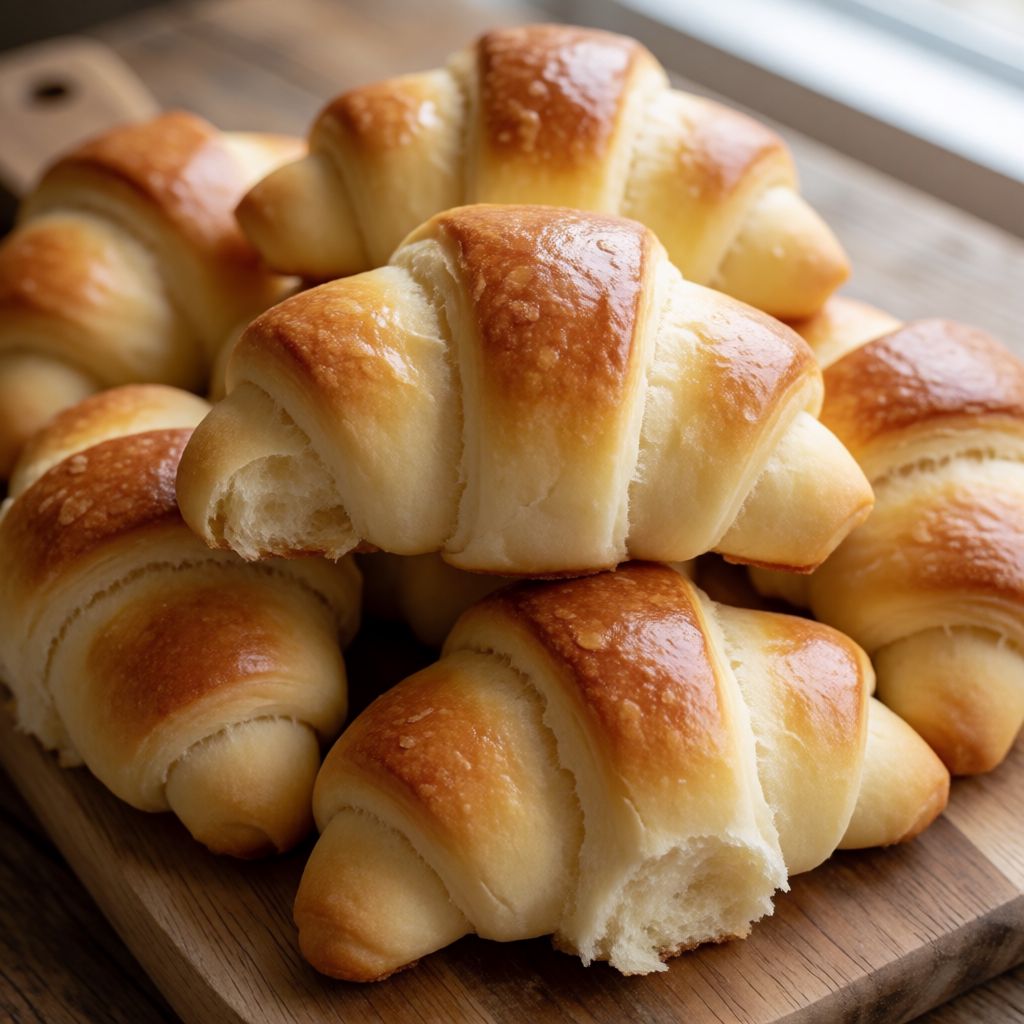
 AI photo
Buttermilk Crescent Rolls
Overnight buttermilk rolls filled with marzipan, cardamom and apple.
Labels are worked out automatically from the ingredients and can be wrong. Check the packaging if it matters to you.
Ingredients
- 300 g Plain flour
- 50 g Caster sugar
- 0.5 tsp Vanilla sugar
- 1 pinch Salt
- 100 g Butter cold
- 20 g Yeast fresh yeast
- 200 ml Buttermilk at room temperature
- 75 g Butter at room temperature
- 75 g Caster sugar
- 100 g Marzipan coarsely grated
- 1 pinch Cardamom
- 1 pcs Apple peeled and cut into wedges
- 1 pcs Egg for brushing
- 30 g Almonds finely chopped
- 30 g Pearl sugar











Steps
Mix the flour, sugar, vanilla sugar and salt, then rub in the butter until crumbly.
Dissolve the fresh yeast in the buttermilk and knead into a dough.
Put the dough in a bowl, cover and chill in the fridge overnight.
Mix the butter, sugar, marzipan and cardamom for the filling.
Divide the dough into two parts and roll out each into a circle.
Cut each circle into 6 triangles.
Place a spoonful of filling and a wedge of apple on each triangle, then roll up into crescents.
Place on a baking tray lined with parchment and leave to rise for 1 hour under a clean tea towel.
60 minBrush with beaten egg and sprinkle with almonds and pearl sugar.
Bake in a preheated oven at 175°C (fan) for about 15 minutes.
15 min
This is a cold-fermented, butter-laminated yeast dough wrapped around a marzipan-cardamom filling and a wedge of apple — a hybrid of a croissant and a cinnamon bun, but gentler on you because it skips the folding. The whole thing hinges on one decision made the night before: you chill the dough overnight instead of proving it warm on the counter. That's not a stalling tactic, it's the actual technique. Cold slows the yeast right down but doesn't stop the gluten and the fat from settling into each other, so by morning you've got a dough that's both flavourful and workable, rather than one that's ballooned up fast and tastes of nothing but yeast.
Rubbing cold butter into flour before the liquid goes in is what keeps these from baking up dense and bready. The flour coats the fat, and every little butter crumb becomes a tiny barrier that stops long gluten strands forming everywhere — so the crumb stays short and flaky rather than chewy. Some say you need a stand mixer with a dough hook for yeasted dough, no — your hands and ten cold minutes do this better, because a machine warms the butter through friction and you lose the point of having it cold at all.
Fresh yeast versus the dried kind you've probably got in the cupboard: fresh works faster and gives a softer, more even crumb because it's already alive and doesn't need rehydrating, but it dies in a fortnight in the fridge. If you can only get dried active yeast, use about a third of the weight — so roughly 7g — and dissolve it in the buttermilk the same way, just give it ten minutes to foam before you trust it. The buttermilk itself isn't there for a tang you'll even taste by the time this bakes; its acidity gently tenderises the gluten, which is part of why this dough is softer than an ordinary bread roll. No buttermilk in the house — and in the UK it sits oddly between the yoghurt and the milk in most supermarkets, so it's easy to miss — stir a tablespoon of lemon juice into 200ml of ordinary milk and let it sit five minutes; same acidity, same job.
The two butters in this recipe are doing two completely different jobs, which is why one is cold and one is room temperature, and swapping them would ruin the result. The cold 100g goes into the flour to create flakiness, as above. The soft 75g in the filling needs to be spreadable so it binds with the sugar and grated marzipan into something you can actually dollop onto a triangle of dough without tearing it — if it's cold and hard here it just sits as a lump and burns rather than melting into the layers as it bakes.
Marzipan is almond paste bulked with sugar, and grating it coarsely rather than chopping it means it melts unevenly through the filling in little sweet pockets, rather than turning into one uniform paste. If you don't keep marzipan in, almond paste with a slightly higher almond content works, or in a pinch blitz blanched almonds with icing sugar and a few drops of almond extract — it won't be quite as silky, but the cardamom and apple carry most of the flavour anyway. Cardamom itself is the quiet reason these don't taste like a plain cinnamon roll; it's a Scandinavian habit more than a German or Austrian one, born of old spice-trade routes through the Baltic ports — so if the smell is unfamiliar to you, that's why, and a pinch of ground ginger or even nutmeg will stand in, though it changes the character, not just the accent.
The apple wedge isn't decoration, it's moisture control. As the pastry bakes, the apple releases a little steam right in the centre of the roll, keeping that innermost layer from drying out before the outside browns — tuck it in raw, don't pre-cook it, or you lose that effect and just get mush. Any firm, not-too-sweet apple works; a soft dessert apple collapses to nothing in 15 minutes at this heat.
The egg wash and the pearl sugar on top are for looks and for crunch respectively, and neither affects whether the inside is cooked, so don't skip the almonds and sugar thinking you're saving time — they're what gives you something to bite against, otherwise the whole roll is uniformly soft and a bit one-note. If you can't find pearl sugar, a light scatter of demerara gives you something close enough in crunch, even if it melts a touch more.
175°C fan is hot enough that the sugars on the surface caramelise and the butter in the layers turns to steam fast, pushing the dough up rather than just drying it out — any cooler and you get pale, dense crescents that taste of raw dough in the centre. Twelve crescents from this feeds a table of twelve generously for a Sunday-morning spread alongside the usual tea with milk, or six people if everyone's having two, which, with marzipan and apple in the mix, they probably will.