
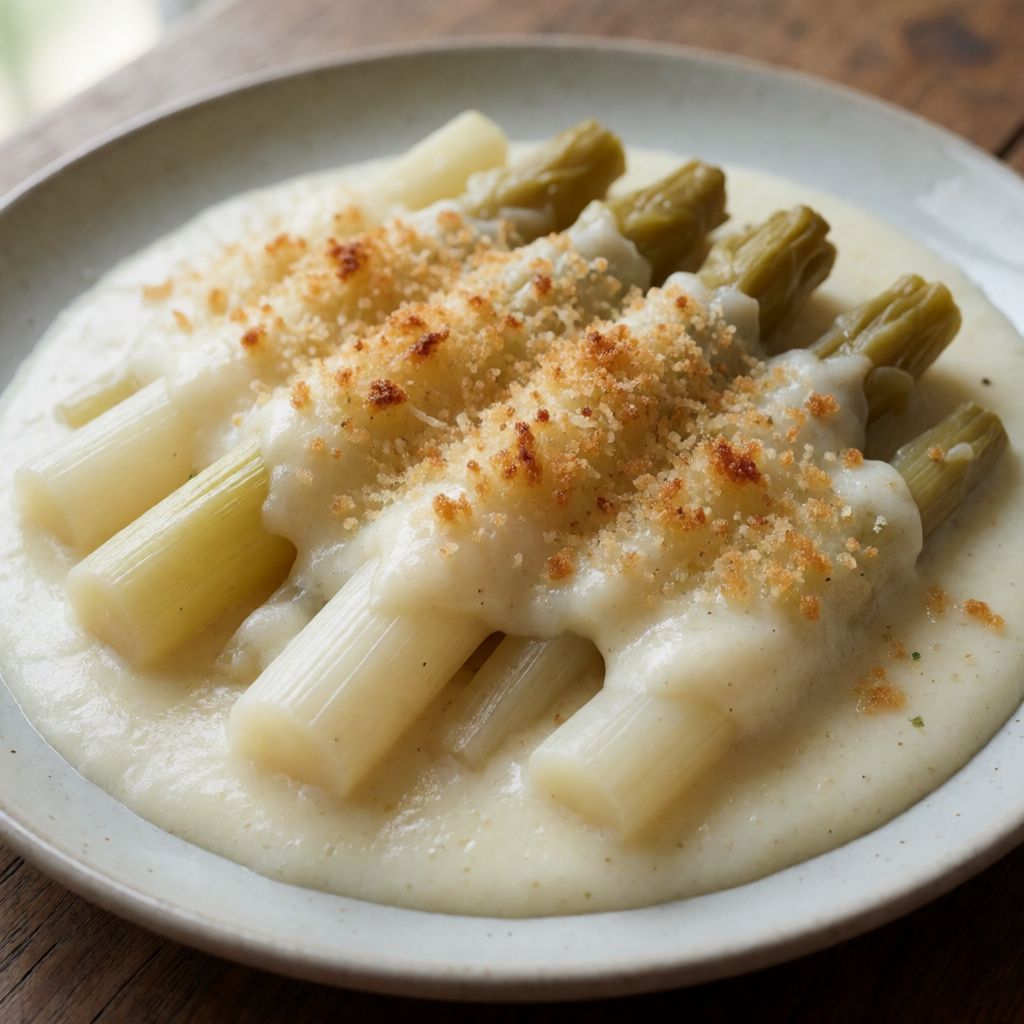
 AI photo
Cardoons in Béchamel Sauce with Parmesan
A comforting bake of tender cardoons layered with creamy béchamel and parmesan.
Labels are worked out automatically from the ingredients and can be wrong. Check the packaging if it matters to you.
Ingredients
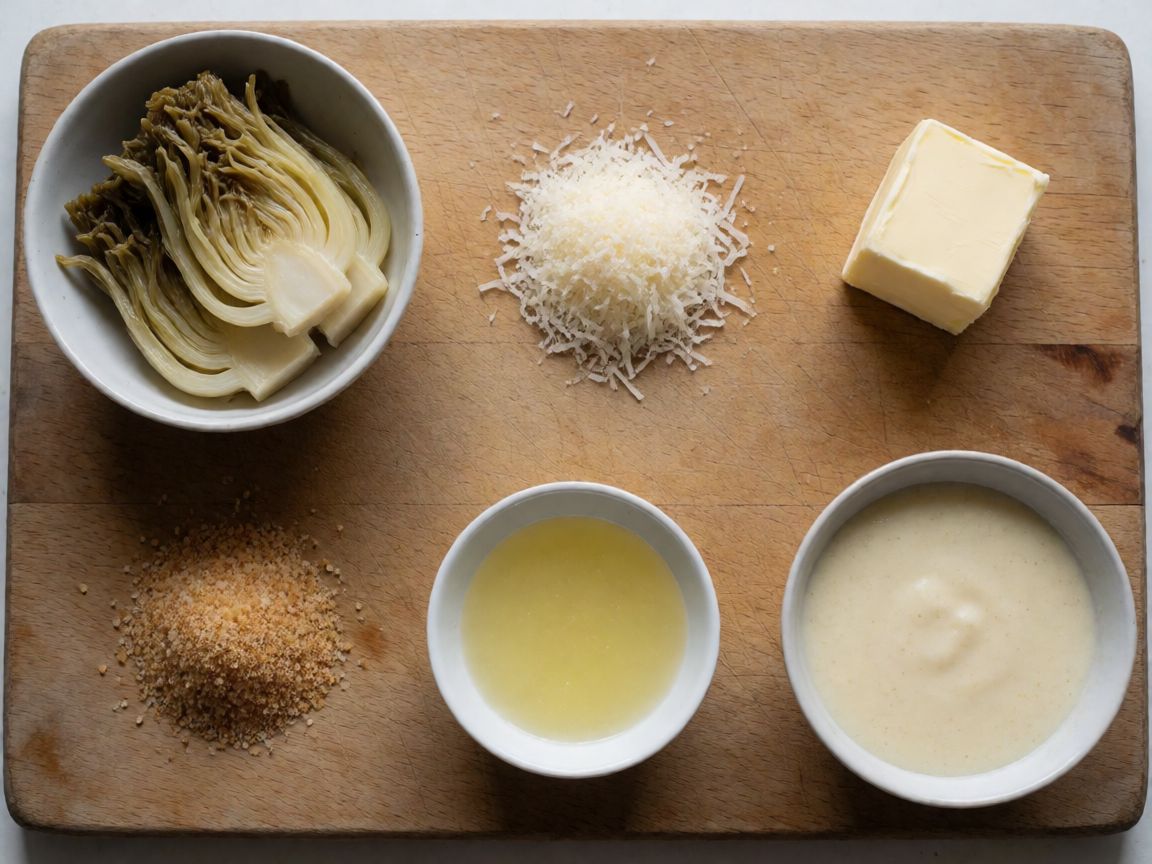
- 1 kg Cardoons
- 100 g Parmesan
- Butter to taste
- 3 tbsp Breadcrumbs dried
- Salt to taste
- Lemon Juice to taste
- 500 ml Béchamel Sauce






Steps
Cut any overly long cardoon stalks in half and use a knife to remove the tough strings.
Slice the cardoons into strips and boil them in water with a little lemon juice added.
45 minPrepare the béchamel sauce.
Grease a baking dish with butter and spread a first layer of béchamel over the base.
Arrange a first layer of cardoons on the bottom, sprinkle with half the parmesan and drizzle with half the béchamel.
Add a second layer of cardoons, parmesan and béchamel, repeating until the ingredients are used up.
Sprinkle breadcrumbs over the top.
Bake at 200°C for 40 minutes.
40 min
Cardoons look like celery's gaunt cousin and behave like an artichoke that never grew a heart — same family, same instinct to turn grey and bitter the second you cut them. This dish is really two separate problems solved in sequence: tame a vegetable that fights you, then let an old French sauce carry it into something you'd put next to a Sunday roast without blinking.
What decides whether it works is the boiling, not the baking. Cardoons are full of the same enzyme that browns an apple, and raw air turns the cut flesh brown-grey within minutes — ugly, and it tastes of iron and bitterness too. Lemon juice in the water isn't a flavour choice, it's acid doing a job: it stops that oxidation cold and keeps the strips pale. Some say you need a vinegar-and-flour paste like the Italians use for proper artichoke prep — no, because for cardoons in this quantity a splash of lemon in simmering water is enough; you're not preserving them for a week, just getting them to the oven in one piece.
The second thing the boiling does is break the strings. Cardoon stalks are ribbed with fibres exactly like celery's, and if you skip stripping them with a knife before cooking, no amount of boiling will make those fibres tender — they'll just go soft on the outside and stay stringy in the middle, the kind of thing that gets stuck in your teeth at the table. Bend a stalk before you trust it: it should give, not snap and not just droop. Forty-five minutes is where most cardoons land, but the vegetable decides, not the clock — older, thicker stalks sulk longer.
Cardoons themselves are the hard part to source here — they're a Mediterranean vegetable, big in Italian and French kitchens in late autumn when artichokes are out of season but the same plant family is still going. In an ordinary British shop you're unlikely to find them outside a specialist greengrocer or a farmers' market with a Mediterranean stall. If you can't get them, the honest substitute is whatever gives you the same long, fibrous, mildly bitter stalk: celery, cooked longer and peeled of its outer strings the same way, gets you close in texture though not in flavour — it's sweeter, less bitter, so the dish will be gentler. Don't reach for chard stalks instead; they collapse too fast and won't hold a layer.
Parmesan here isn't decoration, it's doing two jobs — salting the béchamel from inside instead of relying on a shaker, and, once it hits 200°C, browning into the crust alongside the breadcrumbs. Any hard, dry, well-aged cheese that melts into itself rather than stringing will do the same job — a mature Cheddar works, though it'll push the dish toward a British cauliflower-cheese flavour rather than an Italian one, which isn't a failure, just a different dish wearing the same construction.
The butter greasing the dish is prevention, not habit: béchamel is mostly milk solids, and milk solids stick to a dry surface and scorch at the edges before the middle's even hot. A thin film of fat between sauce and dish buys you an even bake instead of a burnt rim and a cold centre.
Breadcrumbs on top aren't there for crunch alone — they're there because béchamel has no structure of its own once it's hot and loose in the oven; without something dry sitting on the surface, the top just stays a wet skin. Dried breadcrumbs pull moisture up and brown, giving you a lid that actually has some bite to it. If you're out of dried breadcrumbs, dry stale bread works in the way it always has in poorer kitchens that didn't waste bread — a few days old, grated or blitzed, gives the same effect; fresh breadcrumbs won't, they just go soggy and defeat the point.
On the béchamel itself: this recipe assumes you already have 500ml made, and that's worth respecting rather than rushing — a sauce that's been stirred patiently over gentle heat until it coats a spoon is a different animal from one that's been left lumpy because you walked away. Patience here isn't poetic, it's literally the difference between a smooth layer and a gritty one.
At 200°C for 40 minutes you're not cooking the cardoons again — they're already done. You're driving off surface moisture, melting the parmesan into the breadcrumbs, and colouring the top. Watch the colour, not the clock: you want the surface to go from pale and wet-looking to matte gold with darker freckles at the raised bits. If it's still pale and soft after 40 minutes, give it longer rather than trusting the timer — ovens in most flats run cooler than the dial claims, especially older ones, and that's a kitchen limit worth just accepting rather than fighting.