
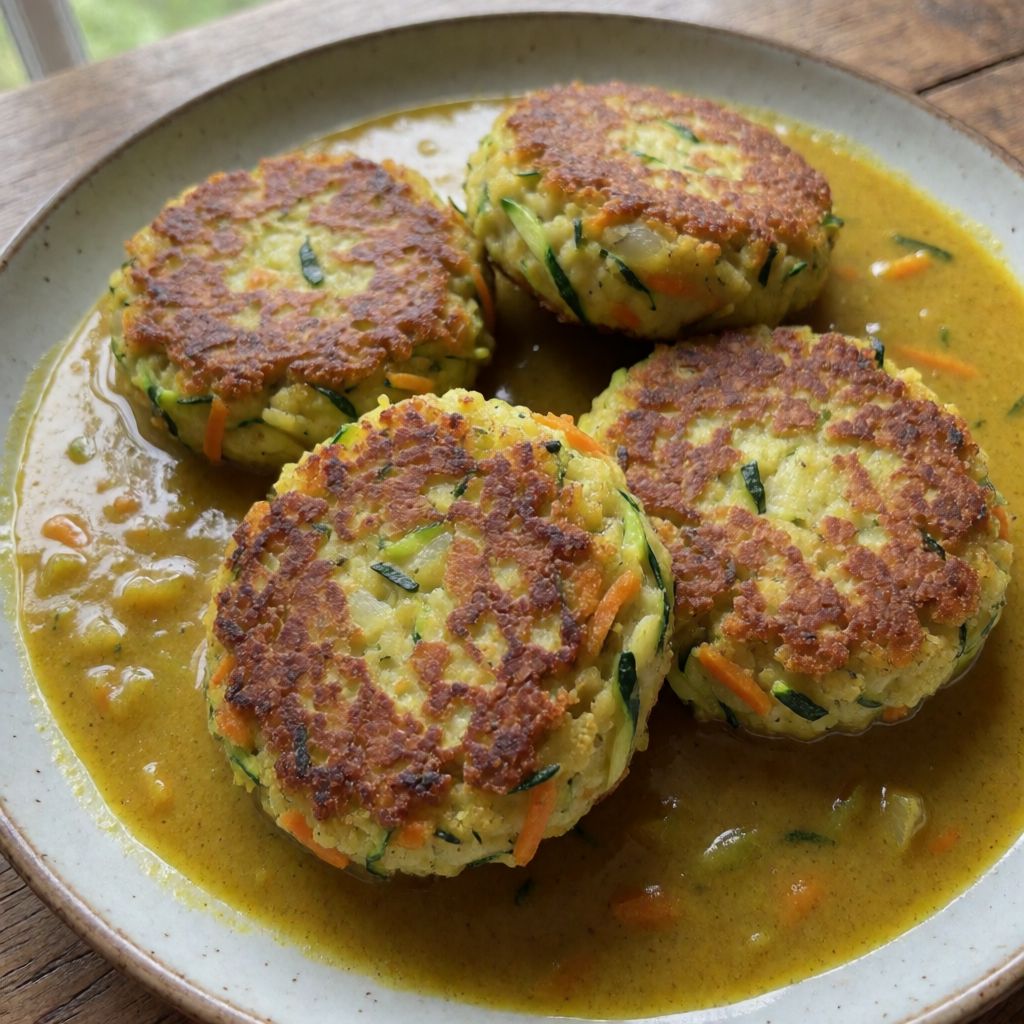
 AI photo
Vegetarian Cauliflower Cakes in Curry Sauce
Crisp vegetarian cauliflower, chickpea and feta cakes served with a creamy coconut curry sauce, basmati rice and mango chutney.
Labels are worked out automatically from the ingredients and can be wrong. Check the packaging if it matters to you.
Ingredients
- 2 tbsp Curry powder medium hot
- 300 g Courgette diced
- 3 pcs Carrot diced
- 2 pcs Onion finely chopped
- 4 clove Garlic finely chopped
- 1 pcs Apple diced
- 1 tsp Turmeric dried
- 400 ml Coconut milk
- 100 ml Stock
- 1 tsp Soy sauce
- 1 tsp Sesame oil
- 1 pinch Black pepper freshly ground
- 175 g Chickpeas canned or cooked
- 175 g Cauliflower broken into florets
- 200 g Feta crumbled
- 2 pcs Eggs
- 1 clove Garlic crushed
- 50 g Breadcrumbs dried
- 1 pinch Salt
- 1 tsp Olive oil for greasing
- Butter a small amount, to taste
- 300 ml Basmati rice cooked according to packet instructions
- 75 g Mango chutney
- 0.5 tsp Chilli flakes
- 0.5 bunch Parsley finely chopped
























Steps
Blitz the chickpeas, cauliflower and feta in a food processor until coarsely chopped.
2 minTip into a bowl with the eggs, garlic, breadcrumbs, salt and pepper and mix until a thick, even mixture forms.
3 minHeat a frying pan with the oil and a little butter and fry the cauliflower cakes until golden brown.
10 minToast the curry powder in a dry pan until fragrant.
1 minAdd the oil, courgette, carrot, onion, garlic, apple and turmeric and mix well, cooking for a few minutes.
4 minAdd the coconut milk, cover and simmer for about 15 minutes or until the carrot is tender.
15 minBlend the sauce until smooth and creamy.
Adjust the consistency with stock and season with soy sauce and pepper to taste.
3 minAdd the cauliflower cakes to the sauce.
Serve on plates with basmati rice, the cauliflower cakes in curry sauce and mango chutney, sprinkled with chilli flakes and parsley.
This dish is really two kitchens running at once: a fritter kitchen and a curry kitchen, and they only meet at the very end. The cauliflower cakes are a binding problem — chickpeas, cauliflower and feta are all wet, crumbly things that want to fall apart, and egg plus breadcrumbs is what stops them. The curry is a blending problem — you cook vegetables rough, then make them smooth, and the test for "done" is not a clock but the carrot: push it with a spoon, it should bend, not snap. Get those two things right and the rest — spooning it over rice, a dab of chutney — looks after itself.
Some say curry powder is a shortcut, not real cooking — no, because "curry" as a single dish barely exists in India at all. The premixed powder is a British invention from the days of empire, built to recreate the memory of Indian spicing for cooks who had neither the spice cupboard nor the local knowledge to blend their own. There's no shame in a jar; it's just a standardised answer to a logistics problem, and it's why this dish can exist in a British kitchen on a Tuesday with no fuss.
The cakes are fried and set before they ever meet the sauce, and that order matters. Egg protein needs dry, direct heat to firm up into a crust; drop the raw mixture straight into a wet, simmering curry and it will not hold, it will dissolve into crumbs before the egg ever sets. The crust you're frying for isn't decoration — it's the shell that lets you then add the cake to liquid without it collapsing.
Cauliflower, chickpeas and feta go into the processor together and you want them chopped, not pulped — a few short pulses, checking as you go. Pulp loses structure; coarse crumbs still have edges to lock against each other once the egg sets. If you don't have feta, look for any cheese that's salty and crumbles rather than stretches — a mature Lancashire or Wensleydale does the same job and is sitting in most British fridges already; mozzarella or anything that melts smooth will turn the cakes gluey instead of giving them bite.
The egg and breadcrumbs aren't flavour, they're structure. Cauliflower releases water once it's broken up, feta adds more moisture and salt — without something dry to soak that up and something proteinous to set under heat, you'd have a sauce, not a cake. Dried breadcrumbs work because they're already dehydrated and absorb fast; if you're out, blitzed stale bread or even oats will do the same job, the test is simply: dry, starchy, no strong taste of its own.
Curry powder goes into a dry pan first, alone, until the smell changes from raw and dusty to something closer to toasted nuts — that's maybe a minute, no more, and it's the ceiling, not a target to beat. Ground spice carries its aromatics in oils that are locked in until heat frees them; skip this and the final sauce tastes flat and powdery underneath the coconut milk. Push past that first change in smell, though, and the same oils burn and turn bitter — there's no coming back from that, so pull it off heat the moment it turns, then let the fat you add next carry the flavour rather than the dry pan.
Turmeric goes in with the vegetables rather than alone, because on its own in a dry pan it just scorches — it wants oil and moisture around it to colour the dish without turning acrid. The apple is doing two things at once: its sugar takes the raw edge off the curry powder's heat, and its pectin, once blended, gives the sauce a little more body for free, the same way apple sauce thickens almost by itself.
Coconut milk is simmered, covered, not boiled — a hard boil splits the fat from the water in coconut milk and you end up with an oily film floating over a thin liquid instead of one creamy sauce. If you've no lid that fits a frying pan — and most domestic ones don't — a plate laid over the top does the same job of holding steam in so the carrot actually steams-slash-simmers to tender rather than drying out on top while the bottom cooks. No coconut milk in the cupboard, use the criterion rather than a single swap: something high in fat that won't curdle under gentle heat — a tin of evaporated milk with a spoon of stock stretches further, though you'll lose the coconut note itself, nothing quite replaces that.
Frying the cakes on an ordinary hob, don't crowd the pan. A kazan or a commercial burner holds its heat when you drop food in; a domestic ring drops temperature fast, and too many cakes at once means they steam in their own moisture instead of browning — you get pale, soft cakes that stick. Fry in batches, give the pan a minute to recover its heat between them, and only turn a cake once it releases on its own — if it resists, the crust underneath hasn't set yet, and forcing it tears the cake in half. That resistance is the whole point of frying before saucing: it's telling you the structure is ready.