
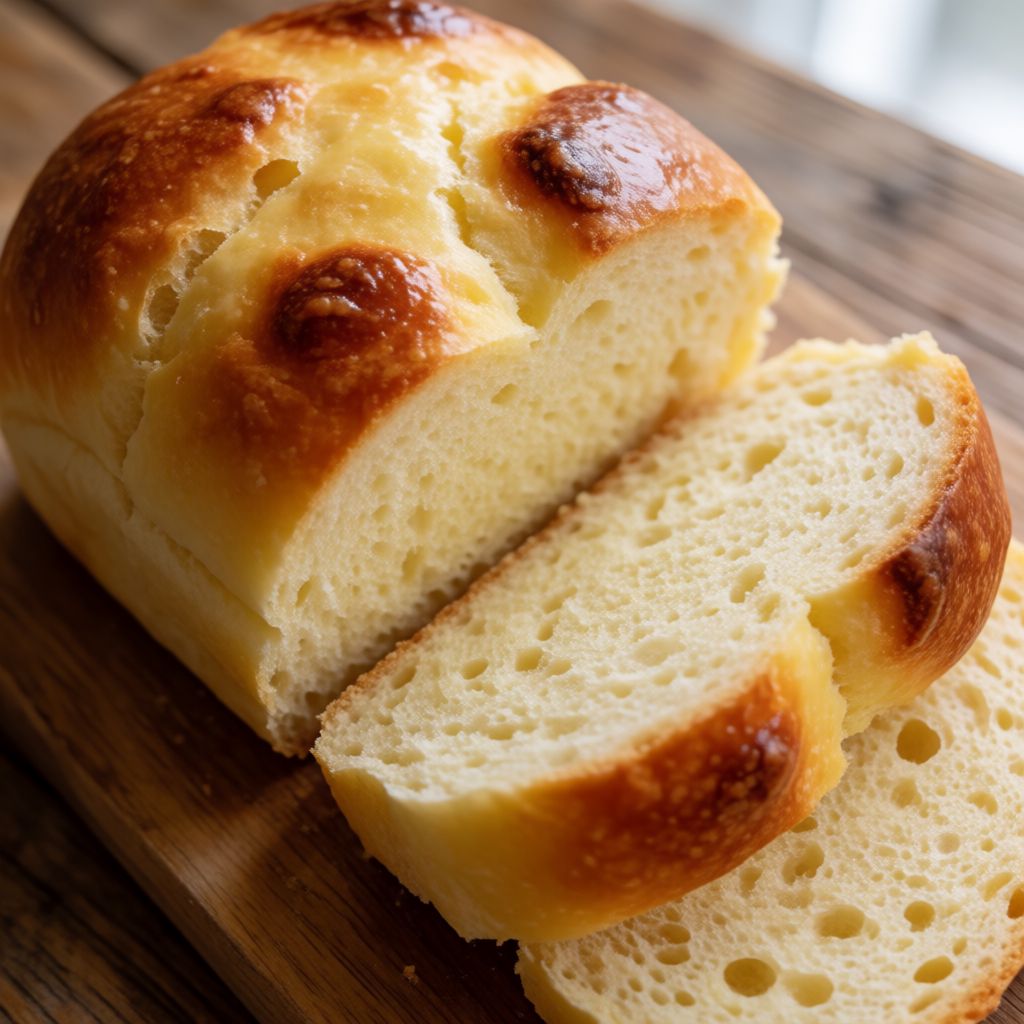
 AI photo
Cheese Bread
A pull-apart bread with layers of garlic butter and cheddar cheese.
Labels are worked out automatically from the ingredients and can be wrong. Check the packaging if it matters to you.
Ingredients
- 20 g Yeast
- 100 ml Milk at room temperature
- 200 ml Yogurt at room temperature
- 1 pcs Eggs
- 60 g Butter soft, at room temperature
- 1 tsp Salt
- 1 tbsp Honey
- 150 g Wholemeal Flour
- 350 g Plain Flour
- 150 g Mature Cheddar freshly grated
- 1 pcs Eggs beaten




Garlic Butter
- 50 g Butter
- 2 clove Garlic finely grated
- 2 tbsp Parsley finely chopped
- Salt
- Black Pepper freshly ground



Steps
Dissolve the yeast in the milk.
Add the yogurt, egg, honey, butter, salt and wholemeal flour and mix well.
Add the plain flour and mix or knead well, ideally with a mixer on medium speed, for 7-10 minutes.
Shape the dough into a round ball and place in a clean bowl greased with oil.
Cover with a clean towel and leave the dough to rise on the kitchen counter for 45 minutes.
Roll out the dough on a floured surface into a large square and cut into squares about 6x6 cm.
Brush each square with garlic butter and sprinkle with cheddar cheese.
Stack the squares layer upon layer so that cheddar cheese and garlic butter are between every layer, forming a tower of about 6-7 layers of dough.
Generously grease a loaf tin with butter and arrange the dough squares upright in the tin, picturing a tall tower of dough slices.
Cover with a clean towel and leave the bread to rise for about 45 minutes.
Gently brush with beaten egg and bake in a preheated fan oven at 175°C for 30-40 minutes.
Garlic butter: melt the butter in a small saucepan, remove from the heat and stir in the garlic, parsley, salt and freshly ground black pepper.
Let the butter cool to room temperature.
This isn't really a loaf. It's a stack of little envelopes, each one holding butter, garlic and cheese, stood up on their spines in a tin so that when you slice it, you get ribbons — bread, fat, cheese, bread, fat, cheese — running through the middle like the pages of a book somebody buttered before closing. The pull-apart effect everyone's after with this bread isn't a trick of folding dough in on itself like a croissant. It's simpler and cruder than that: you cut squares, you glue them in pairs with garlic butter and cheddar, you pile six or seven of those glued pairs on top of each other, and you tip the whole tower on its side into the tin. The oven does the rest — the butter between the layers never fully soaks in, it melts and the steam from it pushes the layers slightly apart as they bake, so what you get is bread that separates along the seams you built, not bread that happens to separate.
Yeast and yogurt together are doing two different jobs, and it's worth knowing which. The yeast is your riser — 20g is a generous amount, more than you'd use for a plain loaf, because this dough is heavy with butter, egg and yogurt, all of which slow fermentation down by coating the gluten and yeast cells in fat and acid. The yogurt isn't there to make the bread rise; it's there to make it tender and give it a faint tang, the way buttermilk does in soda bread. If you've no yogurt, soured milk or kefir does the same acidic-tenderising job — thin it slightly if it's very thick, you want it pourable.
The two flours are a compromise, and it's an honest one: wholemeal for a bit of structure and nutty flavour, plain for lightness, because an all-wholemeal dough here would be too heavy to lift into neat separate layers — it would bake dense and defeat the whole point of the tower. If you only have plain flour, use all plain; you'll lose a bit of character but not the mechanism. Don't go the other way and use all wholemeal — that's where people get a brick instead of bread.
Butter appears twice in this recipe doing two separate jobs, and that's deliberate, not a list that forgot to merge itself. The 60g soft butter goes into the dough itself, for softness and a moist crumb — soft meaning spreadable with a knife, not melted, because melted butter knocked back into a dough changes how the gluten develops and can leave greasy pockets. The 50g butter is for the garlic butter that goes between layers, and there it's melted on purpose, because you need it liquid enough to brush thinly onto flat squares of dough without tearing them.
Mature cheddar, not mild, and that's a real choice, not snobbery. Mild cheddar melts into something fairly neutral and slightly rubbery; mature cheddar has had time to break down its proteins and develop sharpness, so it melts looser and tastes of something even diluted by bread and butter around it. Any firm cheese with a long memory — an aged Gouda, a well-matured Comté — would do the same job. A fresh, mild cheese won't: it'll just go gluey.
The garlic in the butter is grated, not crushed or sliced, and that's not fussiness — grated garlic breaks the cell walls completely and releases its flavour instantly and evenly through warm butter, where sliced garlic would leave pockets of raw bite and crushed garlic sits somewhere in between. Parsley goes in once the butter's off the heat, because parsley cooked in hot fat turns bitter and dull — you want it stirred in while the butter's cooling, so it keeps its green brightness.
On the shaping itself: squares roughly 6x6cm is a guide for your hand, not a ruler to hold to the dough. What matters is that the squares are roughly even, so your tower sits flat in the tin rather than leaning. And greasing the tin generously with butter before you stand the squares up — that's not for ease of turning out, though it helps with that too. It's because the dough touching metal directly, with no fat between, will stick and tear when you try to free it, pulling the carefully built layers apart in the wrong place rather than along the seams you built.
175°C in a fan oven, for 30 to 40 minutes, is a range, and what you're actually watching for is a top that's turned deep gold rather than pale, and a loaf that sounds hollow — not wet — when you tap its base once it's out of the tin. If the top's browning too fast before the inside's set, that's your oven running hot, or the loaf sitting too close to the fan — loosely cover the top with foil rather than guessing at a lower number nobody tested for you.
Patience here isn't romantic, it's structural — both rises need to actually happen, not be rushed past because the recipe gives you a number. A dough that hasn't doubled twice won't separate into layers; it'll just be dense bread with cheese hidden inside, which is a different, lesser thing.