
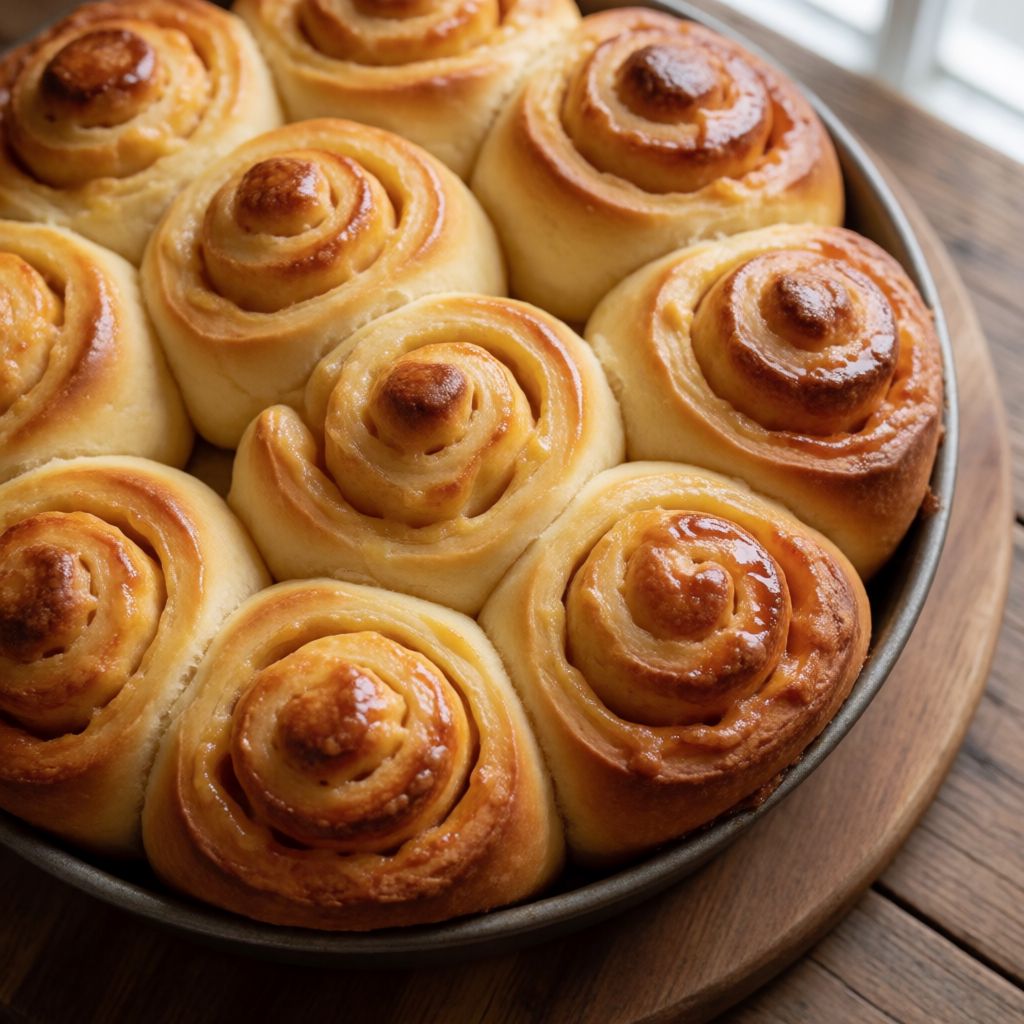
 AI photo
Cheese Swirl Rolls
Soft yeasted rolls filled with a garlicky cheddar and parsley swirl, baked until golden.
Labels are worked out automatically from the ingredients and can be wrong. Check the packaging if it matters to you.
Ingredients
- 25 g Yeast
- 100 ml Milk
- 100 ml Yogurt
- 1 tbsp Honey
- 1 pcs Eggs
- 100 g Wholemeal flour
- 275 g Plain flour
- 50 ml Olive oil
- 1 tsp Salt
- 1 clove Garlic crushed
- 150 g Mature cheddar freshly grated
- 100 ml Parsley finely chopped
- 1 pcs Egg beaten, for brushing
- 2 tbsp Olive oil







Steps
Crumble the yeast into a bowl with the milk and stir until dissolved. Add the yogurt, oil, honey, salt, egg and wholemeal flour, and mix well into a loose batter.
9 minGradually add the plain flour and knead the dough until smooth and soft.
Place the dough in a bowl, cover with a clean tea towel and leave to rise for 2 hours on the kitchen counter.
120 minRoll the dough out on a lightly floured surface into a large rectangle.
Mix the crushed garlic with the olive oil and brush this over the dough. Sprinkle with grated cheddar and parsley, then fold one half of the dough over the other. Cut into long strips and twist into swirls.
Place the swirls on a baking tray lined with parchment paper and leave to rise for 45 minutes on the kitchen counter, covered with a tea towel.
45 minBrush with egg and bake in a preheated fan oven at 175°C for about 18 minutes.
18 min
What was changed
Graham flour is hard to find in British shops, so Wholemeal flour is used instead.
These are yeasted dough strips, twisted rather than rolled into a tight spiral, so you get a bread with a cheesy, garlicky core running through loose coils instead of a neat snail-shell cinnamon-bun look. What decides whether they work isn't the garlic or the cheddar — it's the yeast's two separate rises, and whether you actually let them finish rather than rushing to the oven because the dough "looks big enough".
The dough itself is a hybrid: half wholemeal, half plain, softened with yogurt and a little honey. Yogurt's acidity does something milk alone can't — it relaxes the gluten strands so the dough stays extensible instead of springing back, which matters here because you're about to roll it thin and then fold and cut it. A dough that fights you at the rolling stage will fight you again when you twist it, and tear.
Some say you need a stand mixer for a dough this sticky. No — you need patient hands and a surface you're not afraid to flour twice. The dough is loose on purpose at the batter stage; that's not a mistake to fix with extra flour, it's step one of gluten development, and adding flour too early just makes a denser bun.
The filling is simple because it has one job: stay put when you twist, and not leak oil everywhere when it bakes. Garlic cooked only in raw olive oil, brushed thin, means it mellows in the oven rather than scorching — garlic burnt before the dough has coloured is bitter, and you can't fix bitter after the fact.
Yeast — 25 g is a lot by UK packet standards (your usual sachet is 7 g dried), so if you're buying fresh yeast in blocks from a bakery counter or using fast-action dried, scale down: roughly 7–9 g dried yeast does the same job as 25 g fresh. What yeast actually does here is feed on the honey and the sugars in the flour, throwing off carbon dioxide that the gluten net traps as bubbles. No yeast activity, no rise, no swirl — just a flat cheesy flatbread, which isn't the dish.
Milk and yogurt together give you a dough that's soft without being wet. Milk's proteins tenderise the crumb (this is why milk breads feel softer than water breads); yogurt's acid loosens gluten bonds so the dough stretches rather than snapping back. If you've only got milk, add a spoon of lemon juice or a splash of buttermilk to it — you're mimicking the acidity, not the dairy.
Honey isn't there for sweetness you'll taste. It's yeast food, and it also helps the crust brown by caramelising at the surface once it's in the oven — this is why the egg wash goes over the top too, for colour you can see rather than guess at. Any thick sugar syrup or even a teaspoon of sugar works if honey isn't in the cupboard; the dish doesn't depend on honey specifically, only on feeding the yeast something simple.
Wholemeal flour alongside plain flour is a texture decision, not a health one dressed up as virtue. Wholemeal brings bran, which cuts the gluten strands short and gives the crumb some backbone and flavour; all wholemeal would make the dough too heavy to roll thin without tearing, all plain would make it fluffy but flavourless. 100 g to 275 g is the balance point — shift it and you shift the crumb, nothing more mystical than that.
Mature cheddar, grated fresh, matters because pre-grated bagged cheese is often dusted with starch to stop it clumping — that starch stops it melting properly, so you get drier, less cohesive filling. Mature cheddar specifically because its sharpness survives the oven's heat; a mild cheese just turns to bland melted fat once baked. Any firm, well-flavoured melting cheese substitutes fine — a mature Gouda, a strong Lancashire — the criterion is sharp flavour and good melt, not the name cheddar.
Parsley, finely chopped, is there for a green note that cuts the fat of the cheese and oil — not for decoration. Use flat-leaf if that's what's in the fridge; curly works too, it's just coarser, so chop it finer to match.
The two rises are where people cut corners, and it's the single biggest reason swirls come out dense. The first two hours lets the yeast build real structure before you handle the dough roughly — rolling, folding, cutting, twisting. The second 45 minutes, after all that handling has knocked some gas out, lets the yeast recover and reinflate before the oven sets the structure for good. Skip or shorten the second rise because the first looked like enough, and you bake in the deflation — tight, chewy swirls instead of light ones. Patience here isn't optional seasoning; it's the actual mechanism.
175°C in a fan oven, for about 18 minutes, is hot enough to set the crust and melt the cheese before the dough dries out — a domestic fan oven runs even and brisk, so trust the visual cue over the clock: egg wash gone deep gold, cheese at the seams bubbling, not weeping orange grease everywhere. If your oven runs hot in spots (most do, nearest the fan or the back wall), turn the tray once rather than opening the door repeatedly — every open door drops the temperature and costs you oven-spring, the last bit of rise that happens in the first few minutes of heat.