
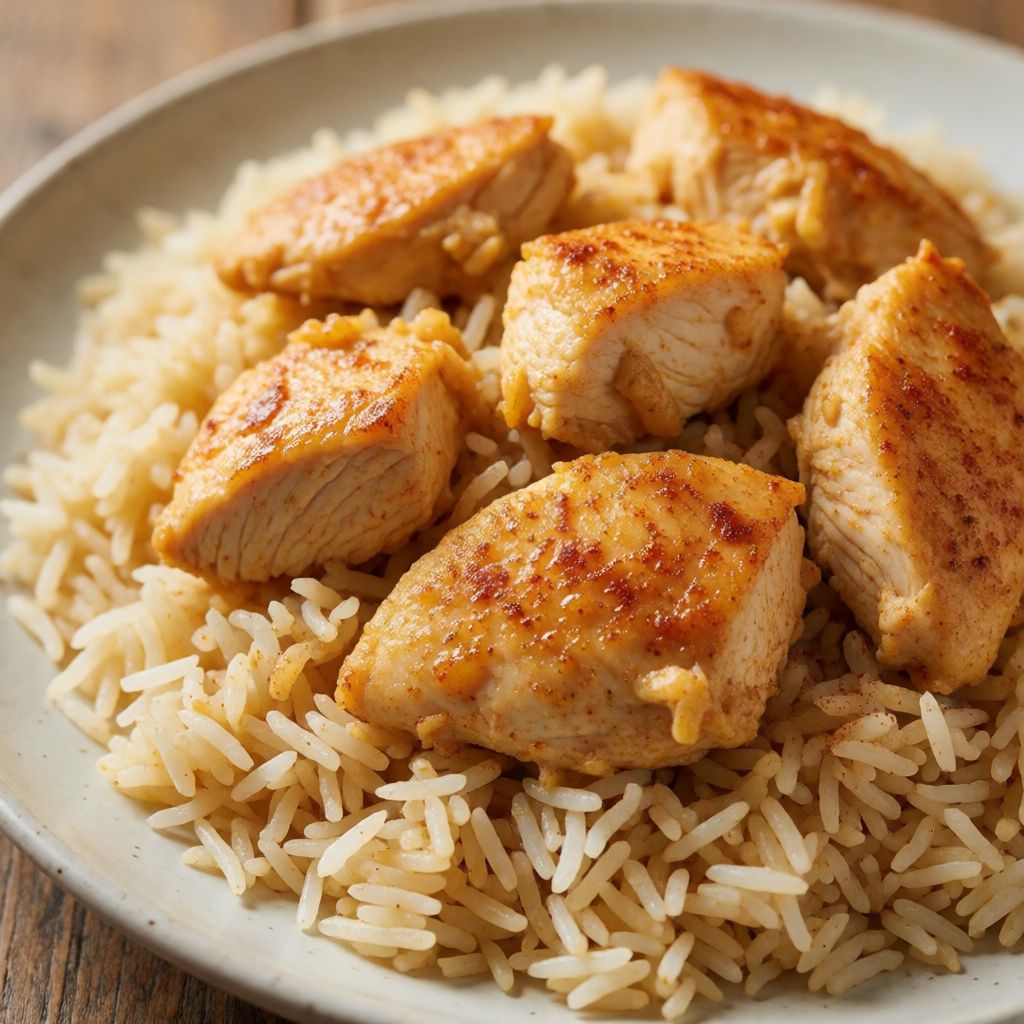
 AI photo
One-Pot Chicken and Rice
A warming one-pot dish of spiced chicken and basmati rice with saffron, onion and garlic, finished with lemon and pine nuts.
Labels are worked out automatically from the ingredients and can be wrong. Check the packaging if it matters to you.
Ingredients
- 1 tsp Cumin
- 0.5 tsp Ground coriander
- 1 tsp Paprika sweet or smoked
- 4 pcs Chicken breast
- 20 g Plain flour
- 300 ml Basmati rice
- 1 pcs Onion finely chopped
- 3 clove Garlic finely chopped
- 1 pinch Saffron
- 600 ml Chicken stock or vegetable stock
- 1 pcs Lemon juice and zest
- 1 tsp Olive oil for frying
- 1 pinch Salt
- 1 pinch Black pepper
- 2 tbsp Pine nuts toasted
- 1 bunch Rocket
















Steps
Toast the cumin, coriander and paprika in a flameproof casserole dish over medium heat until fragrant.
3 minTip the spices onto a plate and set aside.
Coat the chicken breasts in the mixture of flour, salt and pepper.
2 minIn the same casserole dish used for the spices, add the oil and butter.
Brown the chicken on all sides until golden, then set aside on a plate.
Rinse the rice in a sieve until the water runs clear, then add it along with the oil, toasted spices, onion, garlic, saffron and chicken stock to the casserole dish, stir well, cover and simmer for 5 minutes.
3 minAdd the chicken, place the uncovered casserole dish in an oven preheated to 200°C (fan) and bake for 25 minutes, until the chicken is cooked through and the rice is tender.
25 minSeason with lemon juice and finely grated zest.
2 minServe with rocket and pine nuts.
This is a pilaf wearing an English coat — chicken breast instead of lamb, a casserole dish instead of a kazan, an oven instead of embers. What decides whether it works is the order of fat and heat: spices bloom in dry heat first, then the chicken gets a crust in that same fat, and only then does the rice go in to drink everything the pan has given up so far. Skip that order and you get boiled rice with spice dust floating in it, not a dish that tastes of itself.
Toasting cumin, coriander and paprika dry, before anything wet touches the pan, is not a flourish — it's physics. Spice flavour lives in oils that need heat to release, and those oils scorch fast once there's liquid or fat sitting on top of them muting the direct contact. Three minutes in a dry hot pan, nose down, watching for the smell to turn from raw to warm — that's the whole test. Go by smell, not a clock: the moment it smells like itself is the moment to pull it off, because thirty seconds later it smells like ash.
The rice: basmati is chosen for its long dry grain and low starch surface, which means it stays separate instead of clumping into a risotto texture. Rinsing until the water runs clear isn't fussiness — it washes off the loose starch dust coating every grain, which is exactly what would otherwise gum together under heat. Some cooks skip the rinse thinking "it's just rice, it'll be fine." It's often fine, but it's also often why one-pot rice ends up with a pasty bottom layer. If you've no basmati, any long-grain rice works on the same logic — long grain, low stickiness; short-grain or risotto rice will fight you here, it's built for the opposite job.
Saffron is there for colour and a faint honeyed bitterness, not for an overpowering taste — a pinch genuinely is enough, because its flavour compounds are potent and water-soluble; too much turns medicinal. If you don't have it, don't chase it with turmeric pretending it's the same thing — turmeric gives colour with no aroma, which is honestly fine if colour is all you're after, just be honest that it's a stand-in, not a replacement.
The flour-and-seasoning dredge on the chicken does two things: it gives the browning step something to grip and caramelise beyond the meat's own surface, and it thickens, very slightly, whatever liquid clings to the chicken once it joins the rice. Any plain flour works; it's not doing anything delicate enough to need a particular kind.
Lemon juice and zest go in at the end, not before, because citric acid and heat don't get on — cook acid long enough and it dulls, loses its lift, sometimes turns bitter at the pith if the zest's been in the heat too. Added last, it wakes the dish back up after twenty-five minutes of its flavours settling into each other.
Pine nuts toasted, and rocket raw on top, exist for the same reason a squeeze of lemon does — texture and bitterness against a soft, warm dish. Toasting pine nuts isn't about cooking them through, they're small enough to be "done" raw; it's about the same oil-release logic as the spices — heat coaxes out their own fat's aroma. If pine nuts aren't to hand or budget, flaked almonds toasted the same way do the identical job: crunch plus roasted nut smell, nothing precious about the pine specifically.
On a British hob, be honest about one thing: a casserole dish that's genuinely flameproof and also oven-safe is doing the heavy lifting here, standing in for the kazan this style of cooking actually comes from, where the same vessel goes straight from open flame to a bed of coals without ever being lifted off and swapped. If your casserole dish doesn't fit your oven, or doesn't go from hob to oven safely, this is one place where you can't improvise around it — check the handle and the lid are rated for 200°C before you start, not halfway through.
Patience shows up twice, quietly: once during the five-minute part-simmer before the chicken goes back in, which gives the rice a head start on absorbing stock before the oven's dry heat starts pulling moisture off the top; and once at the end, letting it sit a beat before serving so the grains finish settling into their own steam rather than being disturbed mid-cook. It's a weeknight dish built to look unhurried without actually taking long — twenty minutes cook time, most of it the oven doing the work unsupervised, not you standing over it.