
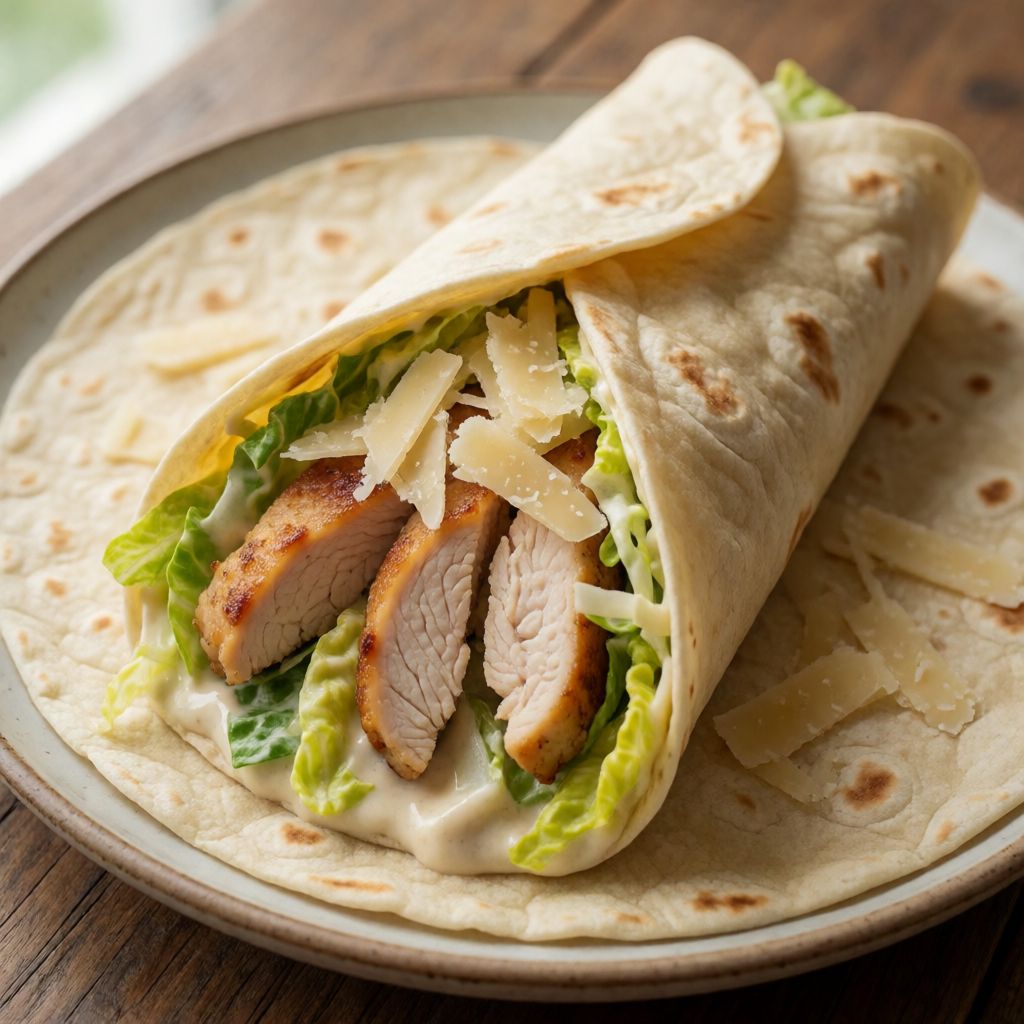
 AI photo
Caesar Chicken Wraps
Soft tortillas filled with crisp romaine, juicy roast chicken, croutons and a homemade Caesar dressing.
Labels are worked out automatically from the ingredients and can be wrong. Check the packaging if it matters to you.
Ingredients
- 400 g Chicken breast
- 25 g Plain flour
- 2 pcs Romaine lettuce torn into large pieces
- 50 g Parmesan
- 8 pcs Tortilla
- 2 tbsp Butter for frying
- 2 tbsp Olive oil for frying
- Salt
- Black pepper freshly ground
- 2 pcs Bread
- 15 g Butter
- 2 pcs Anchovies very finely chopped
- 1 tsp Worcestershire sauce
- 75 g Parmesan
- 1 clove Garlic crushed
- 1 tsp Lemon juice
- 100 ml Mayonnaise
- 100 ml Crème fraîche













Steps
Coat the chicken fillet in flour, season with salt and pepper, and place it in a buttered ovenproof dish.
5 minRoast the chicken in an oven preheated to 180°C for 15-20 minutes until fully cooked.
18 minButter the bread slices on both sides and cut into cubes.
3 minDry out the croutons in the oven on a parchment-lined baking tray for 5 minutes.
5 minMash the anchovies, Worcestershire sauce, Parmesan, garlic and lemon juice into a smooth paste.
2 minMix the anchovy paste with the mayonnaise and crème fraîche, and season with salt and pepper to taste.
1 minSlice the roasted chicken.
2 minWarm the tortillas in a pan until soft and warm.
2 minFill the tortillas with lettuce, juicy chicken, croutons, dressing and a little extra grated Parmesan.
2 min
A Caesar salad that got tired of being a side dish and decided to live inside a tortilla. Same logic, same dressing, just folded instead of forked. The whole thing stands or falls on three things: a dressing that actually tastes of anchovy and garlic and not just mayonnaise, chicken that's been roasted gently enough to stay wet, and a tortilla that's warm and pliable rather than a cold stiff disc that cracks when you fold it.
The croutons do more work than people give them credit for. A wrap without crunch is just a damp parcel — the lettuce goes limp against the warm chicken within minutes, and if the only texture left is soft-on-soft, you've made a very expensive sandwich filling, not a Caesar. The crouton is the bit of the original salad everyone forgets is structural, not decorative.
Some say Caesar dressing needs a raw egg yolk whisked at the table for the "proper" emulsion. No — that's the restaurant theatre version, invented for the tableside show, not because the flavour demands it. Mayonnaise is already an egg-and-oil emulsion that's done its job; here it's just the base you season. What actually makes it taste like Caesar and not like bought coleslaw dressing is the anchovy mashed to a paste, the Worcestershire, the garlic, the lemon — four small sharp things doing the work one soft one (the yolk) gets unfair credit for.
Chicken breast: lean, which is exactly its problem. It has almost no fat to protect it, so it goes from done to dry in the gap of a few minutes you weren't watching. Flouring it before it goes in the dish isn't for crust — there's no pan contact to crisp it — it's a thin barrier that slows moisture loss while it roasts, the same trick as dredging meat for a stew. You're not after a stopwatch reading of 15 or 20 minutes; you're after the fillet feeling firm but still giving slightly when you press it, not rigid. Slice it only once it's rested a few minutes off the heat — cut it hot and the juice runs onto the board instead of staying in the meat.
Anchovies: this is the ingredient people flinch at and then can't name why the dressing tastes flat without it. Mashed fine and melted into fat or dressing, they don't taste of fish — they taste of savoury depth, the same job fish sauce does in a stir-fry. If you genuinely can't get them, a small spoon of fish sauce or a splash more Worcestershire gets you partway, but it's a patch, not a swap — the dressing will be milder and you'll want to push the garlic and lemon a touch harder to compensate.
Parmesan: buy the block, grate it yourself. Pre-grated parmesan is often cut with anti-caking starch and has usually sat around losing its sharp, nutty edge — in a dressing where it's one of only five or six flavours carrying the whole thing, that difference is not subtle. Any hard, well-aged grating cheese with a similar salt-and-savour profile will do if parmesan isn't to hand — Grana Padano, pecorino if you don't mind it saltier.
Butter for the chicken dish and oil for the croutons are doing different jobs, so don't swap one for the other out of habit. Butter under the chicken adds richness and helps it not stick to the dish at these temperatures; for the croutons you want fat that coats the bread and lets it dry out evenly in the oven rather than fry — any flavourless oil or soft butter works, the test is simply that it shouldn't fight with the parmesan and anchovy flavours already doing the heavy lifting.
Crème fraîche alongside the mayonnaise isn't decoration — it loosens the dressing and adds a clean sourness that plain mayonnaise alone doesn't have, stopping the whole thing from tasting heavy and one-note. Soured cream or Greek yoghurt will do roughly the same job if that's what's in the fridge; yoghurt will taste a little sharper and thinner, so don't be surprised if you want it stiffer with a touch more mayonnaise.
Warming the tortillas matters more than it looks on paper. A cold tortilla straight from the packet cracks the moment you try to fold it round a filling — not because it's stale, but because the starches in it are stiff at room temperature and need a little heat to go flexible again. A few seconds a side in a dry pan, just until it softens and you see the faintest blister, is the whole fix. No special equipment, no steaming — this is a flat-in-London kitchen job, done in the same pan you roasted nothing in, because the chicken's in the oven and the hob's free.
This feeds four people generously as a lunch, less if you're serving it after a proper Sunday roast and everyone's still half full from that — in which case cut it down to a starter-sized portion rather than skipping the croutons or the dressing to save on calories. Patience here isn't long, but it's specific: let the chicken rest before you slice it, and don't fill the wraps until everything else is actually ready, because a wrap assembled and left standing goes soggy in the time it takes to call everyone to the table.