
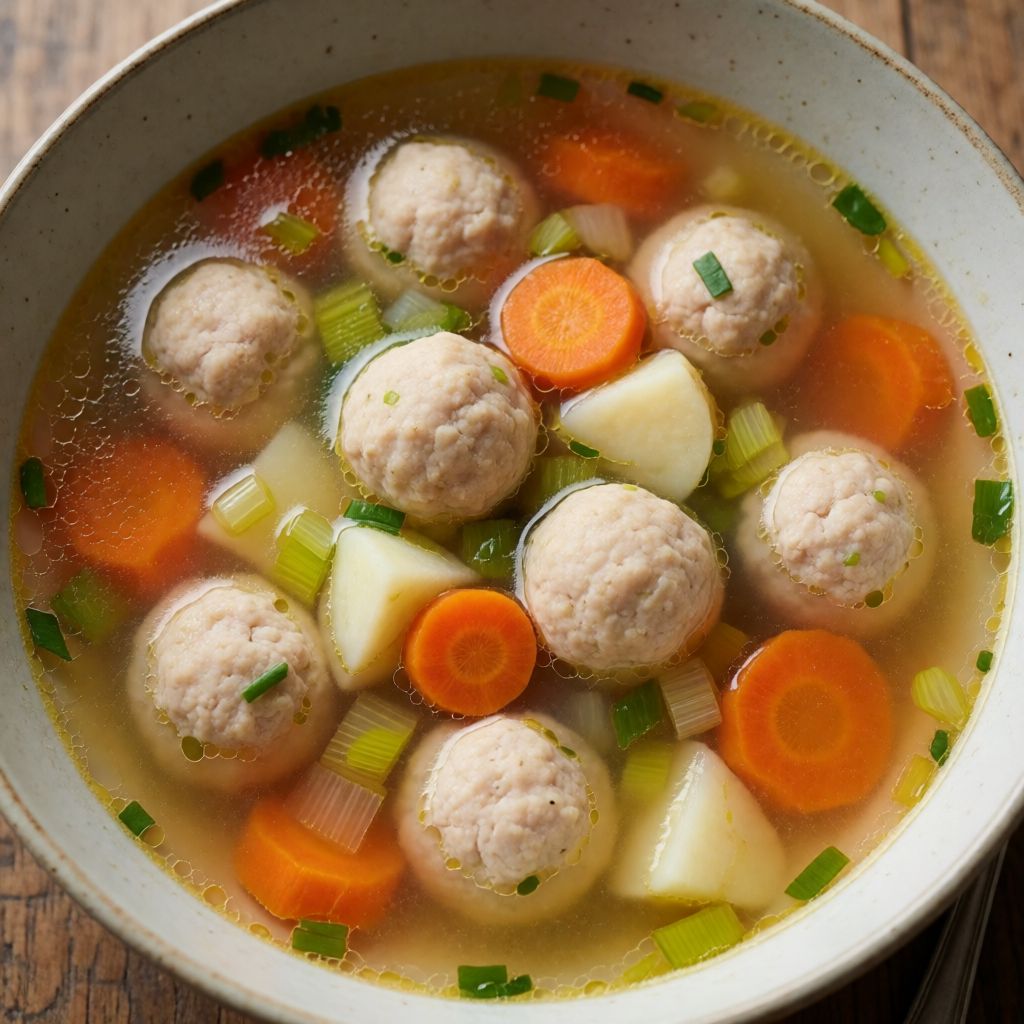
 AI photo
Chicken Soup with Meatballs
A hearty broth of slow-simmered chicken and root vegetables, finished with tender pork meatballs.
Labels are worked out automatically from the ingredients and can be wrong. Check the packaging if it matters to you.
Ingredients
- 1 pcs Boiling chicken
- 3 pcs Carrot cut into large cubes
- 3 pcs Leek sliced into rings
- 1 pcs Parsnip cut into large cubes
- 3 pcs Celery stalks, diced
- 3 clove Garlic finely chopped
- 2 pcs Onion diced
- 1 bunch Parsley
- 3 pcs Bay leaf
- 2 pcs Thyme sprigs, fresh
- Salt
- Black pepper freshly ground
- 1 l Stock
- 3 pcs Carrot cut into small cubes
- 1 pcs Leek sliced into thin rings
- 1 bunch Parsley













for the meatballs
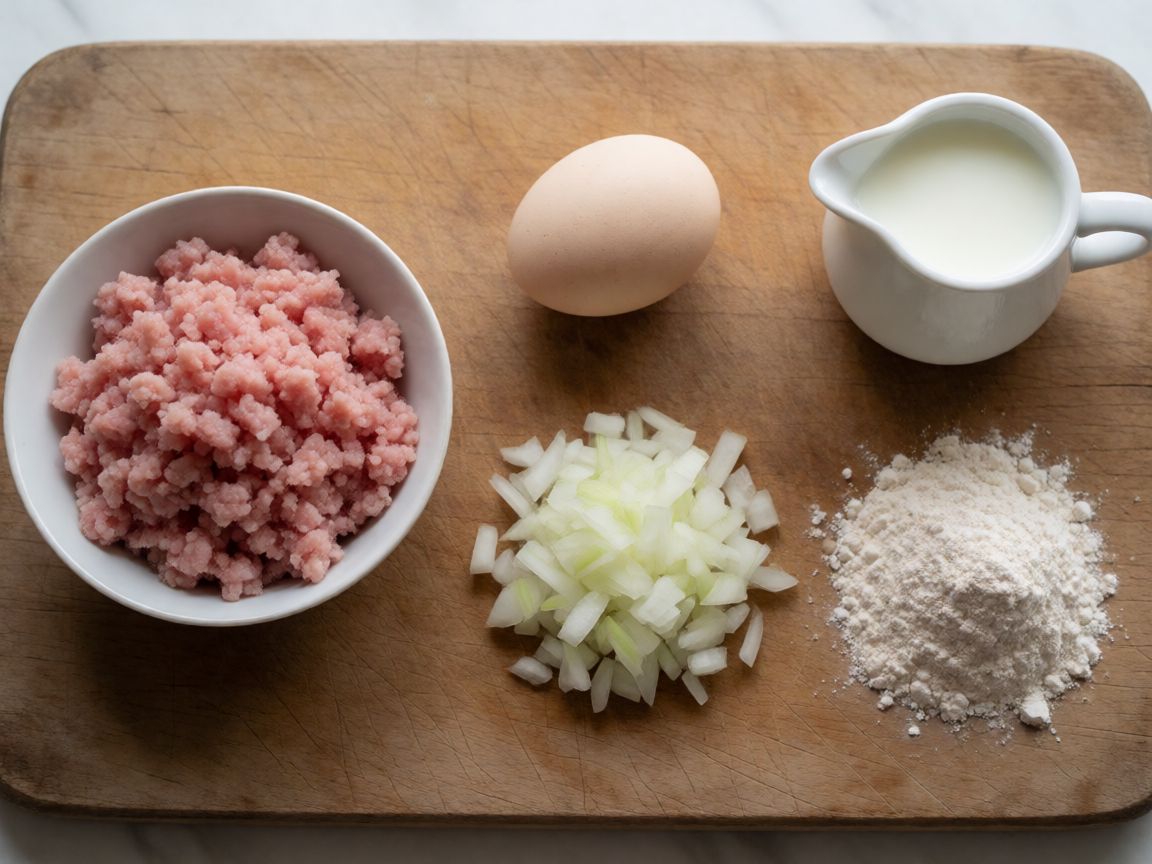
- 400 g Minced pork
- 1 pcs Egg
- 1 pcs Onion finely chopped
- 100 ml Wholemeal flour
- 100 ml Milk
- Salt
- Black pepper freshly ground




Steps
Put the chicken into a large pot and cover with water so it is just submerged. Bring to the boil and skim off the foam that rises to the surface. Keep going until no more foam forms and the water runs clear.
Spend a few minutes on this, add salt and skim off any remaining foam and impurities.
Add all the vegetables together with the other soup ingredients. Make sure the water covers everything, topping up if needed. Leave the chicken and vegetables to simmer gently, covered, for 3–4 hours, until the chicken is completely tender.
210 minStrain the soup through a sieve into a bowl, skimming off the fat and impurities.
5 minFor the meatballs, mix all the ingredients together in a large bowl and beat with a hand mixer.
Shape small meatballs with a teaspoon and cook them for 5-7 minutes in a pot of diluted vegetable stock.
6 minTransfer the soup to a clean pot together with the meatballs, carrot and leek. Bring to the boil - the soup is ready to serve.
5 min
This is a two-part soup wearing one bowl: a long, patient chicken stock on one side, and small pork meatballs cooked separately on the other, married together only at the very end. That separation is the whole trick, and it's where most home versions go wrong — people throw raw meatballs straight into the simmering stock and wonder why it turns cloudy and tastes faintly of liver.
What decides whether this works is foam and time, in that order. The first ten minutes, when the chicken goes into cold-to-boiling water, are not a formality — they're the moment when blood proteins and impurities coagulate and rise as grey scum. Skim it off properly and you get a clear, clean-tasting broth. Skip it, and that scum breaks up under a rolling boil, clouds the liquid, and leaves a slightly metallic, "boiled meat" taste that no amount of salt fixes afterward. So: gentle heat, patient skimming, and only once the water runs clear do you add anything else.
After that, it's a long, unhurried simmer — not a boil. A boiling chicken (an older, tougher bird, the kind bred for flavour rather than speed) needs three to four hours at a bare tremble to give up its collagen and come apart tender; a rolling boil just toughens the muscle fibre and makes the broth murky again, so keep it at the stage where the surface barely shivers, not where bubbles break through. Time here is a floor, not a target — you know it's done when the chicken meat lets go of the bone without a fight, not when the clock says so.
The vegetables in the stock — carrot, leek, parsnip, celery, onion, garlic, bay, thyme, parsley — aren't there to be eaten later; they're flavour donors, cut large so they release slowly over hours rather than disintegrating into mush and clouding the pot. Once they've given what they have, you strain them out entirely. That's not wastefulness, it's just physics: a vegetable boiled for three hours has nothing left to offer your mouth, only your broth.
The meatballs are a different animal and need a different fire. Minced pork, egg, onion, wholemeal flour and milk bound together is a panade — the flour-and-milk part is what keeps the meatballs soft instead of dense and rubbery, because it lets the starch swell and hold moisture that would otherwise cook straight out of the meat. If you're out of wholemeal flour, any flour with enough gluten to bind works, though wholemeal gives a slightly heartier bite that suits this rustic style of soup. Cooking the meatballs in a separate pot of diluted stock, not in the main broth, is deliberate: raw pork fat and blood released into a hot liquid will cloud it instantly, undoing all that careful skimming from the start. Poach them gently elsewhere — again, barely a simmer, not a boil, or they'll split and shed their fat into the water — until they hold together and feel firm when pressed, not springy and raw-soft in the middle.
The second batch of fresh carrot and leek, cut small this time, is added only at the final assembly. This is the part of the dish that gives texture rather than depth: these vegetables stay in the finished soup, so they're cut fine, cooked briefly, and should still have a little resistance — bend, not snap — rather than being cooked to the collapse of the first batch. Some say the vegetables should all go in together for "one honest pot" — no, because that conflates two jobs: flavour extraction wants hours, texture wants minutes, and asking one vegetable to do both means it either undercooks for flavour or overcooks for bite.
A boiling chicken is specifically an older bird — more flavour, more connective tissue, needs the long cook to become tender — and is worth tracking down rather than substituting a young roasting chicken, which will fall apart stringy and bland long before the broth has built any real depth; if you can't find one, a mix of chicken thighs and a couple of wings will get you partway there, since the skin and bone give you the gelatine a boneless breast never will.
In a normal British kitchen without a kazan, this just means a wide, heavy pot with a lid you trust — if you don't have one that seals well, a plate set over the pot does nearly as good a job of holding steam in during that long afternoon simmer. The stove won't give you the even, retained heat of a bed of coals, so expect to nudge the heat down once or twice over those hours rather than setting it and walking away for good.
This recipe assumes you have an afternoon, not an hour. The long simmer, the straining, the separate meatball pot — none of it is difficult, but all of it wants you nearby, half-attentive, the way you'd potter around on a Sunday rather than rushing a weeknight dinner. Four hours of mostly-waiting for four bowls of soup is a fair trade if you're not in a hurry; it is a poor one if you are, and there's no shortcut that doesn't cost you the clarity of the broth.