
 AI photo
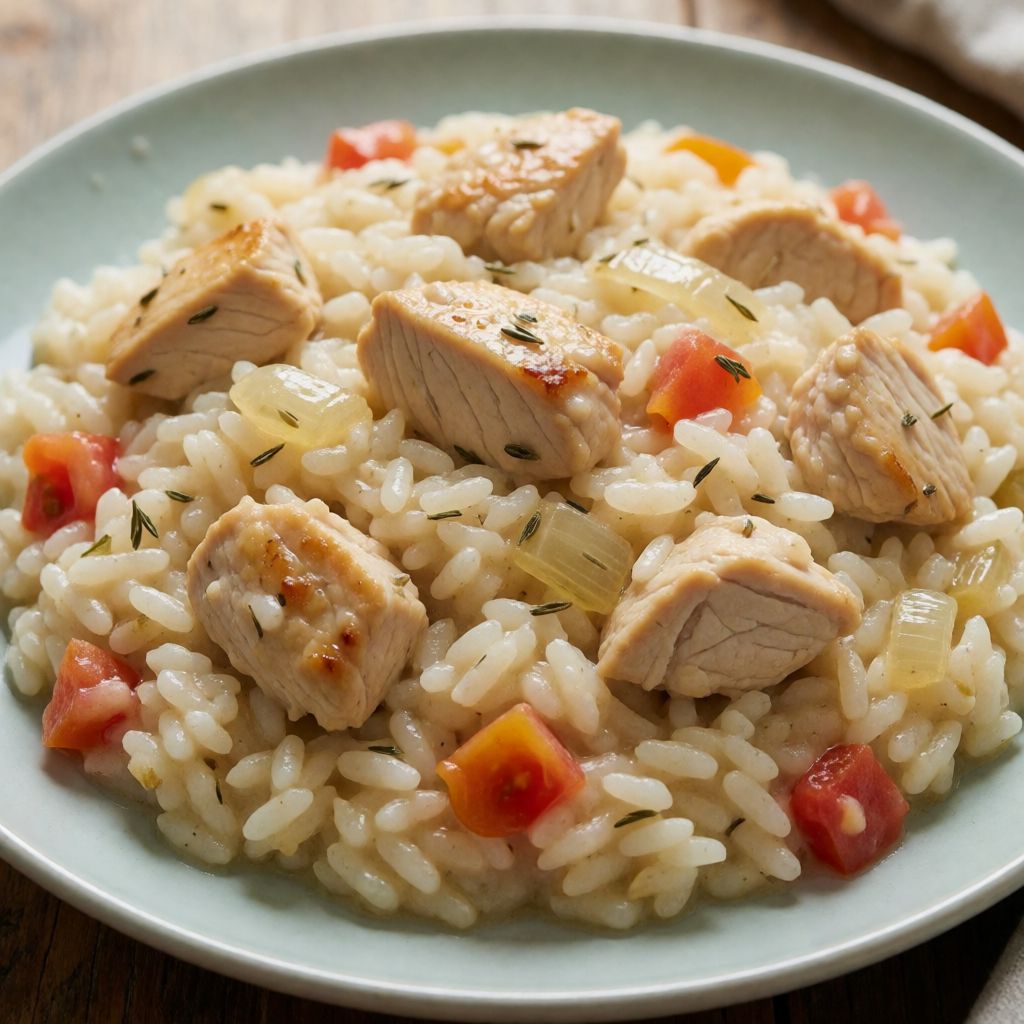
Chicken Risotto
A creamy risotto topped with roasted chicken breast and cherry tomatoes, finished with fresh thyme and parmesan.
Labels are worked out automatically from the ingredients and can be wrong. Check the packaging if it matters to you.
Ingredients
- 500 g Chicken breast
- 1 tsp Dried thyme
- 300 g Tomato halved
- Salt
- Black pepper freshly ground
- 1 pcs Onion finely chopped
- 1 clove Garlic finely chopped
- 400 g Risotto rice
- 100 ml White wine
- 500 ml Stock a little more if needed
- 500 ml Stock
- 50 g Parmesan freshly grated
- 2 tbsp Olive oil
- 1 pinch Thyme fresh










Steps
Fry the onion and garlic in a saucepan with the oil until the onion is soft.
Add the rice and stir well over high heat for half a minute.
1 minPour in the white wine and let it evaporate.
Add the vegetable stock and chicken stock, then lower the heat to a gentle simmer.
Cover the pan and simmer for about 30 minutes, or until the rice is cooked.
30 minSprinkle the chicken breasts with thyme, salt and pepper, and place in an ovenproof dish with the cherry tomatoes.
Roast in an oven preheated to 225°C for about 20-25 minutes.
23 minStir the parmesan and fresh thyme into the risotto, and season with salt and pepper to taste.
Slice the chicken breast and serve over the risotto with tomatoes and parmesan.
This is a roast dinner and a risotto pretending to be two different dishes, cooked at the same time so nobody waits. The chicken goes into a hot oven on its own schedule, the rice simmers on the hob on its own, and they meet only on the plate. What decides whether it works isn't skill, it's timing the two clocks so both finish within a few minutes of each other — start the rice first, it's the slower of the two once it gets going.
The rice itself is the real test. Some say risotto means standing over the pan stirring for half an hour without a break — no, because what rice needs is contact with liquid and a steady gentle heat, not your constant attention. Covering the pan, as this recipe does, is a shortcut that works in a domestic kitchen precisely because you don't have a kazan-wide pan losing heat and moisture to the air; a lid traps the steam that would otherwise escape and do half the cooking for you. You still have to look in now and then.
Doneness for the rice is not a timer going off. It's a grain that gives when you press it between tongue and tooth, no raw chalky core, but not collapsed into porridge either. The stock in the recipe is a lower bound — "about 30 minutes" — because rice absorbs liquid at a rate that depends on your heat, your pan, even how old the rice is. If it's dry and still hard, that's not failure, that's just more hot stock, a splash at a time.
Chicken breast is lean, which means it has almost no fat to protect it from drying out — that's the whole reason it gets salted, peppered and roasted with tomatoes rather than fried hard and fast. The tomatoes aren't decoration: as they roast, they collapse and release juice that bastes the chicken a little and gives you something saucy to spoon over at the end instead of a dry plate. If you can't get cherry tomatoes, any tomato that holds its shape when halved and roasted will do; the soft, watery supermarket ones just turn to mush and give up their juice too early.
Risotto rice — arborio, carnaroli, that family — is chosen for one reason: it's starchy on the outside and firmer at the core than ordinary long-grain rice. That outer starch is what thickens the stock into something creamy as it cooks; long-grain rice won't do this, it just goes soft all the way through and leaves you with a watery soup, not a risotto. If risotto rice genuinely isn't to hand, a short-grain pudding rice is closer in behaviour than basmati, but don't expect the same cling.
The onion and garlic frying in oil first is not about flavour alone — it's softening the onion's cell walls with gentle heat before the rice goes anywhere near the pan, because onion thrown in raw with hot rice burns at the edges before it's cooked through. "Soft" here means translucent and yielding, not browned; browning at this stage means you've gone too hot too early and you'll taste bitterness later, not sweetness.
The wine, poured in and left to evaporate, does a specific job: its acidity cuts through the starchiness and its alcohol carries flavour the stock alone can't. Letting it evaporate rather than leaving it liquid matters, because unburned-off alcohol tastes sharp and raw in the finished dish — you're not getting it drunk, you're just cooking off the harshness. If you don't drink wine or don't have any, a squeeze of lemon added near the end does a similar acidic job, though it won't deepen the dish the way wine's sugars do.
Two stocks, vegetable and chicken, aren't a mistake in the ingredients list — using both gives you a rounder flavour than either alone, chicken stock skewing rich, vegetable stock keeping it lighter. If you've only got one kind in the cupboard, use double of that one; the dish won't suffer badly for it.
The olive oil is just a base fat with a point: anything with no strong smell of its own works — a neutral vegetable oil, a mild groundnut oil — olive oil is just common, inexpensive and does the job without leaving its own strong perfume on top of garlic and onion. Save a fruitier, stronger olive oil for drizzling at the table if you want more character, not for the frying itself.
Parmesan at the end, stirred in off the heat or near it, firms the sauce that the rice's starch has already started and brings salt. Buy a block and grate it yourself if you can — the pre-grated bags dry out and clump, and melt unevenly, leaving little gritty threads instead of folding smoothly into the rice. Any hard, aged grating cheese with a similar sharp, salty character can stand in if parmesan's dear that week; pecorino is the obvious one, just saltier, so taste before you add more.
Fresh thyme at the very end against dried thyme earlier in the chicken is not fussiness — dried thyme survives heat and slow cooking, releasing its flavour gradually in the oven, while fresh thyme added last keeps a brighter, grassier note that would simply burn off and vanish if it went in with the chicken from the start. If you've only dried, use a smaller pinch at the end; it's more concentrated and will overpower if you treat it like the fresh.
Patience is the ingredient nobody lists, but it's the one risotto actually needs: rushing the stock in all at once instead of letting the rice drink gradually gives you grains cooked unevenly on the outside and raw in the middle, because the rice never gets the slow, steady absorption that breaks its starch down properly. Ten minutes more on the hob costs you nothing. A gluey, undercooked risotto costs you the dish.