
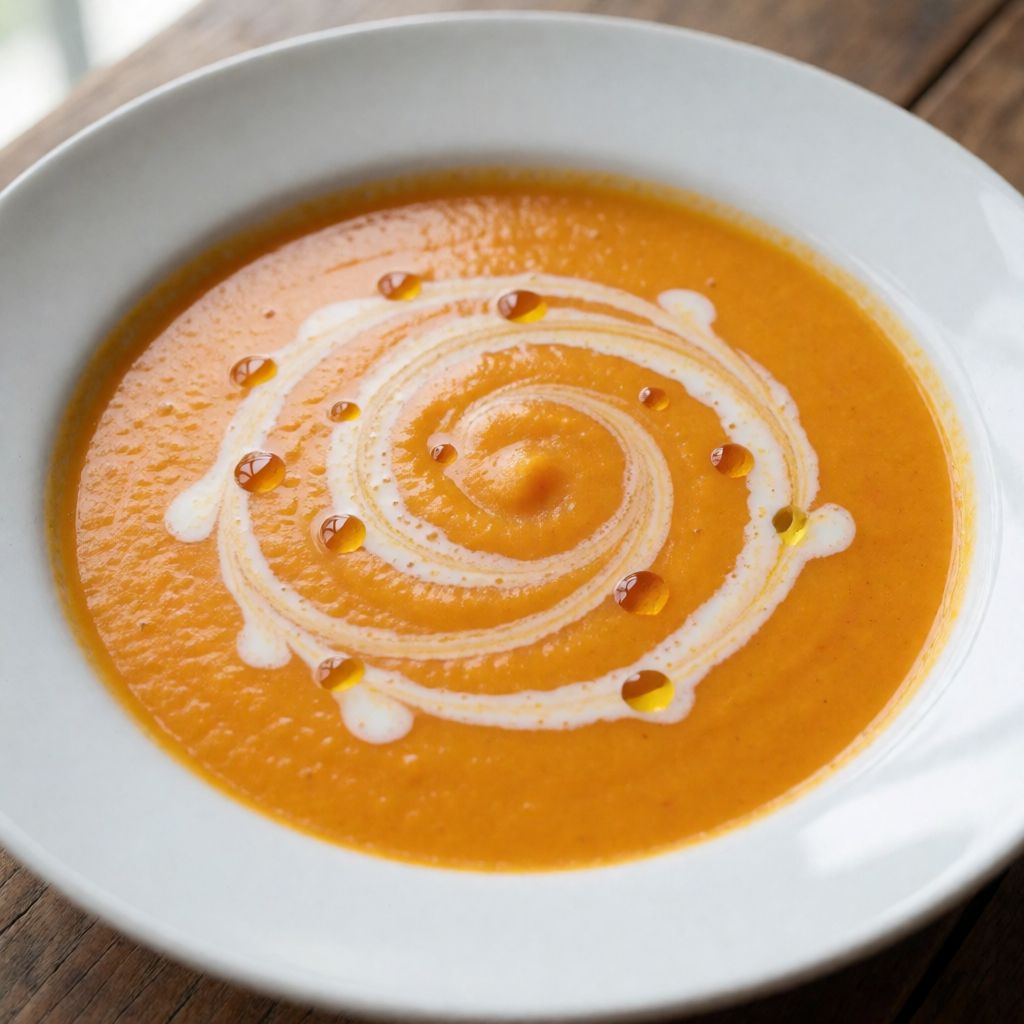
 AI photo
Chilled Carrot Soup with Coconut Milk and Lime
A cooling carrot soup brightened with coconut milk and lime, finished with basil oil and crisp toast.
Labels are worked out automatically from the ingredients and can be wrong. Check the packaging if it matters to you.
Ingredients
- 1 pcs Onion finely chopped
- 2 clove Garlic finely chopped
- 1 pcs Lemongrass stalk, split
- 1 tbsp Ginger finely grated
- 750 g Carrot diced
- 1 pcs Bell Pepper diced
- 800 ml Stock
- 200 ml Coconut Milk
- 1 tsp Sugar
- 2 pcs Lime organic, juice and zest
- Salt to taste
- Black Pepper to taste
- 1 bunch Basil
- 50 ml Olive Oil
- 1 pcs Cucumber half, finely diced, for garnish
- 4 pcs Bread toasted slices













Steps
Fry the onion and garlic in olive oil over medium heat until soft.
4 minAdd the lemongrass, ginger, carrot, pepper and stock. Simmer gently until the carrot is tender.
11 minRemove the lemongrass and blend the soup until smooth and creamy.
2 minSeason with coconut milk, sugar, lime juice and zest, salt and pepper.
2 minChill the soup in the fridge for about 3 hours, or in the freezer for 30–40 minutes, until completely cold.
Blend the basil with the olive oil until the oil turns a bright green.
2 minBlend the soup once more just before serving.
1 minLadle the cold soup into bowls. Drizzle with basil oil, and garnish with finely diced cucumber, freshly ground pepper and toasted bread slices.
A cold soup that has to earn its coldness — this isn't gazpacho where raw vegetables chill themselves, this is a cooked purée that you then force down in temperature, and that's a different job entirely. What decides whether it works is whether the soup tastes of anything once it's cold, because cold mutes flavour — your tongue registers sweet and salty less at low temperatures, that's just physiology, not a flaw in your cooking. So everything here — the lemongrass, the ginger, the lime zest and juice both — is there to shout a bit louder than it would in a hot soup, to survive the volume knob being turned down.
The structure is simple: sweat, simmer, blend, chill, dress. Carrot and bell pepper give you sweetness and body; coconut milk gives you fat, which carries aroma and also smooths the texture so it doesn't feel like baby food; lime cuts through that fat so the whole thing doesn't sit heavy and sweet on a warm day, which is rather the point of a cold soup in the first place.
Doneness at the simmer stage isn't a clock number, it's a fork test — the carrot should give way, not resist, not disintegrate. Carrot cut small simmers faster than carrot cut rustic, so "11 minutes" only means something once you've decided your dice size; treat it as a floor, not a target, and check with the fork before you call it.
The basil oil at the end isn't decoration — it's the one hot-tasting, bright thing in a bowl of cold, soft flavours, and without it the soup can feel like it's all happened under a blanket.
Chilling is the step people underrate. Some say you just put a warm soup in the fridge and wait — no, because a pot of hot liquid cools slowly from the outside in, and the middle can sit in the bacterial danger zone (roughly body-warm to hand-warm) for a good while if the container is deep and the fridge is crowded, which most fridges are. Spread the soup shallow — a wide bowl, not the saucepan — before it goes in, and it drops through that zone fast. The freezer option for 30–40 minutes works on the same logic, just with a steeper temperature drop; stir it once or twice so the edges don't ice while the centre stays lukewarm.
Onion and garlic fried in olive oil first: this isn't about colour, it's about building the base flavour your cold soup will have to live on later, since you can't fix flatness afterwards by turning the heat back up — once it's chilled, heat is off the table as a correction. Soft, pale gold, no browning, no catching — that's the cue, and it matters more here than in a soup you're going to serve hot and forgiving.
Lemongrass split and then fished out is a classic "flavour the liquid, don't eat the fibre" move — like a bay leaf, but woodier and more fragrant. If you can't get it fresh, a stalk from a jar or even a strip of lime zest steeped the same way gets you partway there; it won't be identical, lemongrass has a citrus-grass note nothing else quite copies, but your soup won't collapse without it.
Coconut milk: buy the kind in a tin, full-fat, and shake it before opening — it separates into cream and water, and you want both mixed back together or your soup turns watery and thin where the cream stayed at the top. "Light" coconut milk is mostly water with a coconut memory; it will make a thinner, less rounded soup, fine if you're watching fat, not fine if you want the texture this recipe is built for. No coconut milk at all — use the same volume of single cream and accept you've made a different, less tropical soup; it'll still work on the same mechanism of fat carrying flavour.
Lime, zest and juice separately, is doing two different jobs: the zest carries the oils where the real citrus perfume lives, the juice carries the acid. Zest only an organic or unwaxed lime if you can — supermarket wax coating is there to stop the fruit drying out on the shelf, and you don't want to be grating that onto your dinner. If you can't get unwaxed, scrub hard under hot water first; it helps, it doesn't fully solve it.
The basil oil works because basil's flavour compounds are oil-soluble, not water-soluble — that's why basil in a watery dressing tastes like nothing and basil blitzed into oil tastes like itself, loudly. Use an olive oil with a flavour of its own here, for once — this is the one place in the recipe where "any neutral oil" would actually waste the point.
Bread toasted and cucumber diced on top aren't garnish for the photograph — they're there because a bowl of smooth cold purée has no texture of its own, nothing to chew, and across an evening meal that gets monotonous fast. The crunch is doing structural work, not decorative work.
A Sunday-roast kitchen will have most of what this wants already — a stock from last week's chicken carcass is better here than a cube, carrying more body for the fat to hang onto. Four people, one bowl each as a starter rather than a full meal — this is a light opener before something heavier follows, not the main event.