
 AI photo
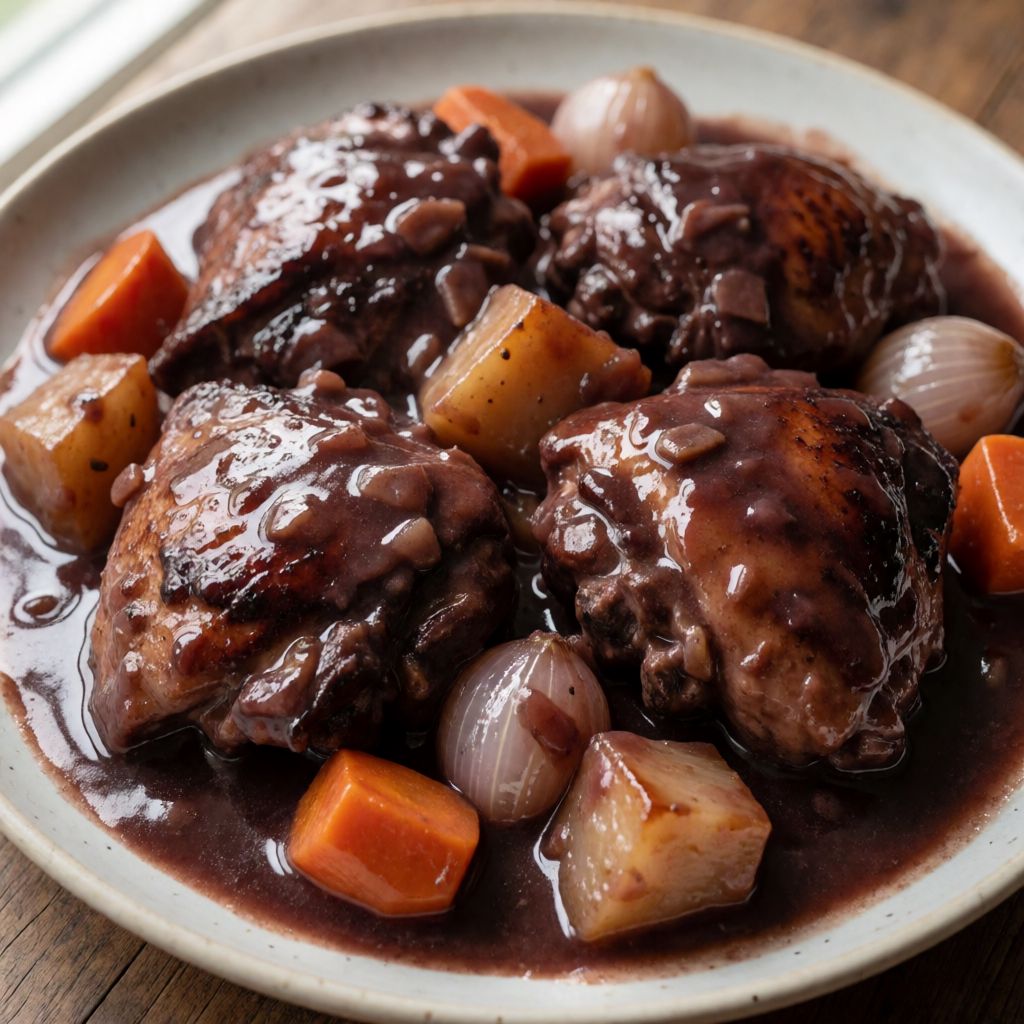
Chicken in Red Wine
A classic braise of chicken simmered in red wine with bacon, mushrooms and pearl onions, served with creamy mashed potato.
Labels are worked out automatically from the ingredients and can be wrong. Check the packaging if it matters to you.
Ingredients
- 1.5 kg Whole chicken breast, thigh, drumstick
- 2 pcs Onion finely chopped
- 4 clove Garlic finely chopped
- 0.5 pcs Celeriac cut into cubes
- 5 pcs Carrot sliced
- 750 ml Red wine
- 1 bunch Thyme fresh
- 5 pcs Bay leaf
- 4 pcs Cloves whole
- 10 pcs Black pepper peppercorns
- 100 g Bacon sliced
- 250 g Mushrooms quartered
- 200 g Pearl onions
- 1 tbsp Sugar
- 1 tbsp Water
- 2 tsp Cornflour mixed with cold water
- 1 tbsp Olive oil for frying
- 1 tbsp Butter for frying
- Salt
- Black pepper freshly ground
- 1 bunch Parsley roughly chopped

















Mashed Potato



Steps
Season the chicken pieces with salt and pepper and fry well in butter and oil in a casserole dish until the skin starts to crisp. Remove the chicken and set aside on a plate.
10 minPut the onion, garlic, celeriac and half the carrot into the casserole and fry for a few minutes.
5 minReturn the chicken to the casserole along with the wine, thyme, bay leaf, cloves and peppercorns. Cover with a lid and braise for 1 – 1 1/2 hours.
75 minShortly before the dish is ready, fry the bacon until crisp. Then fry the mushrooms and remaining carrot in the bacon fat and set aside.
7 minWipe out the pan, add the pearl onions, butter, sugar, salt and water, bring to the boil, stirring, until the onions caramelise.
When the dish is ready, remove the chicken and set aside. Strain the sauce through a fine sieve into a saucepan and discard the solids. Skim off excess fat, bring the sauce to the boil uncovered, thicken with a little cornflour and season with salt and pepper.
Add the chicken, mushrooms, carrot, pearl onions and bacon. Heat the dish through well and sprinkle with herbs, such as parsley, before serving.
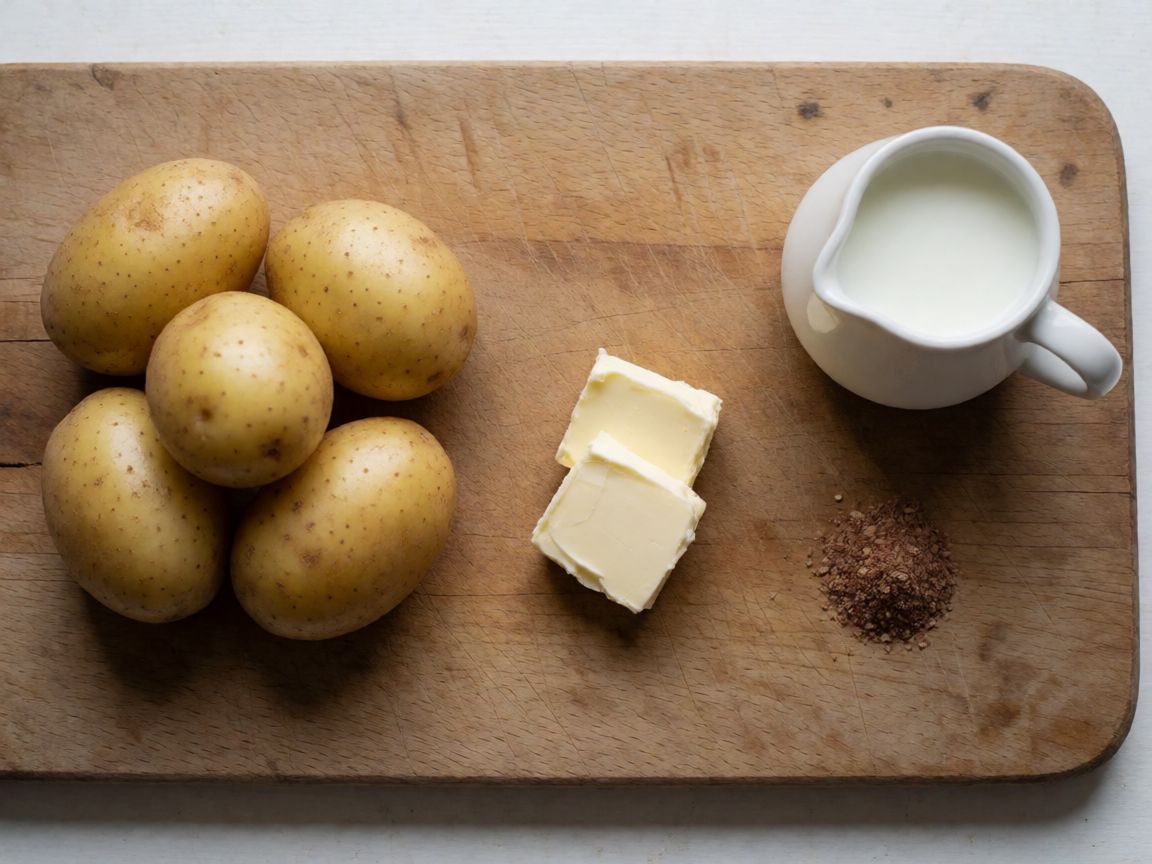
5 minFor the mash, boil the potatoes in unsalted water until soft.
18 minWarm the milk in a saucepan to about 50°C.
Lightly mash the hot, freshly boiled potatoes with butter, then whip the mash with a hand mixer, gradually adding the warm milk, until creamy, airy and velvety. Season with salt, pepper and freshly grated nutmeg.
This is coq au vin in its unfussy, English-kitchen form — a whole bird jointed, browned hard, then left to cook slowly in its own wine until the meat falls off the bone and the sauce tastes of nothing you poured in directly. What decides whether it works isn't the wine, isn't even the chicken — it's the browning at the start and the patience in the middle. Skip the first and you get pale, boiled-tasting meat. Rush the second and you get sauce that's just hot wine, not something that's become a sauce.
Some say you need a kazan or a proper French cocotte for this. No — a wide, heavy pan with a lid, or a plate pressed over it if the lid's lost, does the job. What you can't fake is thickness of metal: thin pans scorch the fond (that dark sticky stuff stuck to the base after browning) before the onions and garlic have softened in it, and that fond is half your sauce's flavour. If your pan is thin, turn the heat down a notch sooner than you think and watch the base, not the clock.
The braise itself is the long middle act, and it has one job: break down collagen in the thigh and leg without boiling the breast meat to rags. That's why the liquid should sit at a bare tremble — the surface moving but not rolling — rather than a boil. A boil toughens muscle fibre fast; a tremble over an hour coaxes collagen into gelatine slowly, which is what gives the finished sauce body without flour doing all the work. Potato, underneath it, is just butter and milk whipped in — simple, but only as good as how hot the potato is when you add the fat.
Start with the chicken itself: jointed into breast, thigh, drumstick, skin on. Skin matters here because it's what you're actually browning — it renders fat, crisps, and gives you that fond on the pan base. A skinless fillet will just steam and go grey. If all you've got is boneless thighs, use them; bone-in pieces give more flavour to the braise but boneless will still eat well, just with a thinner sauce.
The fat for frying is butter and oil together, not butter alone — butter alone burns at the temperature you need to crisp skin, because its milk solids catch before the fat itself is hot enough. The oil buys you headroom. Any neutral oil works here — nothing that smells of itself, so not a strong extra virgin, not sesame. A flavourless vegetable or sunflower oil is the honest substitute, and it's what most British kitchens have in anyway.
Onion, garlic, celeriac, half the carrot — this is your aromatic base, and frying it briefly in the chicken fat before the wine goes in means those vegetables start softening in fat rather than steaming in liquid from minute one. Celeriac's job is a background earthiness; if you can't find it, a parsnip does something close, or leave it out rather than reach for something sweeter like swede. The wine itself doesn't need to be expensive — but it does need to be something you'd drink a glass of, because whatever sourness or thinness is in the bottle concentrates as it reduces. A supermarket mid-range red is the sensible choice; don't raid anything special for the pot.
Thyme, bay, cloves, peppercorns go in whole and get strained out later — that's the point of using them whole rather than ground. Ground spice would cloud the sauce and leave grit at the bottom of the bowl; whole spice perfumes the liquid and then leaves quietly. Four cloves is already assertive — cloves are strong enough that doubling them without tasting first will make the sauce taste medicinal rather than warm.
Bacon, mushrooms, pearl onions, cooked separately and added back at the end — this is classic French bistro economy, not decoration. Braising them with the chicken for an hour would turn mushrooms to rubber and strip bacon of its crispness entirely; cooking them separately and folding them in at the last minute keeps each element doing its own job in the finished dish. The pearl onions caramelising in butter and a spoon of sugar is the same mechanism as any caramelisation — sugar and moisture driven off by heat until what's left browns — just applied to something small enough to do it in minutes rather than the half hour a big onion would need.
For the mash: the reason the potato goes in hot and the milk goes in warm, not cold, is that cold dairy added to hot starch seizes the texture into something gluey rather than smooth — the fat can't distribute evenly through potato that's already cooling and tightening. Warming the milk to blood-heat or so keeps everything the same temperature as it combines, which is the whole trick of a mash that whips up light instead of stodgy. Some say you must rice the potato for a smooth mash — no, not at home: a hand mixer does the same job on a Sunday, provided the potato went in hot and the butter and milk follow while it's still steaming.