
 AI photo
Thermomix Coconut Ice Cream
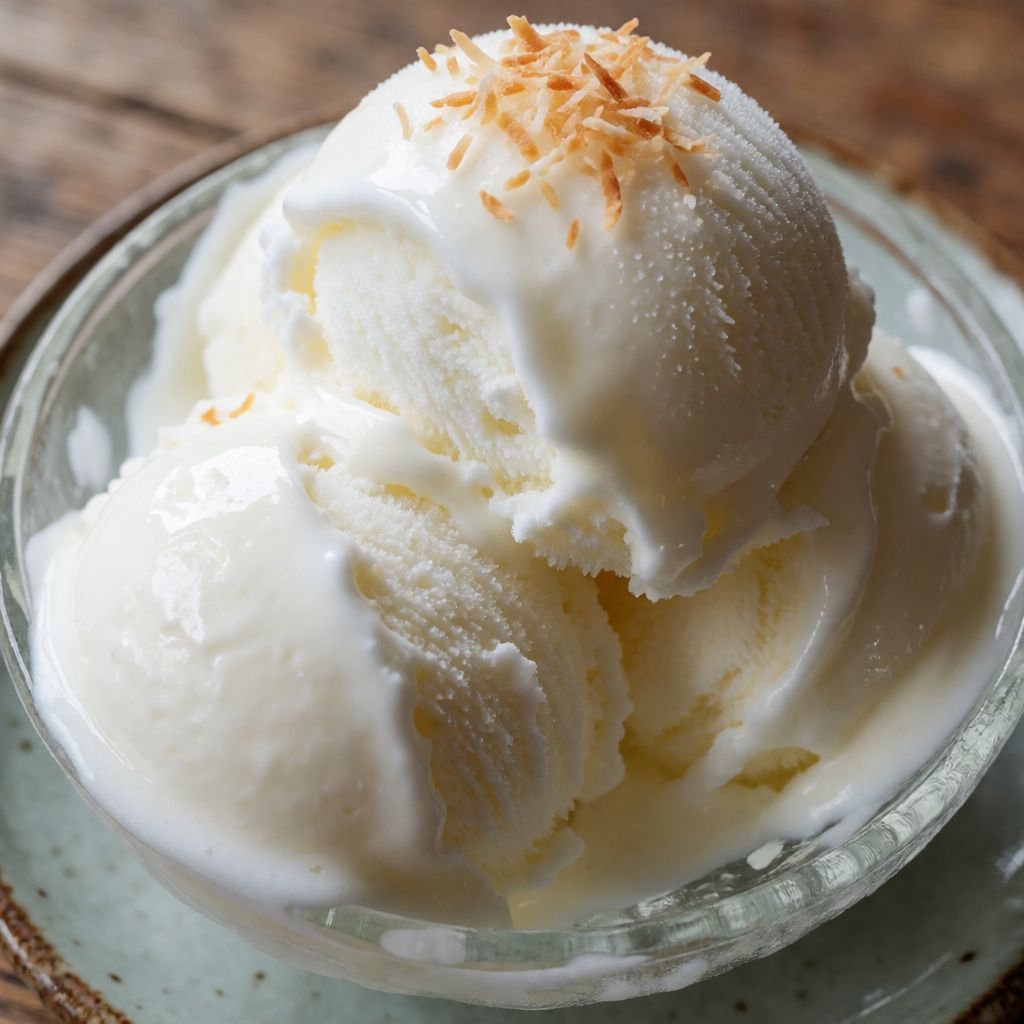
A simple coconut ice cream made in the Thermomix, frozen solid then blitzed with sugar, yogurt and egg white for a creamy finish.
Labels are worked out automatically from the ingredients and can be wrong. Check the packaging if it matters to you.
Ingredients
- 300 ml Milk
- 200 ml Double cream
- 100 g Caster sugar
- 1 tsp Vanilla extract
- 1 pcs Egg white
- 1 package Coconut yogurt small pot
- 50 g Desiccated coconut
- 30 g Cornflour







Steps
Pour the milk and cream into the Thermomix bowl, add the desiccated coconut, vanilla extract and 50 g of the sugar together with the cornflour. Turn on the machine and mix at 90°C on speed 4.
Pour the mixture into containers and place in the freezer for at least 12 hours.
720 minBefore serving, take the ice cream out of the freezer and cut it into pieces.
Put the remaining sugar into the Thermomix bowl and mix for 13 seconds on speed 9.
Add the chopped ice cream and blend for 20 seconds on speed 6.
Add the yogurt and egg white and mix for 60 seconds on speed 4.
The ice cream is ready to serve.
What was changed
Vanilla extract was swapped in, as vanillin sachets are not sold in UK shops.
This is ice cream that never sees a churn. The whole trick: you let the freezer do what a churn does, only backwards. Cook a thin, starch-thickened custard, freeze it rock solid, then smash it to pieces and whip air and tang back into it before it has any chance to melt. No machine with paddles, no rock salt, no hand-cranking for twenty minutes while your arm gives up.
What decides whether this works comes down to crystals, and there are two moments where you either control them or don't. First, the custard: milk, cream and sugar thickened with cornflour cooked to a near-boil, so the water in the mix gets tied up in a starch gel instead of sitting free to form big ice shards later. Second, the finish: once the block is frozen solid, you break it and blitz it — that's the same job a churn does, agitating half-frozen cream so crystals stay small, just done in reverse order, after the freeze rather than during it.
Some say you need an ice cream maker to get a proper scoop. No — the machine's only job is to stir the mix while it half-freezes, so the water in it can't organise itself into long icy fibres. Freeze solid, smash to grit, then reprocess with air and fat folded back in, and you've done the same job the hard way round, with tools most flats already own.
Milk and cream together, not cream alone, is doing a ratio job. Fat carries flavour and silkiness, but at full cream and no milk you'd end up with something closer to flavoured butter than a scoop — too hard to get a spoon into straight from the freezer. The milk thins the fat down just enough that at domestic freezer temperatures it stays workable. Push the balance toward more cream if you want richness, just know you're paying for it in how stubborn the block sets.
Sugar is split in two because it has two different jobs. The 50g cooked into the custard isn't only sweetness — sugar lowers the freezing point of the whole mix, and that's the real reason under-sweetened homemade ice cream turns into a brick rather than a scoop. The second 50g gets blitzed alone and dry, for those 13 seconds, before anything else goes near it — ground down past caster toward something closer to icing sugar, because sugar barely dissolves into something already frozen; coarse grains sitting in a cold base just read as grit on the tongue. Grind it first and it disperses instead of crunching.
Cornflour here is standing in for the egg yolks a proper custard-based ice cream would use, and it's doing that because it's cheaper and far less temperamental — yolks curdle if you take your eye off them above about 80°C, starch doesn't. Cooked to 90°C, the starch granules swell and burst, and the liquid turns from thin milk into something that coats a spoon — that's the cue you're watching for, not the clock. Stop before that point and the starch never gelatinises properly: you'll taste it raw and slightly chalky, and worse, the mix won't be thick enough to hold ice crystals back once it freezes. Any clear-setting, neutral starch does the same job — potato starch, arrowroot — cornflour's just the one already in every cupboard here.
The egg white goes in raw, right at the end, and its only function is air — whisked at speed it foams, lightening what would otherwise thaw into something dense and chewy. In Britain this is less of a worry than people assume: eggs stamped with the British Lion mark are vaccinated against salmonella, which is precisely why raw-egg puddings and mousses stayed ordinary on English tables long after other countries got nervous about them. If you'd rather leave eggs out altogether, whipped aquafaba — the liquid tinned chickpeas sit in — does the same foaming job; you lose a faint eggy background you probably weren't tasting under all that coconut anyway.
Coconut yogurt and desiccated coconut are both pulling flavour, but the yogurt earns its place for the acid in it as much as the taste — a little tang cuts the sweetness, and because yogurt's fat and live cultures don't freeze the way milk fat does, it keeps the finished texture softer rather than icy. Any plain, full-fat yogurt will do the structural job if you've none in — skip the fat-free kind, that's mostly water and just adds more ice to fight. The desiccated coconut wants to be the fine, unsweetened kind, not the coarse ribbon style, which turns fibrous and chewy once frozen instead of melting into the base; if sweetened is all you've got, pull sugar back elsewhere rather than add more.
And when you get to blending the frozen block — Thermomix or an ordinary blender at home, it makes no difference to the logic — cut it into pieces first, not out of ceremony but because a motor without real torque stalls, or the blades just skate uselessly across one solid brick. You want chunks small enough to tumble past the blade, not slide round it. A food processor, pulsed in short bursts with a rest whenever it sounds strained, does the same job a Thermomix does on speed 6 — just slower, and with you watching it instead of trusting a dial to know when to stop.