
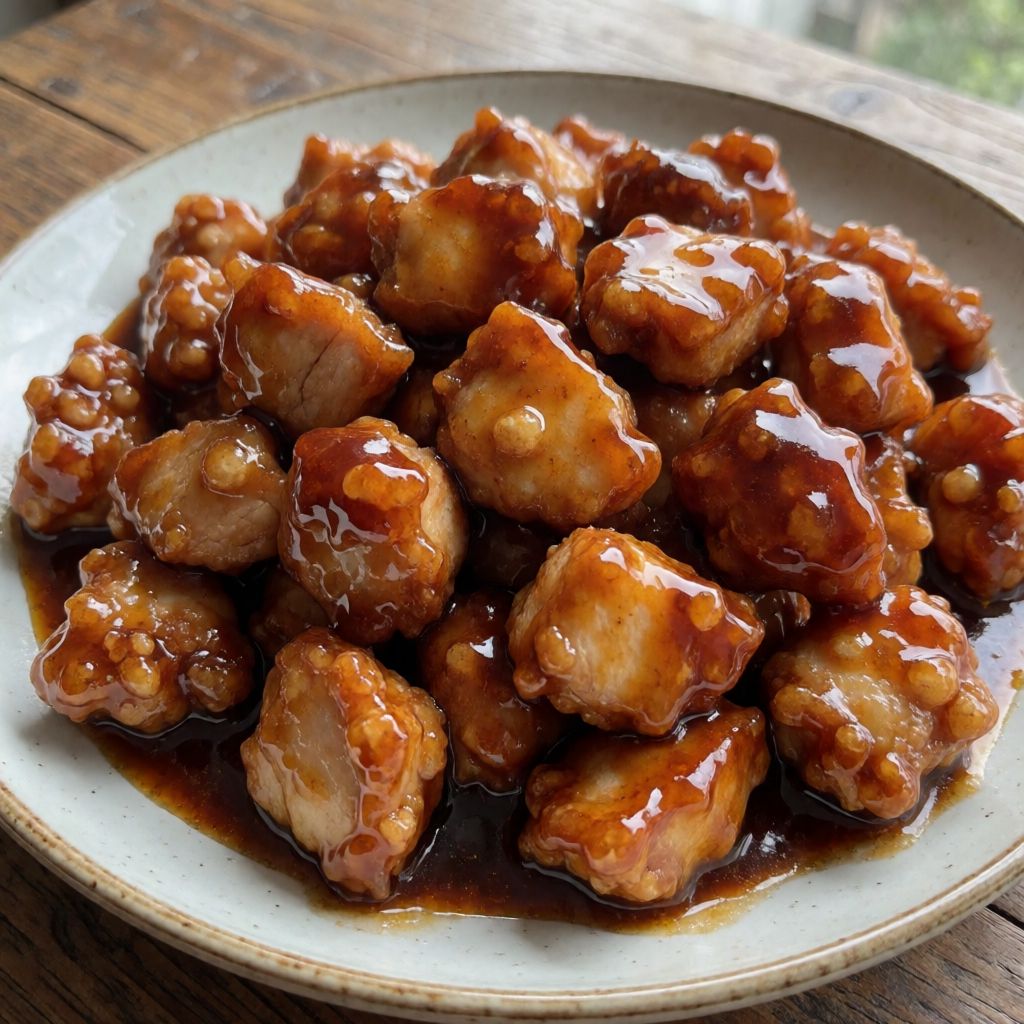
 AI photo
Kung Pao Chicken
A quick, spicy stir-fried chicken dish with peanuts and spring onion, served over rice.
Labels are worked out automatically from the ingredients and can be wrong. Check the packaging if it matters to you.
Ingredients
- 400 g Chicken breast cut into cubes
- 0.5 tsp Baking powder
- 2 tbsp Soy sauce
- 2 tbsp Rice vinegar
- 2 tbsp Cornflour
- 3 tbsp Sesame oil
- 1 tbsp Sriracha
- 1 pcs Stock cube
- 2 tbsp Soy sauce
- 1 tbsp Cornflour
- 3 clove Garlic finely chopped
- 2 tbsp Hoisin sauce
- 1 pcs Ginger finely grated
- 0.5 tsp Sichuan pepper
- 0.5 tsp Chilli flakes
- 1 pcs Bell pepper diced
- 4 pcs Spring onion sliced
- 300 ml Rice cooked according to packet instructions
- 40 g Peanuts roughly chopped, salted

















Steps
Mix the baking powder, soy sauce, rice vinegar and cornflour, add the chicken and stir. Leave to marinate.
Mix all the sauce ingredients together until smooth.
Toast the Sichuan pepper in a dry pan and grind it in a mortar.
Put the garlic, ginger, Sichuan pepper and chilli flakes into the pan with oil and fry, stirring, until fragrant.
3 minAdd the chicken together with the marinade and quickly stir-fry over high heat until golden.
5 minAdd the sauce and simmer until the chicken is tender.
5 minAdd the bell pepper and spring onion, and stir through.
Serve with rice in bowls, topped with spring onion and peanuts.
What was changed
Added Bell pepper as a separate row, since the diced vegetable in that step is a bell pepper, not the ground Sichuan pepper; also added Ginger and Chilli flakes, which the frying step named but which had no ingredient row.
Kung Pao chicken is a wok dish built on a contradiction that sounds like a mistake until you understand it: the chicken is coated and sauced wet, then cooked over the fiercest heat you have. That's the whole mechanism. High heat plus a dry pan surface drives off moisture fast enough that the outside sears instead of stewing, but the coating itself — baking powder, cornflour, soy, vinegar — is there to make sure the inside stays soft while that's happening. Get the heat wrong, or crowd the pan, and you don't get seared chicken, you get boiled chicken that happens to be brown.
What decides whether it works is less the recipe and more your hob. A domestic ring, even on its highest setting, puts out a fraction of what a commercial wok burner does. Some say you need a wok and a gas flame licking up the sides — no, because the flame licking the sides is just China's cheap way of getting heat into a round-bottomed pan; what you actually need is a hot, dry surface and chicken in a thin enough layer that each piece touches metal, not a puddle of its neighbours' juice. A wide frying pan does this better than a narrow saucepan ever will, because width is what gives you that thin layer. If your chicken is steaming and greying instead of catching colour, that's not a flaw in you — it's just too much chicken for too small a pan, and the fix is to do it in two batches, not to turn the heat up further and burn the garlic underneath.
The marinade step is doing more than seasoning. Baking powder raises the pH on the surface of the chicken, which is what lets it brown and crisp rather than just cook through grey — the same reason a pinch of it goes into some Chinese stir-fries and nowhere near a British roast chicken, where you want rendered skin, not seared meat. Cornflour in the marinade forms a thin starch jacket; this is your real defence against dry, stringy chicken breast, because the coating seals moisture in while the outside takes the heat. Leave the marinating time short rather than skip it — ten, fifteen minutes is enough for the starch to cling, you don't need hours, this isn't a confit.
Chicken breast is the cheap, lean cut here precisely because the coating does the tenderising work that fat would otherwise do. If you've only got thigh, use it — it's more forgiving of a slightly overcooked pan and arguably better for a first attempt, since breast punishes you quickly for crowding the pan or dawdling at the stove. Either way, cut the pieces to a size that cooks through in the time it takes to colour on the outside — too big and you're back to seared-outside, raw-inside; too small and you lose the contrast of a crisp edge against the tender centre.
Sesame oil here is for flavour, not for frying at high heat — it scorches and turns bitter fast, which is a real risk on a home ring where the pan heats unevenly. If you're using it as the main cooking fat, watch it, or cut it with a neutral oil with no smell of its own — sunflower, vegetable, rapeseed — and save a dash of sesame for the finish instead, where its toastiness survives. Soy sauce, Sichuan pepper and chilli flakes are not interchangeable with a jar of generic "stir-fry sauce" — soy gives salt and the deep savoury note (umami, if you want the word), vinegar gives the dish lift so it doesn't taste flat and one-note, and the pepper and chilli are the two different kinds of heat — tingling versus burning — that Kung Pao is actually named for. Drop the Sichuan pepper if you can't find it and you've made a perfectly nice chilli chicken, just not this dish; black pepper won't substitute, it has no numbing effect to offer.
Hoisin and the stock cube in the sauce mixture are doing the job that a proper Chinese stock or fermented bean paste would do in a professional kitchen — concentrated savoury depth without a day spent on stock. There's no shame in that; home cooking has always borrowed shortcuts from the shelf, and a stock cube dissolved into two tablespoons of liquid is not meaningfully different in effect from simmering bones for an hour, just faster and honest about it.
The bell pepper and spring onion go in last and briefly — this prevents them going soft and losing their crunch, which is the whole point of adding vegetables to a stir-fry rather than a stew. Chop the peanuts roughly, not to a powder, so they keep their bite against the softer chicken and rice; a food processor will turn them to peanut butter in half a second if you're not careful, and then you've lost the texture you added them for in the first place. This feeds four properly hungry people with rice, which, on a weeknight after work rather than a Sunday roast, is about the right ambition — fifteen minutes' prep, fifteen minutes at the stove, and most of the patience spent is in not rushing the marinade or overcrowding the pan.