
 AI photo
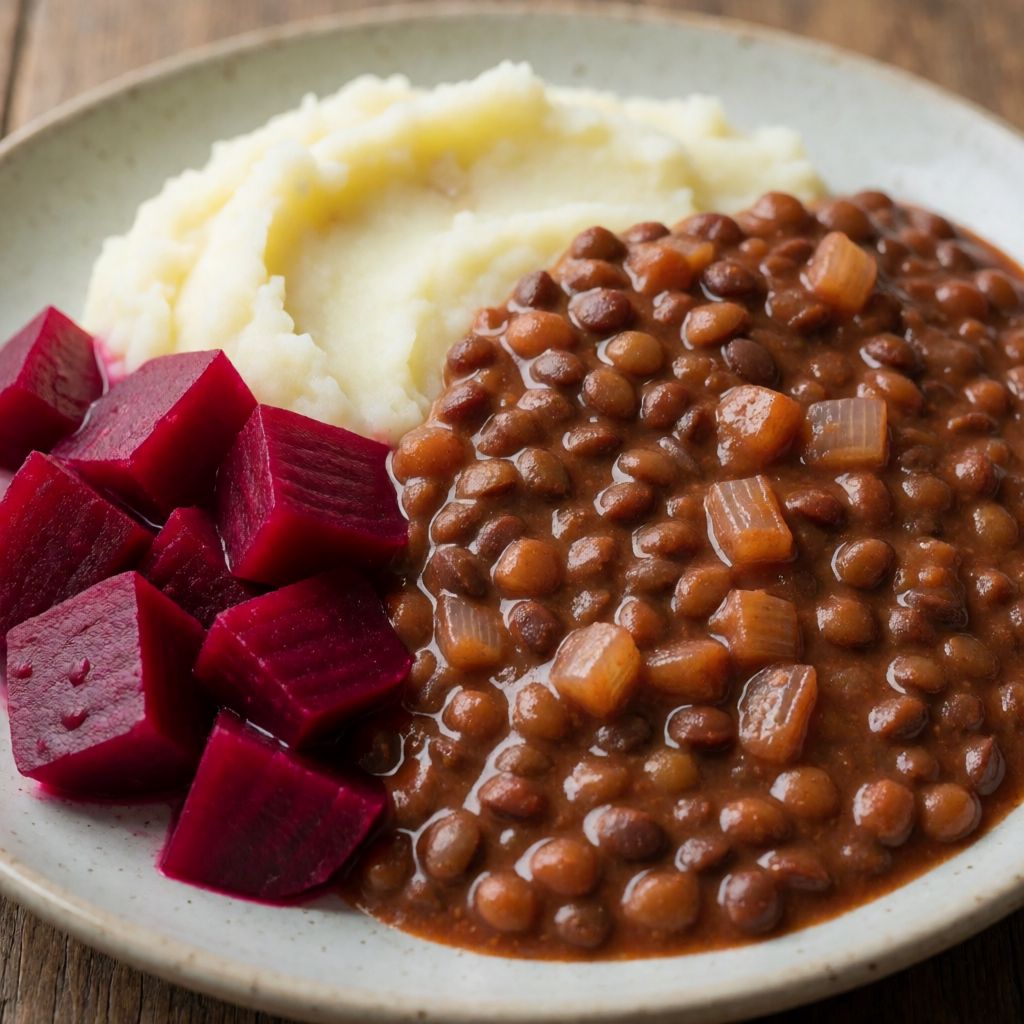
Lentil Ragout with Mash and Pickled Beetroot
A rich black Beluga lentil ragout served with creamy mash and pickled beetroot.
Labels are worked out automatically from the ingredients and can be wrong. Check the packaging if it matters to you.
Ingredients
- 2 pcs Onion finely chopped
- 1 tsp Dried thyme
- 1 tsp Paprika
- 30 g Tomato paste
- 300 ml Stock
- 2 pcs Bay leaf
- 2 tbsp Balsamic vinegar
- 200 g Black Beluga lentils
- 250 g Mushrooms finely chopped
- 150 ml Double cream
- 1 tbsp Cornflour
- 0.5 tsp Caramel food colouring
- 2 tbsp Olive oil
- 20 g Butter
- Salt to taste
- Black pepper freshly ground, to taste
- 1 kg Potatoes cut into cubes
- 500 g Cauliflower cut into florets
- 75 g Butter
- 150 ml Milk warmed to 50°C
- Salt to taste
- Black pepper freshly ground, to taste
- 150 g Pickled beetroot
- 1 bunch Parsley finely chopped





















Steps
Fry the onion in the olive oil and butter in a saucepan over medium heat for 5–7 minutes, until soft.
Add the thyme, paprika, tomato paste, stock, bay leaves, balsamic vinegar, lentils, mushrooms and half the cream. Stir and bring to the boil.
Cover and simmer for 30 minutes.
Meanwhile, boil the potatoes and cauliflower in unsalted water.
Once the potatoes are soft, drain the water.
Mash the hot potatoes and cauliflower with the butter, then whip on low speed with the warm milk until light and creamy.
Season the mash with salt and pepper to taste.
Remove the bay leaves from the lentils and season with salt and pepper to taste.
Stir the cornflour into the remaining cream and add it to the ragout.
Bring to the boil and cook for a few minutes, stirring, until thickened.
If needed, adjust the colour with caramel food colouring, a few drops at a time.
Serve the airy potato and cauliflower mash together with the lentils, pickled beetroot and chopped parsley.
This is a cottage pie that lost its meat and didn't notice. Lentils and mushrooms do the work mince usually does — they bulk up, they brown, they carry fat and salt and come out savoury instead of virtuous. Cauliflower rides shotgun in the mash, cutting the potato so the whole plate isn't just a beige wall of carbohydrate. It's an economical dinner dressed up with a good vinegar and a jar of pickled beetroot, and that's exactly the point — this is not an impoverished version of something better, it's its own thing.
What decides whether it works is the onion at the start and the reduction at the end, nothing in between. Onion cooked properly — soft, translucent, starting to smell sweet rather than sharp — is where the whole base flavour comes from, because everything that follows (stock, tomato paste, lentils) just sits on top of it and simmers; it doesn't build new flavour, it only extends what's already there. And the cream-and-cornflour finish at the end is the only moment you're actually thickening and concentrating anything — skip it or rush it and you've got lentil soup with ambitions, not a ragout that holds its shape next to a pile of mash.
Start with the onion, because it decides more than people give it credit for. Two onions, finely chopped, into oil and butter together — the oil because butter alone burns before the onion softens, and the butter because oil alone gives you no flavour, just slip. You're not browning here, you're softening: medium heat, no rush, no colour beyond maybe the edges going faintly gold. If the onion catches and browns hard before it's gone soft, the whole pot carries a bitter edge that no amount of balsamic will fix later. Any neutral oil works for this — anything with no smell of its own, sunflower, vegetable, rapeseed if you're in a British kitchen already — the only sin is using something too assertive, like a strong extra virgin olive oil, that fights the thyme and paprika for space.
Beluga lentils are the one ingredient worth being specific about. They're a variety bred to hold their shape — small, black, glossy, and they cook in roughly the same time as a simmered stew needs anyway, so they're not inconvenient here, they're convenient. If you can't find them, green or brown lentils will do the job, just watch them harder near the end because they soften faster and go to mush if you leave the lid on and walk away. Red lentils are the one substitution to avoid — they're bred to disintegrate, which is perfect for dal and wrong for a ragout that needs texture.
The mushrooms are there to do what the lentils can't: give you that deep, savoury, almost meaty backnote — the umami that a purely vegetable stew lacks without it. Chop them finely and let them go in with everything else rather than frying them separately first; you lose a bit of browned-mushroom flavour that way, but you gain simplicity, and in a stew that simmers thirty minutes, the mushrooms give up their flavour into the liquid regardless of whether they were browned first. If you want more depth and don't mind the extra pan, frying them in a hot dry pan first until they lose their water and start to colour will add something real — that's a trade worth knowing about, not a rule you're breaking by skipping it.
Tomato paste and balsamic vinegar are doing two different jobs that look similar. The paste gives body and a dark, slightly savoury depth — cooked tomato paste, even briefly, loses its raw sharpness and turns into something closer to umami. The vinegar at the end gives acidity and lift, cutting through the richness of the cream so the dish doesn't go flat and heavy. Don't swap balsamic for a sharper vinegar like malt or white wine — balsamic brings sweetness alongside the acid, and that sweetness is doing real work against the savoury lentils and mushrooms.
The caramel colouring is a cosmetic fix, not a flavour ingredient — a few drops to push the ragout darker if it's come out looking paler and greyer than you'd like next to white mash. It's entirely optional and entirely about how the plate looks, not how it tastes; skip it without worry if you don't have it or don't care.
For the mash: warm the milk before it goes in, because cold milk shocks hot mashed potato and makes it seize up slightly, go gluey rather than smooth — that's the real reason behind "warm milk," not tradition for its own sake, just physics of starch and temperature. Whip on low speed once the butter and milk are in, not high — high speed over-develops the starch in potato and you end up with something gummy, almost like wallpaper paste, which is the genuine risk with electric mixers and mash. The cauliflower needs no special treatment beyond boiling alongside the potato in the same pot and draining together — it's there to lighten texture and add a little sweetness, not to announce itself as a flavour.
This feeds four as a proper dinner, the kind of thing that sits next to a Sunday roast in spirit even though it isn't one — hearty, savoury, a bit of a production on a weeknight but worth it on a Sunday when you've got the time and the patience, which here really is the last ingredient. Rushing the onion, rushing the simmer, rushing the cream reduction — each shortcut shows up on the plate as something thinner than it should be.