
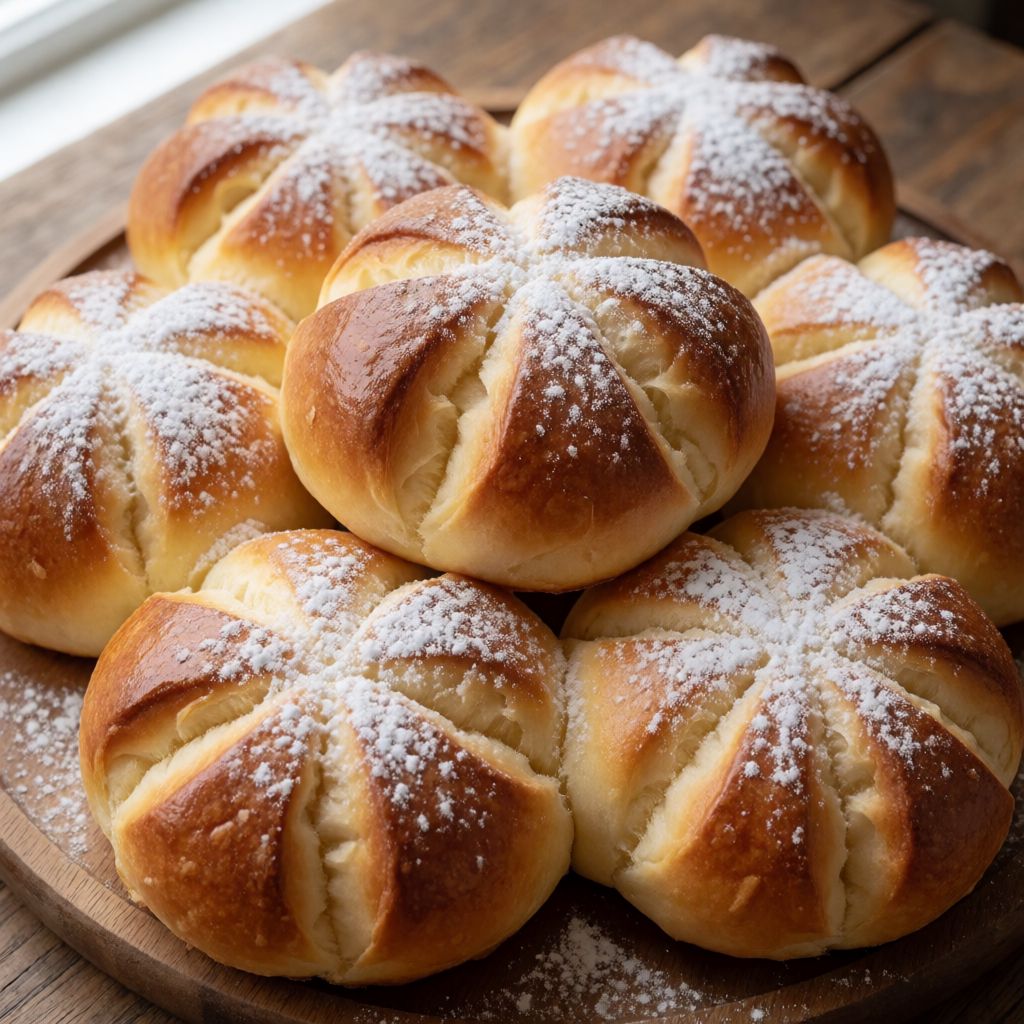
 AI photo
Snowflakes — Soft Brioche Buns with Milk Cream Filling
A dessert of soft little brioche buns filled with a delicate ricotta and cream filling, finished with a milk custard.
Labels are worked out automatically from the ingredients and can be wrong. Check the packaging if it matters to you.
Ingredients
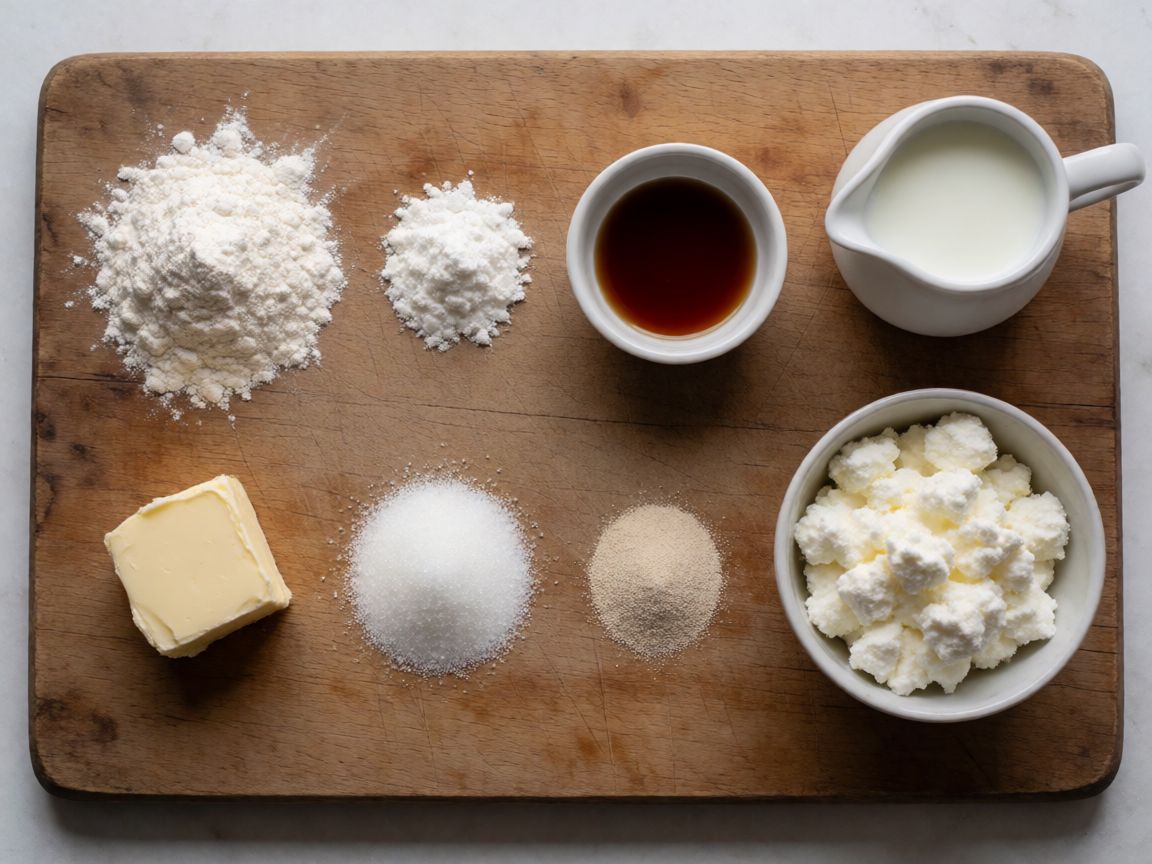
- 125 g Plain flour
- 100 g Strong white flour
- 40 g Butter softened
- 40 g Caster sugar
- 8 g Yeast
- 85 g Milk at room temperature
- 40 g Water at room temperature
- pinch Salt a pinch
- 1 tsp Vanilla extract
- 150 g Ricotta
- 150 g Double cream
- 25 g Icing sugar
- pcs Lemon zest from 1/2 a lemon
- 200 g Milk
- 60 g Caster sugar
- 20 g Cornflour
- 1 tsp Vanilla extract
- g Icing sugar to taste













Steps
Mix the plain flour, strong white flour, caster sugar, yeast and vanilla extract, add the milk and water and work into a dough, then add the butter and salt, kneading until smooth and elastic.
Cover the dough with cling film and let it rise until doubled in size.
90 minDivide the dough into 30 g pieces, shape into balls and place on a baking tray lined with parchment.
Cover with cling film and let rise again until doubled in size.
60 minMix the ricotta with icing sugar and lemon zest; separately whip the double cream and gently fold it into the ricotta, then refrigerate.
Pour the milk into a small saucepan, add the vanilla extract and caster sugar, warm over low heat, add the cornflour and cook, stirring, until thickened, then leave to cool.
Bake the snowflakes at 180°C until golden.
11 minLet the brioche buns cool slightly, combine the two creams, transfer to a piping bag and fill the buns through a hole in the bottom.
Store in the fridge and dust with icing sugar before serving.
A snowflake bun is just a soft milk bun — a cousin of brioche, lighter than a doughnut because it's baked, not fried — hollowed out and stuffed with a cream that's half cheesecake, half custard. The dough is the easy part. The thing that actually decides whether these work is restraint: restraint with flour when kneading, restraint with heat when baking, and restraint with patience, because yeast doesn't negotiate.
Two flours here, not one, and that's not fussiness. Plain flour alone gives you something that tears like cotton wool; all strong flour gives you chew, almost like a dinner roll, too insistent for a bun that's meant to be eaten in two bites with tea. The mix splits the difference — enough gluten to hold a ball shape and trap gas, not so much that the crumb fights back.
What makes it "brioche-ish" without the usual guilt of brioche is the butter: only 40 g against 165 g of flour, worked in late, after the wet dough has already come together. Butter coats gluten strands and stops them linking up — add it too early and you fight the dough for twenty minutes for nothing. That's why the order is wet-then-flour-then-butter-then-salt, not everything in at once.
And then there's the forming: thirty-gram balls, like shaping dumplings — small, so they bake through in eleven minutes without the outside colouring before the inside sets.
Some say yeast dough needs a warm airing cupboard or it won't rise. No — it needs time and a temperature it won't die at. Yeast is a living thing: kill it with anything hot to the touch and you get a flat disc that never argues back. Room temperature milk and water in this dough aren't a throwaway detail — warm liquid would have sped things up but also shortened your margin for error on a domestic hob kitchen where there's no proving drawer, just the top of the fridge or near a radiator. Ninety minutes first rise, then shape, then a second hour — that second rise is what gives you a bun with air inside instead of a brick with a crust. Don't rush it because the clock says 90 minutes passed. Look for the dough visibly loose and wobbly under clingfilm, nearly doubled, holding a dent from a fingertip without springing straight back.
The yeast itself — 8 g here reads as instant/fast-action, the kind you tip straight into flour, no proofing in water first. If what you've got is fresh yeast, double the weight and crumble it into the warm-ish milk first to wake it; dried active yeast (not instant), proof it the same way for ten minutes until foamy, or it'll sit inert in the dough and you'll blame the recipe instead of the yeast.
The filling is two creams doing two different jobs, and that's deliberate, not decoration. Ricotta and whipped double cream folded together give you lightness and a slight tang — ricotta on its own is grainy and wants sweetening and lemon zest to lift it, the zest cutting through what would otherwise be a one-note sweetness. The cooked milk-and-cornflour cream is the opposite: body, that thick custard-like set that stops the filling running out of the hole you've piped it through. Combine the two and you get something that holds its shape in a piping bag but still melts on the tongue — the custard gives structure, the ricotta-cream gives air. Skip the cornflour cream and pipe ricotta alone, and you'll have a filling that weeps and soaks into the bun within the hour.
Cornflour here isn't filler, it's the thickener that sets without eggs — cook it stirring constantly over low heat (gentle bubbles at most, nothing violent, or it'll catch and taste of scorched milk on the bottom of the pan) until the mixture coats the back of a spoon rather than running off it. That's your doneness cue, not a timer.
Baking at 180°C for about eleven minutes is a lower bound, not a guarantee — ovens lie, especially small domestic ones with no fan calibration worth trusting. Go by colour: golden all over, not pale and not biscuit-brown, and a gentle spring back when you press the top. Any oil-based substitution isn't relevant here since it's a butter dough, but if you're short on double cream, a mascarpone-and-milk mix will whip close enough, though it won't hold air quite as long, so pipe and chill promptly.
This isn't a fried doughnut wearing a disguise, and that distinction matters economically as much as technically — frying needs litres of oil, constant temperature-watching, and produces something heavier and oilier. Baking small milk buns and filling them after is the cheaper, calmer route: an oven you already have on for a roast anyway, a piping bag instead of a thermometer and a vat of oil. It's a bun built for a kitchen that doesn't own specialist kit, finished in the fridge, dusted with icing sugar only at the very end — because sugar on a warm or damp bun just dissolves into nothing, and you'll have wasted it.