
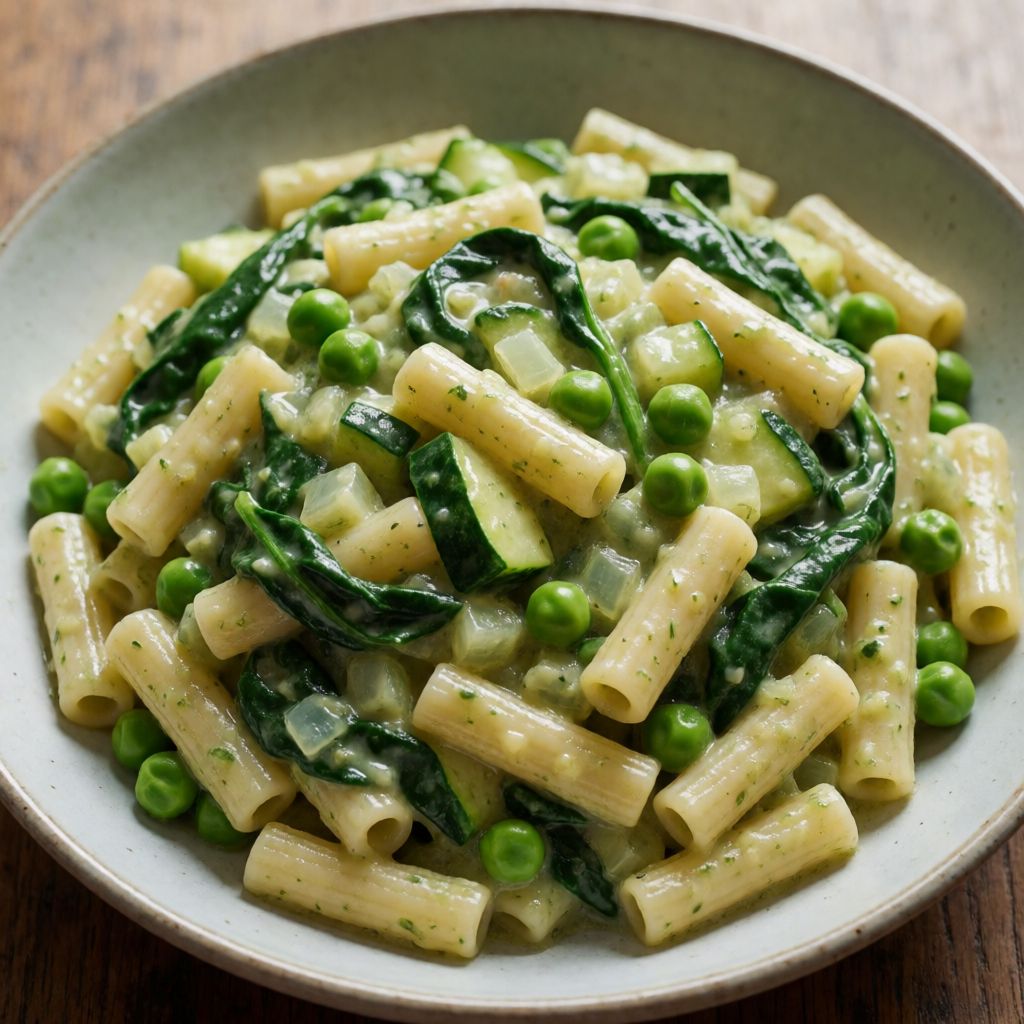
 AI photo
One-Pot Pasta with Spinach and Peas
A simple one-pot pasta with spinach and peas, finished with toasted pine nuts, parmesan, lemon and basil.
Labels are worked out automatically from the ingredients and can be wrong. Check the packaging if it matters to you.
Ingredients
- 400 g Pasta
- 1 pcs Onion finely chopped
- 2 clove Garlic finely chopped
- 2 pcs Courgette coarsely grated
- 125 g Spinach
- 200 g Peas frozen or fresh
- 1 bunch Basil
- 100 ml Double cream
- 1 l Stock
- 1 tbsp Olive oil
- Salt
- Black pepper freshly ground
- 2 tbsp Pine nuts toasted
- 30 g Parmesan freshly grated
- 1 pcs Lemon finely grated zest
- 2 tbsp Basil finely chopped













Steps
Put all the ingredients into a large pot.
Bring to the boil, stir well and cover with a lid.
Reduce the heat and simmer gently for 10 minutes, until the pasta is perfectly cooked — al dente, with a slight bite.
10 minServe the dish with the toasted pine nuts, parmesan, lemon and basil.
One-pot pasta is really a technique, not a dish — the pasta cooks in exactly the amount of liquid it needs, so by the time it's al dente, the sauce is already made. No draining, no separate saucepan of sauce reducing while the water boils over next door. This is what decides whether it works: the ratio of stock to pasta. Too much liquid and you're left with soup; too little and the pasta scorches to the bottom before it's cooked. A litre of stock to 400g pasta in a wide pan is the working balance here — a narrow, deep pot concentrates heat on a small base and invites sticking, so use the widest pan you own.
Some say pasta must always be cooked in a huge pot of furiously boiling water, salted like the sea, and anything else is a compromise. No — that rule exists because restaurant kitchens cook pasta separately from sauce for timing reasons across many tables, and because starchy water needs diluting fast or it goes gluey. At home, for one pan, one sitting, you don't have that problem: the starch that would normally go down the drain stays in the pot and quietly thickens your cream into a sauce. That's not a shortcut, that's the whole point.
Pasta: shape matters less than how it cooks dry-in-liquid. A short or medium shape that doesn't need a huge pot of water to move freely — penne, fusilli — behaves better than something very long needing to lie flat across a wide surface. Long pasta works, but you'll stir more to stop it clumping into a raft.
Stock: this is the base of the whole flavour, not background noise. Use what you'd be happy to drink a spoonful of on its own — if it's thin and flavourless, the finished pasta will be thin and flavourless, cream or no cream. A good shop stock cube dissolved properly works; a weak one won't improve just because pasta's been simmered in it. If you have homemade stock, this is where it earns its freezer space.
Onion and garlic: finely chopped because they go in raw and have no browning stage to build flavour through caramelisation — they soften by boiling, so the smaller the pieces, the faster and more evenly they give up their sharpness. This isn't the dish for the oniony crunch some people like; here it dissolves into the background.
Courgette: coarsely grated, not sliced, because sliced courgette in this short a simmer stays half-raw at the core and rubbery at the edge. Grating multiplies surface area so it collapses into the sauce rather than sitting in it as a vegetable you have to chew around.
Double cream: added with everything else, not stirred in at the end — because the starch released by the simmering pasta is what stabilises it, stopping it from separating or curdling under heat the way cream sometimes does when added cold to a very hot, nearly-finished sauce. If you have none, a full-fat crème fraîche or even a splash of milk with a knob of butter will carry the body, just thinner.
Pine nuts, toasted, and parmesan, basil, lemon zest — these go on at the end, uncooked, because they're there for texture and brightness the simmering has already used up. Toasting pine nuts beforehand isn't decoration — raw pine nuts taste faintly of nothing, toasted they taste of themselves. If pine nuts aren't to hand or budget, toasted flaked almonds do the same job of contrast: crunch against soft pasta.
Patience here isn't about waiting long — it's about not lifting the lid every thirty seconds to check. Each time you do, heat escapes and the simmer drops, and you're adding time you didn't need to add. Put the lid on, trust the ten minutes as a floor, and go and lay the table instead.