
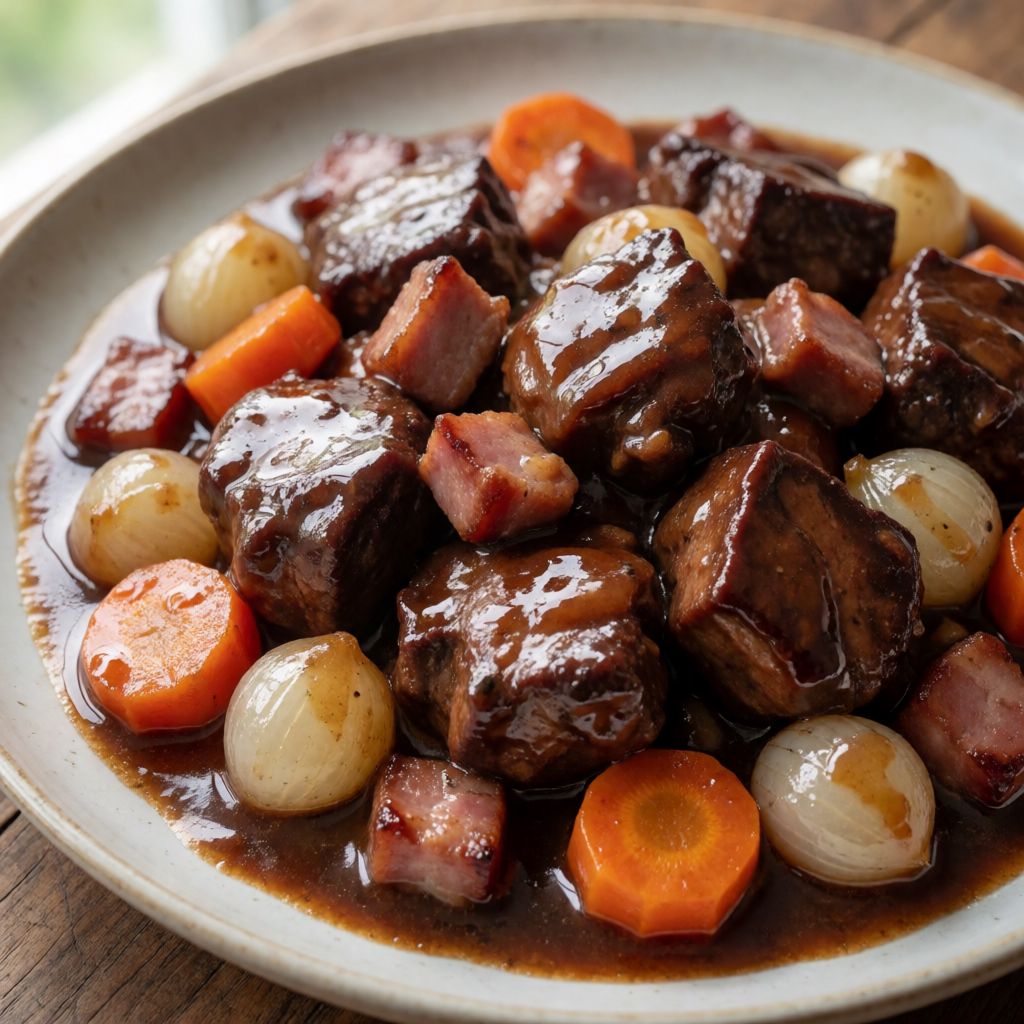
 AI photo
Pork Cheeks Burgundy-Style
Pork cheeks slow-braised in red wine with bacon, carrots and mushrooms, served with buttery mashed potato.
Labels are worked out automatically from the ingredients and can be wrong. Check the packaging if it matters to you.
Ingredients
- 750 g Pork Cheeks
- 20 g Plain Flour
- 100 g Bacon sliced
- 2 pcs Onion finely chopped
- 3 pcs Carrot diced
- 500 ml Red Wine preferably Pinot Noir
- 1 tbsp Dried Thyme
- 4 pcs Bay Leaf
- 200 ml Stock
- 250 g Mushroom halved
- 150 g Pearl Onion
- 25 g Caster Sugar
- 20 g Butter
- 1 tbsp Olive Oil for frying
- Salt
- Black Pepper freshly ground
- 1 bunch Parsley finely chopped













Mashed Potato



Steps
4 hours before serving, clean the pork cheeks, pat dry with kitchen paper and coat in flour mixed with freshly ground pepper and salt.
240 minFry the bacon in a little oil in a hot pan until crisp, drain on kitchen paper, then roughly chop.
8 minHeat a large pot with oil, add the butter and let it sizzle. Brown the cheeks well on all sides.
10 minReduce the heat slightly and fry the onion and carrot in the pot together with the meat until the onion softens.
6 minAdd the bacon, red wine, thyme, bay leaves and stock, and slowly bring to the boil.
5 minReduce the heat, cover and simmer gently for 3–3 1/2 hours.
210 min1 hour before serving, heat a pan over high heat with oil. Add the butter, let it sizzle and fry the mushrooms until nicely golden-brown.
5 minMelt the sugar and butter in another pan and let caramelise. Add the pearl onions and toss in the caramel for 15–30 minutes until golden and caramelised.
22 minAdd the mushrooms and caramelised pearl onions to the pot with the cheeks and season well with salt and freshly ground pepper. Serve with mashed potato and finely chopped parsley.
2 minFor the mash, boil the potatoes in unsalted water until soft.
18 minWarm the milk in a saucepan to about 50°C.
Lightly mash the hot, freshly boiled potatoes with butter, then whip with a hand mixer, gradually adding the warm milk, until creamy, airy and velvety.
5 minSeason with salt, freshly ground pepper and freshly grated nutmeg.
1 min
This is braised pork cheek the way Burgundy would do it if Burgundy had a Sunday roast instead of a Sunday stew — the same instinct, really: a tough, cheap cut given hours instead of heat, until it gives up and goes soft. The cheek is a working muscle, chewed on all day by a live animal, dense with connective tissue. You cannot shortcut that tissue into tenderness; you can only dissolve it, slowly, in liquid, over time. That's the whole mechanism of the dish — not a secret, just patience with a lid on it.
What decides whether it works is not the wine, though people like to think it's the wine. It's whether you actually browned the meat properly before it went near the liquid. That crust is where the flavour lives — the Maillard reaction, if you want the chemistry name for it — and it only happens in a dry, hot pan. Add wine too early and you steam the meat instead of searing it, and you get grey, flat-tasting cheeks no amount of simmering will rescue afterwards.
Some say you need a kazan-style heavy pot with a tight lid to do a proper braise. No — you need enough liquid and enough time at a bare simmer; a wide pan with a plate pressed down instead of a lid does the same job on an ordinary UK hob, as long as you keep an eye on evaporation and top up with stock rather than letting it go dry.
Pork cheeks: buy them cleaned if you can, because there's a membrane and sometimes a gland that needs trimming, and nobody wants that in their plate. If your butcher doesn't do cheeks, use pork shoulder or beef cheek cut into similar chunks — anything with a good amount of collagen that needs long cooking to break down. Don't use loin or any lean cut; it has nothing to dissolve, it will just dry out and sit there, offended.
The flour coating before browning isn't about crust alone — it thickens the sauce later as the flour cooks out into the wine and stock. Skip it and you'll have a thinner, winier liquid at the end; fine if you don't mind, but it won't cling to the mash the same way.
Red wine: Pinot Noir is suggested because it's light enough not to turn bitter over three hours of reduction, with enough acid to help break down the meat's fibres. Any dry, not-too-tannic red does the job — the rule is "a wine you'd drink a glass of," not an expensive one, because three hours of heat will not taste the bottle's price tag. Avoid anything sweet or a wine that's gone slightly vinegary; it will only get more so.
The stock is there to stop the sauce going too intense and acidic once the wine reduces — use whatever stock you have, chicken or pork, fresh or from a cube; nobody in a home kitchen is making veal stock for a Tuesday braise, and this dish doesn't need you to.
Bacon: this is the Burgundy habit of using cured pork fat to season a braise from the inside, the same logic as lardons in a French kitchen or pancetta in an Italian one. Any streaky, fatty bacon works; the point is rendered fat and a smoky, salty backbone, not a particular brand.
Pearl onions are fiddly to peel — blanch them briefly in boiling water first and the skins slip off, rather than fighting each knife-sized onion individually. If you can't find them, shallots quartered will behave close enough, though they won't hold their round shape as nicely in the caramel.
Mushrooms: fried hard and fast in a hot pan so they brown rather than stew in their own water — mushrooms release a lot of moisture, and a crowded or lukewarm pan traps it, giving you grey, rubbery mushrooms instead of golden ones. Button or chestnut mushrooms both work; the darker chestnut ones bring a bit more depth.
For the mash: warming the milk to around 50°C before adding it isn't ceremony — cold milk shocks the starch in hot potato and makes the mash gluey rather than smooth. And whip the potato while it's still hot; it cools and firms as it sits, and cold potato mash is never airy again no matter how hard you beat it. Some say floury potatoes are essential for mash — mostly true, because waxy potatoes hold too much water and go gluey under a mixer; Maris Piper or King Edward, common on any UK shelf, are built for exactly this.