
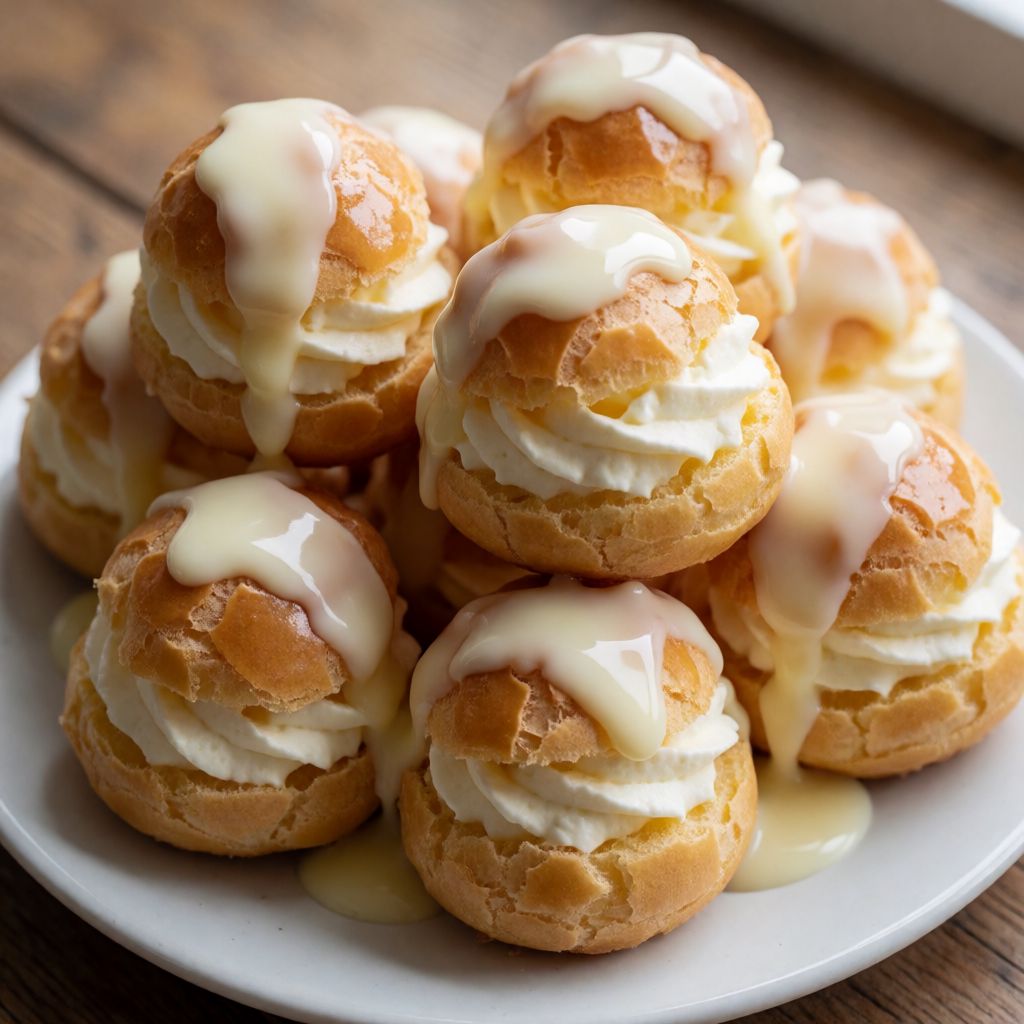
 AI photo
Profiteroles with White Chocolate
Choux pastry buns filled with a dark chocolate pastry cream and topped with a white chocolate glaze.
Labels are worked out automatically from the ingredients and can be wrong. Check the packaging if it matters to you.
Ingredients
- 100 ml Water
- 75 g Plain flour
- 75 g Butter
- 1 pinch Salt
- 4 pcs Eggs
- 300 ml Double cream
- 5 pcs Egg yolk
- 150 g Caster sugar
- 45 g Cornflour
- 500 g Milk
- 1/2 pcs Vanilla pod
- 120 g Dark chocolate
- 300 ml Double cream
- 500 g White chocolate
- 2-3 tsp White food colouring optional












Steps
For the choux pastry, combine the water, a pinch of salt and the butter in a saucepan and bring to the boil over a low heat.
Tip in the flour and mix very quickly with a wooden spoon, stirring until you have a thick dough that comes away from the sides of the pan.
Remove from the heat and let cool, then beat in the eggs one at a time, mixing thoroughly after each addition.
Spoon the dough into a piping bag fitted with a round nozzle and pipe walnut-sized mounds onto a lined baking tray.
With damp fingers, gently press down the top of each mound to smooth it slightly.
Bake in a fan oven preheated to 170°C for 25 minutes (or 30 minutes at 190°C conventional), keeping the door slightly ajar.
25 minIn a bowl, combine 120 g of the caster sugar with the egg yolks, whisk together, then add the sifted cornflour.
Bring the milk to the boil with half a vanilla pod, pour in the egg mixture, stirring until thickened.
Remove from the heat, add the dark chocolate, stir until melted, cover with cling film and leave to cool completely.
Whip the double cream with the remaining 30 g caster sugar, fold into the cooled custard with gentle upward strokes.
Spoon the cream into a piping bag, make a small hole in the base of each profiterole with the tip of a knife and fill with cream.
Stack the filled profiteroles into a pyramid, joining them with dabs of cream.
In a saucepan, bring the double cream almost to the boil, add the chopped white chocolate and stir until smooth.
Remove from the heat, stir in 2-3 tsp white food colouring and mix thoroughly.
Let the glaze cool slightly, then pour it over the profiteroles, covering them completely.
Chill in the fridge for at least 1 hour to set, decorate with dabs of cream and serve.
60 min
What was changed
The alternative static oven temperature was rounded to the local display step .
Choux pastry is a trick with steam. You cook a paste on the stove until it's dry enough to shock, then you force eggs into it, and what you get is a dough that is mostly water held in a flour-and-egg scaffold. In the oven that water turns to steam, the steam has nowhere to go but out, and it blows the dough into a hollow shell before the crust sets around it. No raising agent does this. The lift is entirely mechanical — trapped steam pushing against a wall that's just strong enough to hold its shape and just weak enough to expand. That's why the door stays ajar: a fully sealed domestic oven traps humidity, the shells stay damp inside, and they collapse the moment you take them out. A cracked door lets the steam you don't need escape and keeps the one you do need inside the bun.
Some say you can't make choux without a stand mixer. No — because the dough at the "beat in eggs" stage is stiff enough to fight a wooden spoon, not impossible for one. What you actually need is patience at the point where the flour goes in: you're cooking out raw starch and driving off water until the paste pulls cleanly off the pan sides and leaves a filmy coat on the bottom. Underdo that and the shells never dry properly, however long you bake them. The dough tells you when it's ready by texture, not by a clock.
Water, butter, flour, salt, eggs — nothing in choux is decorative. Butter's job is fat coating the flour's starch and protein, which slows gluten formation and gives you a paste rather than bread dough; it also carries flavour and helps the crust brown and crisp rather than just dry out. Any neutral, firm fat can replace it structurally, but butter's own taste is part of the point here, so don't reach for a flavourless substitute unless you have to. The eggs do three jobs at once: they loosen the cooked paste back to a pipeable consistency, they provide the protein network that sets the crust in the oven, and their moisture is a second source of the steam that inflates the shell. Four eggs is a working average — crack them in gradually and stop when the dough falls off the spoon in a thick, reluctant ribbon, because egg size varies and a too-wet dough won't hold a shape when piped.
Double cream appears twice, for different reasons. In the filling, whipped cream lightens pastry cream into something that pipes and eats soft, not stodgy. In the glaze, cream unmelted is just cream, but warmed until it's nearly boiling, it has enough heat to melt chopped chocolate into a stable emulsion without scorching it — chocolate seized straight over direct heat turns grainy, because cocoa solids and sugar don't like sudden, uneven heat, they like gentle and even. If you don't have double cream, any cream with enough fat to whip — above roughly 35% — will do the same job; thin cream won't hold shape and won't make a glaze that sets.
Egg yolks, sugar and cornflour together are what make the custard a crème pâtissière rather than a sweet sauce. Yolks give richness and some set; cornflour gives a stable set that survives folding, piping and a day in the fridge, where egg alone would break down. The cornflour must be sifted into the yolk-sugar mixture and not dumped in dry, or you get lumps that never fully hydrate and leave grit in the finished cream — that's the defect the sifting step is quietly preventing. Vanilla pod split into the hot milk infuses real vanillin oils that a splash of extract only approximates; use extract if you must, but expect a flatter flavour, not a worse one exactly, just thinner.
Dark chocolate melted into the hot custard turns it into a chocolate pastry cream without you having to cook a separate chocolate custard from scratch — the custard's own heat is enough to melt it, which is one less pan and one less chance to scorch something. White chocolate in the glaze is a different animal: it's mostly cocoa butter, sugar and milk solids with no cocoa mass, which is why it needs the food colouring if you want it properly white rather than the natural ivory it goes slightly yellow-cream from the cocoa butter and milk fats — purely cosmetic, skip it and nothing about the taste or set changes.
Some say profiteroles need a professional piping setup to look right. No — because the whole point of piling them into a pyramid under a poured glaze is that it hides unevenness. A disposable bag with the corner snipped off does the choux and the filling both; what actually matters is piping walnut-sized mounds of roughly even size, because wildly different sizes bake at different rates and you'll have some dry and some soggy out of the same tray.
This feeds eight as a proper dessert, more as a tea-table centrepiece next to the usual pot of tea with milk — a pyramid like this is built to be picked at, not portioned out in exact eighths, so treat the serving number as a rough guide to quantity, not a cutting diagram.