
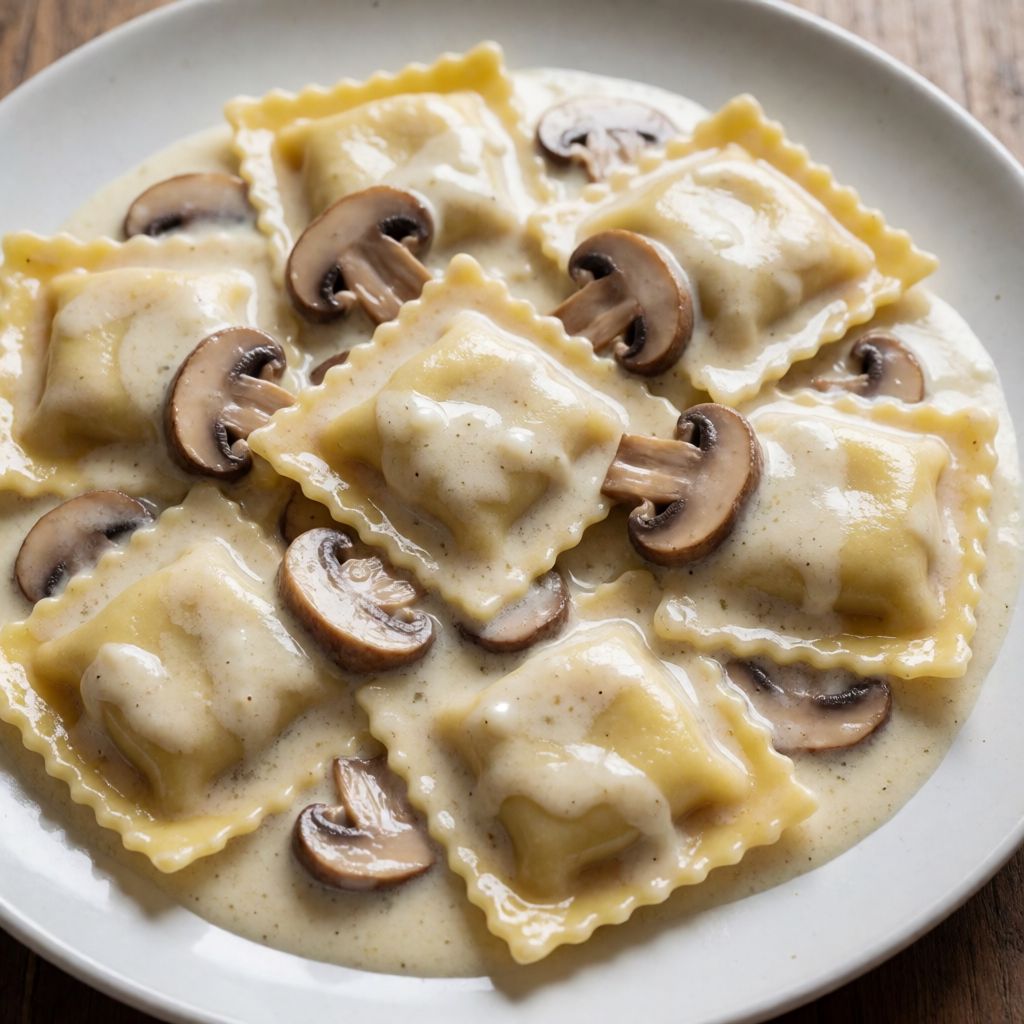
 AI photo
Ravioli with Gorgonzola Sauce
Homemade ravioli filled with wild mushrooms, ricotta and walnuts, served with a creamy blue cheese sauce and rocket.
Labels are worked out automatically from the ingredients and can be wrong. Check the packaging if it matters to you.
Ingredients
- 175 g Durum flour
- 175 g Plain flour
- 4 pcs Eggs
- 1 tbsp Olive oil
- 1 pinch Salt
- 150 g Chanterelles or other mushrooms
- 250 g Ricotta
- 1 bunch Parsley finely chopped
- 1 clove Garlic crushed
- 40 g Walnuts finely chopped
- Black pepper freshly ground
- 15 g Butter for frying
- 170 g Blue cheese
- 0.5 pcs Onion finely chopped
- 200 ml Double cream
- 1 tsp Olive oil for frying
- 75 g Rocket
- 1 tbsp Parsley finely chopped








Steps
Mix the flour and salt, and pile onto the worktop with a well in the centre. Pour in the eggs and olive oil, gently beat the eggs with a fork, gradually working in the flour until the dough is smooth and can be kneaded.
Depending on the size of the eggs, you may need a little more flour.
Put the dough in an airtight container and chill in the fridge for 1 hour, or overnight, to rest.
60 minFry the chanterelles in butter in a hot pan, set a few aside for serving, and finely chop the rest.
Mix the ricotta with the chanterelles, parsley, garlic, walnuts, salt and freshly ground black pepper until smooth.
Roll the dough out thinly using a pasta machine or a rolling pin on a floured surface.
Cut out circles or squares with a cutter.
Place a teaspoon of filling on each circle of dough, cover with another circle and pinch the edges together all round — with a ravioli cutter or a fork.
Bring a large pot of water to the boil.
Add salt and cook the ravioli for 3 1/2 minutes.
4 minLift out the ravioli with a slotted spoon and let the water drain off.
Fry the onion in olive oil in the pan until soft.
Add the cream and blue cheese to the pan and stir until the cheese has melted.
Season with freshly ground black pepper to taste.
Serve the freshly cooked, hot ravioli on plates with the gorgonzola sauce, sprinkled with rocket.
This is pasta built from two directions at once: an egg dough you make yourself, and a filling that borrows from the forest. The dough is the bit people are afraid of and shouldn't be. The filling is the bit people rush and shouldn't.
What decides whether this works is moisture — in the filling and in the sauce. Ricotta holds water the way a sponge holds water: look fine, squeeze, and it floods the dough. If the filling is wet, the ravioli won't seal, it'll weep through the pinch and the parcels will burst open in the boil, filling drifting off into the pot instead of staying put. So you fry the chanterelles properly, not steam them in their own juice, and you let them lose their water in butter before they ever meet the ricotta. That one frying step is the whole insurance policy.
The sauce has the same problem from the other end. Blue cheese and cream both want to split if you push them too hard — cream because fat separates when it boils fast, cheese because its own fat and salt curdle the dairy around it. So it's a melt, not a simmer: cream goes in, cheese goes in, heat stays gentle enough that you're coaxing rather than cooking. If it ever looks grainy or oily on top, that's the fat breaking away from the liquid — it's gone too hot, too long, not "not enough cheese."
The flour split — durum and plain, half and half — isn't fussiness, it's physics. Durum is high-protein, high-gluten, the flour pasta factories use because it gives a dough that holds its shape and a bite that doesn't go to mush. Plain flour on its own would give you dough too soft to roll thin without tearing; durum on its own, by hand, can fight you and crack. Together you get dough that's strong enough to roll paper-thin and still elastic enough to seal. If you only have plain flour in the cupboard, use it — just expect slightly softer pasta, and don't try to roll it as thin as you would the mix.
Four eggs plus a spoon of olive oil is doing the job that water would do in cheaper dried pasta — eggs give fat and protein that make the dough rich, yellow, and tender rather than just starchy. The oil is there to stop the dough being dry and crumbly at the kneading stage; a pinch more or less flour depending on egg size is normal, eggs aren't a fixed volume. Chilling the dough for an hour isn't about food safety, it's about the gluten relaxing — knead dough and it fights back when you try to roll it; rest it and it goes slack and co-operative. Skip the rest and you'll find yourself wrestling the pasta machine.
Chanterelles are named because they're good, not because they're required — any mushroom that holds its shape when fried works, chestnut mushrooms from the supermarket are a fair stand-in and nobody will complain. What matters is frying them hot and hard enough that the water they release evaporates rather than pools, which is the only way to get concentrated mushroom flavour instead of a wet, pale version of it. Butter rather than oil here because butter browns and carries flavour into the mushroom as it cooks — oil just lubricates.
Ricotta is the filling's base because it's mild and loose enough to bind garlic, walnut, parsley and mushroom without fighting any of them for attention — a strong cheese would drown out the chanterelles you just worked to get right. Walnuts, finely chopped, add bite against all that softness; parsley and garlic are there raw-ish, folded in off the heat, to keep some freshness against the cooked, buttery mushroom.
For the sauce, "blue cheese" and "gorgonzola" in the name aren't the same promise — true gorgonzola, especially the dolce version, is softer and milder than a lot of British blue, so if you use a sharp Stilton expect a stronger, saltier sauce, and taste before you add extra salt. Double cream, specifically, because its higher fat content is what lets it take the heat and the cheese's salt without curdling — lighter cream is more likely to split under that combination. The rocket at the end isn't decoration so much as correction: bitter leaf against rich cheese sauce, cutting it the way you'd want a squeeze of lemon to cut something fried.
Some say ravioli has to be cut into neat identical circles with a proper cutter to be "real" — no, because what the shape is actually protecting against is uneven sealing. A fork-pinched edge or a rough square holds filling in just as well as a fluted circle; restaurants use cutters for photographs, not for flavour. What you can't skip is pressing the air out before you seal — trapped air makes the ravioli puff and then split in the boiling water, same failure as a filling that's too wet, different cause.
And three and a half minutes in boiling, salted water is a floor, not a clock to watch — fresh pasta this thin cooks fast, and the real sign is the ravioli rising and looking slightly swollen and translucent at the edges, not a timer going off. Pull one out and bite it if you're unsure. That's not cheating, that's how you learn what three and a half minutes actually looks like in your own pot.