
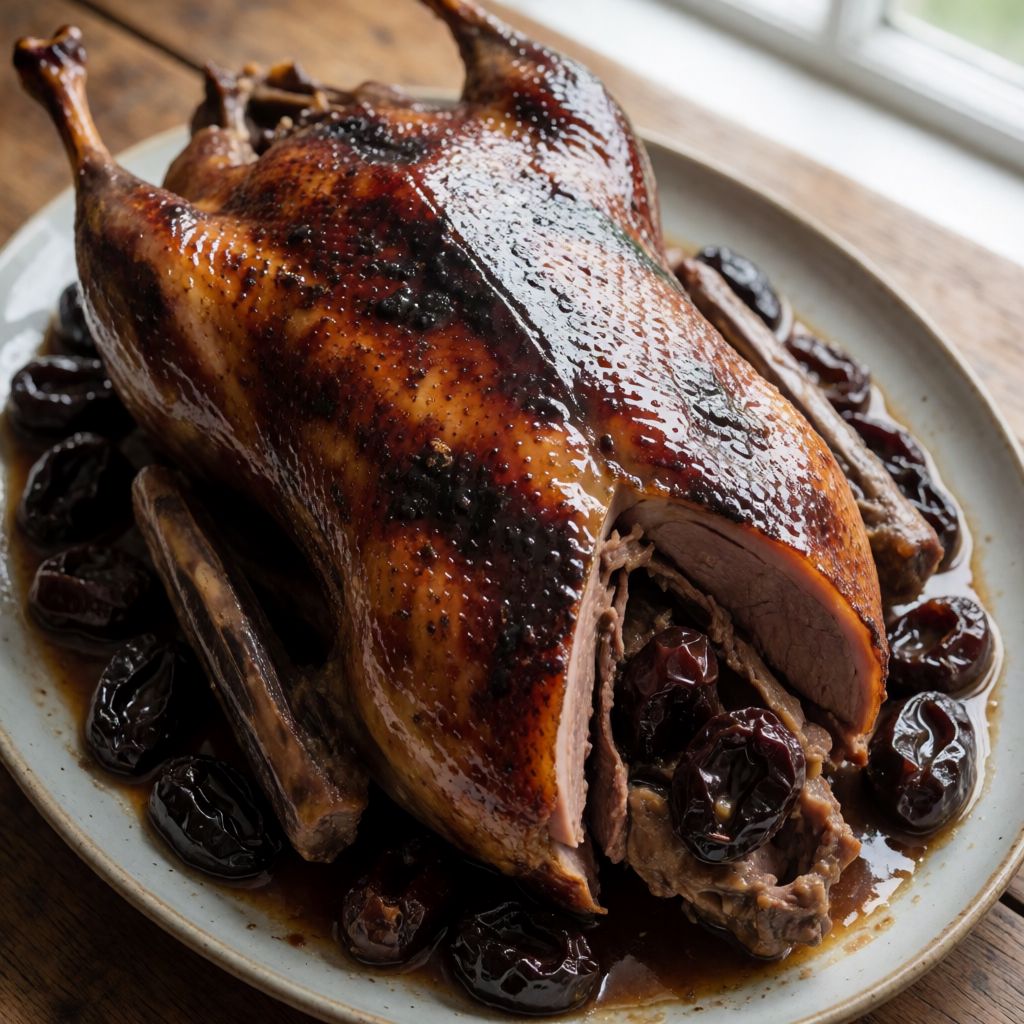
 AI photo
Slow-Roasted Goose
A slowly roasted goose with a prune and apple stuffing, cured in brine for a day before cooking.
Ingredients
- 4 kg Goose whole
- 5 l Water
- 500 g Salt
- 250 g Caster sugar
- 200 g Prunes stoned
- 200 ml Port wine
- 4 pcs Apple diced
- 3 pcs Red onion quartered
- Salt
- Black pepper freshly ground
- 500 g Goose giblets
- 2 pcs Red onion quartered
- 4 pcs Carrot cut into large chunks
- 4 pcs Celery cut into large chunks
- 1 pcs Leek cut into large slices
- 4 pcs Bay leaf
- 2 pcs Thyme fresh sprigs
- 10 pcs Black pepper peppercorns
- 2 l Water














Steps
Defrost the goose slowly in the fridge over 3-4 days, starting 4 days before roasting, keeping the fridge at 5-7°C.
The day before roasting, remove the giblets from the goose, place them in a covered bowl and keep in the fridge.
Bring 5 litres of water with the salt and sugar to the boil, cool completely and pour over the goose in a large tub, cover and leave in a cold place for 24 hours.
Soak the prunes in the port wine 1 day before roasting.
Before roasting, pat the goose dry inside and out with paper towels and rub generously with salt and pepper, inside and out.
5 minPut the port-soaked prunes, diced apples, red onion, salt and pepper into a large bowl and mix well. Stuff the goose with this mixture and close the opening with cooking skewers so the stuffing doesn't fall out.
10 minPlace the goose giblets on the bottom of the roasting tin together with the onion, carrot, celery, leek, bay leaf, thyme and peppercorns to form a snug bed for the goose.
5 minPlace the goose breast-side down in the tin and roast at 125°C, conventional setting, for 2.5 hours.
150 minRemove the goose and pluck out any remaining pin feathers with kitchen tweezers, taking off small bits while the skin is still warm.
15 minSet the oven to 150°C, place the goose on a rack over the tin breast-side up, pour water into the tin and insert a thermometer into the thickest part. Roast for 1 hour, basting with the pan juices every 30 minutes, until the temperature reaches 65°C.
60 minRemove the goose, strain the juices and stuffing from the tin through a fine sieve into a bowl. Discard the stuffing, and place the bowl of stock in the fridge for a few minutes for the sauce.
5 minPour 200ml of water into the tin and place the goose back in. Raise the temperature to 230°C and roast until the temperature reaches 72°C, optionally giving it a few more minutes for crispy skin up to 73-74°C.
30 minLet the goose rest uncovered for 10-15 minutes on the counter, until the temperature rises to 75°C.
What was changed
In the 150°C step, the duration (1 hour) was added, which was missing from the original text.
A goose is not a big chicken, and if you roast it like one you'll serve rubber over a lake of fat. This is a bird built to insulate a cold-water animal — a thick layer of fat sits right under the skin, and your whole job for two hours is to render that fat out slowly without cooking the meat underneath to death. Everything in this method — the brine, the low start, the breast-down position, the final blast at the end — answers to that one fact.
Brining first, 24 hours in a salt-and-sugar water. Some say brining is for drying out, overcooked cuts that need help. No — here it's doing the opposite job. Goose breast is lean muscle sitting over that fat layer, and lean muscle on a long slow roast will seize and squeeze its own moisture out before the fat around it has even started to melt. The salt changes the protein structure so the meat holds water under heat instead of fighting to expel it. The sugar isn't for sweetness you'll taste — it balances the cure and helps the skin colour later.
Breast-side down for the first 150 minutes at a heat gentle enough that nothing browns — 125°C. That's the whole trick of this bird: upside down, the breast sits furthest from the floor of the tin and the fat on the back and legs renders downward and bastes the exact muscle that dries out fastest. The vegetables and giblets underneath aren't flavour for their own sake, they're a rack — they keep the bird's own weight from stewing in the fat that's dripping out, and they feed the sauce later.
Start with the thaw, because this is where most home geese go wrong before they've even seen an oven. Four kilos of bird frozen solid needs three to four days in a fridge running at 5-7°C to come back to life evenly. Do it on the counter and the outside sits in the danger zone for bacteria while the inside is still ice — not a theoretical risk, a real one with a bird this size. Patience here isn't optional, it's the ingredient that makes everything after it safe.
The giblets go under the bird as a bed with onion, carrot, celery, leek, bay, thyme, peppercorns — this is a stock you're building in situ. Any root vegetable that holds its shape under two and a half hours of heat will do the job; what matters is bulk and moisture, something between the goose and bare metal. No giblets, no bother — a mesh of any cheap aromatics does the physical job of the rack, you'll just lose some depth in the strained juices later. A kazan would hold its heat evenly round a bird like this; your oven does it with a fan and a thermometer instead, and that's a fair trade as long as you trust the numbers over your eyes.
Prunes soaked a day ahead in port — the stuffing isn't there to be eaten as stuffing, mostly. Its real job is to hold moisture and aromatic steam inside the cavity while the outside renders, and to pick up goose fat and juice as it sits. Port gives acidity and sugar that balances the richness of the fat; if you haven't got it, any dark, slightly sweet wine or even strong black tea with a spoon of honey does the same chemical job — soften the prune, add a contrasting note, nothing more mystical than that. Apple does similar work, releasing moisture as it softens, and red onion turns from sharp to sweet as it steams inside there, same transformation you'd want from an onion anywhere, just happening in a closed, humid oven of its own.
Salt and pepper rubbed on after patting the skin properly dry — and dry is the word to take seriously. Any water sitting on the surface has to boil off before the skin can start rendering and crisping, and that wasted energy is exactly why some people find goose skin goes rubbery rather than brittle. Paper towels, patience, press don't wipe.
On the final stage: raising to 230°C at the very end is a short, deliberate shock, not the whole cook. By this point the fat is mostly rendered and the meat is basically there — this blast is only for the skin, converting that last rendered layer into something crisp before the proteins underneath have time to toughen. Watching 72 creep to 74°C is you deciding how much crackle you want against how much you're willing to risk the breast drying. There's no wrong answer, only a trade you're making with your eyes on the dial.
The resting stage at the end, uncovered on the counter, looks like nothing is happening — that's the point. The heat sitting in the outer layers keeps travelling inward with no flame under it, pushing the core up those last couple of degrees to 75°C while the muscle fibres relax and pull the juice back in rather than onto your carving board. Cut into it straight from the oven and you'll watch all that work run out onto the plate. Ten to fifteen minutes costs you nothing and buys back everything the two-hour render was for.
As for the fat that collects in the tin through all this — don't throw it out, obviously. Strained and kept, it's better for your next roast potatoes than anything you'd buy in a bottle for that purpose, and that's really the only sensible way the British kitchen and this very Continental method of cooking a goose end up shaking hands.