
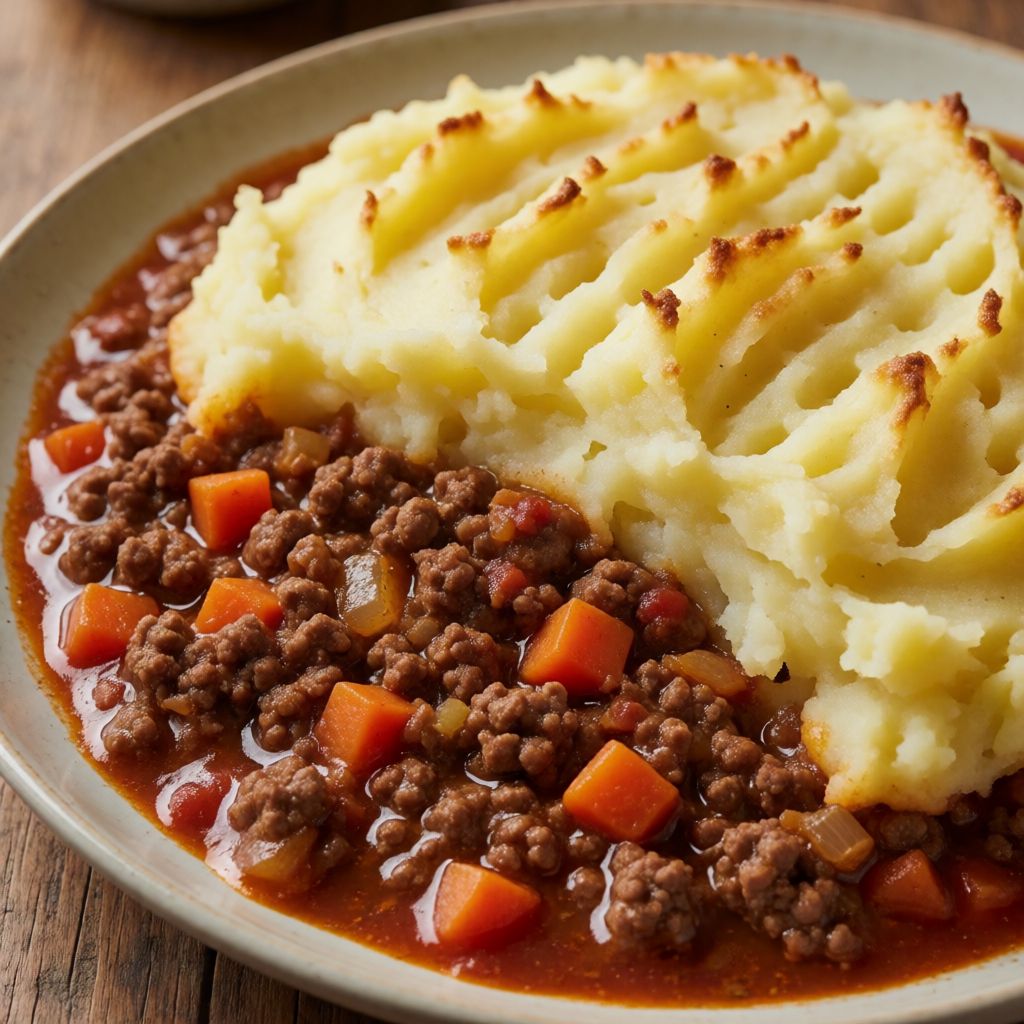
 AI photo
Cottage Pie
A comforting, hearty beef and vegetable pie topped with creamy mashed potato.
Labels are worked out automatically from the ingredients and can be wrong. Check the packaging if it matters to you.
Ingredients
- 1 pcs Onion finely chopped
- 500 g Minced beef
- 2 pcs Carrot coarsely grated
- 2 pcs Celery stalks, coarsely grated
- 2 clove Garlic finely chopped
- 2 tbsp Tomato purée
- 200 ml Stock
- 100 ml Red wine
- 2 tbsp Worcestershire sauce
- 1 tsp Dried thyme
- 1 tbsp Rosemary finely chopped, fresh
- 1 tbsp Butter for frying
- Salt
- Black pepper freshly ground
- 1 kg Potatoes
- 75 g Butter
- 3 tbsp Double cream
- 2 tbsp Parmesan freshly grated
- 1 tbsp Breadcrumbs
- Salt
- Black pepper freshly ground
- 100 ml Parsley finely chopped, for sprinkling



















Steps
Fry the onion in a saucepan with butter until soft.
Add the minced beef and brown well over high heat.
Lower the heat and add the carrot, celery, garlic, tomato purée, red wine, Worcestershire sauce, stock, thyme and rosemary, salt and pepper.
Bring to the boil and simmer uncovered for 10 minutes.
Boil the potatoes in a pot of plenty of unsalted water until soft.
Transfer the potatoes to a bowl with the butter and whisk with a mixer until creamy.
Add the cream and season with Parmesan, salt and pepper.
Spoon the meat sauce into a greased ovenproof dish and cover with the mashed potato.
Smooth the mash with a spatula and score a pattern with a fork.
Sprinkle with breadcrumbs and a little extra Parmesan.
Bake in a preheated fan oven at 180°C for 30-45 minutes.
Before serving, sprinkle with finely chopped parsley.
Cottage pie is a bookkeeping dish before it's a comfort dish. Someone in Britain, generations back, worked out that leftover meat from the Sunday roast didn't need to be leftover at all if you put a lid of mash on it and sent it back into the oven — the oven did the reheating and the dressing-up in one go. Mince came later, once beef got cheaper than the whole joint, but the logic stayed: meat underneath, potato on top, nothing wasted. Shepherd's pie is lamb, cottage pie is beef — that's the whole difference, and it's worth saying plainly, because people argue about it as if it were theology when it's just which animal was in the pot.
What decides whether it works is restraint in two places. The mince has to actually brown — not steam, not go grey and watery — because that crust is where the flavour of beef actually lives; skip it and you have grey meat sauce under potato, technically cottage pie, tasting of neither place. And the mash has to be dry enough to hold a ridge from a fork without slumping, because a wet mash will just slide and merge with the meat juice underneath and you lose the two textures that make the dish interesting: the give of potato against the bite of sauce.
Start with the mince itself. "Brown well over high heat" is doing real work in step 2 — a domestic hob at full blast in a normal saucepan still won't get you a proper sear if the pan is crowded, because 500g of meat dumped in at once releases water fast, and water in the pan means you're boiling, not browning. If your pan is narrow, do it in two batches rather than one crowded one; the colour you're chasing is a deep ginger-brown crust on the mince, not grey crumbs that merely cooked through. That crust is the Maillard reaction — just caramelisation of proteins and sugars — and it's the entire reason this dish tastes of something instead of tasting of nothing but salt.
The carrot and celery go in grated, not diced, and that's not a texture whim — coarse grating gives them more surface area, so ten minutes of simmering is actually enough to soften them into the sauce rather than leaving raw crunchy flecks in a dish that's meant to collapse together. If you only have a chunk of carrot and no grater, fine dice will do the same job slower; just give it a few extra minutes and check by eye — a carrot piece that still snaps when you press it with a spoon isn't ready, one that gives and bends is.
Red wine and Worcestershire sauce are both doing the same job from different directions: acidity and umami that the stock alone won't supply. If you don't drink wine or don't have any open, a splash of balsamic or even a spoon of extra tomato purée loosened with water gets you partway there — you're not trying to taste wine, you're trying to cut the fattiness of the beef. Worcestershire sauce has no real substitute flavour-wise, but a dash of soy sauce plus a drop of vinegar mimics its fermented-savoury-sharp character reasonably well in a pinch.
For the stock: use what you'd use for gravy on the Sunday roast, beef stock by preference, since this is a dish built from the economics of that same roast. Thyme and rosemary are the herbs that survive long cooking without turning bitter or disappearing — soft herbs like basil or parsley would just vanish into the simmer, which is exactly why parsley is reserved raw, for the very end, where its brightness can still be tasted rather than boiled away.
On the mash: "plenty of unsalted water" for the potatoes isn't fussiness, it's about starch. Salt the water and you slow the potato's uptake of moisture, which can leave a slightly waxy centre; salt the mash itself afterwards instead, when you can taste and adjust. Use a floury potato — Maris Piper or King Edward if you're shopping in the UK — because a waxy potato (new potatoes, Charlotte) won't break down properly and you'll get a gluey mash instead of a fluffy one, however hard you whisk. Whisking with a mixer rather than mashing by hand is there to beat air in, but go carefully — overdo it and the starch cells rupture and the mash turns gluey regardless of potato type, which is the one place in this recipe where more effort actively works against you.
The butter and cream in the mash aren't optional richness, they're what makes the top layer taste like something on its own rather than just a lid — this dish rises and falls on that top crust as much as the meat, since it's the first thing your fork and your eye meet. Parmesan and breadcrumbs on top exist for one purpose: a dry, hot oven surface browns, a wet one doesn't, so sprinkling something porous and something with its own protein-sugar content onto the mash gives the 180°C fan oven something to catch and colour into a crust, rather than leaving you with pale, steamed potato under a lid.
One pound of potato and half a kilo of mince for four people is a reasonable domestic ratio — not stingy, not showing off. If your oven dish is deep, lean toward the 45-minute end of the bake; shallow dish, nearer 30 — you're waiting for the gravy to bubble up visibly at the edges and the top to turn spotted brown, not for a timer to go off. Patience here is mostly in the first ten minutes of the sauce and the browning of the mince — rush either and no amount of oven time fixes it afterward.