
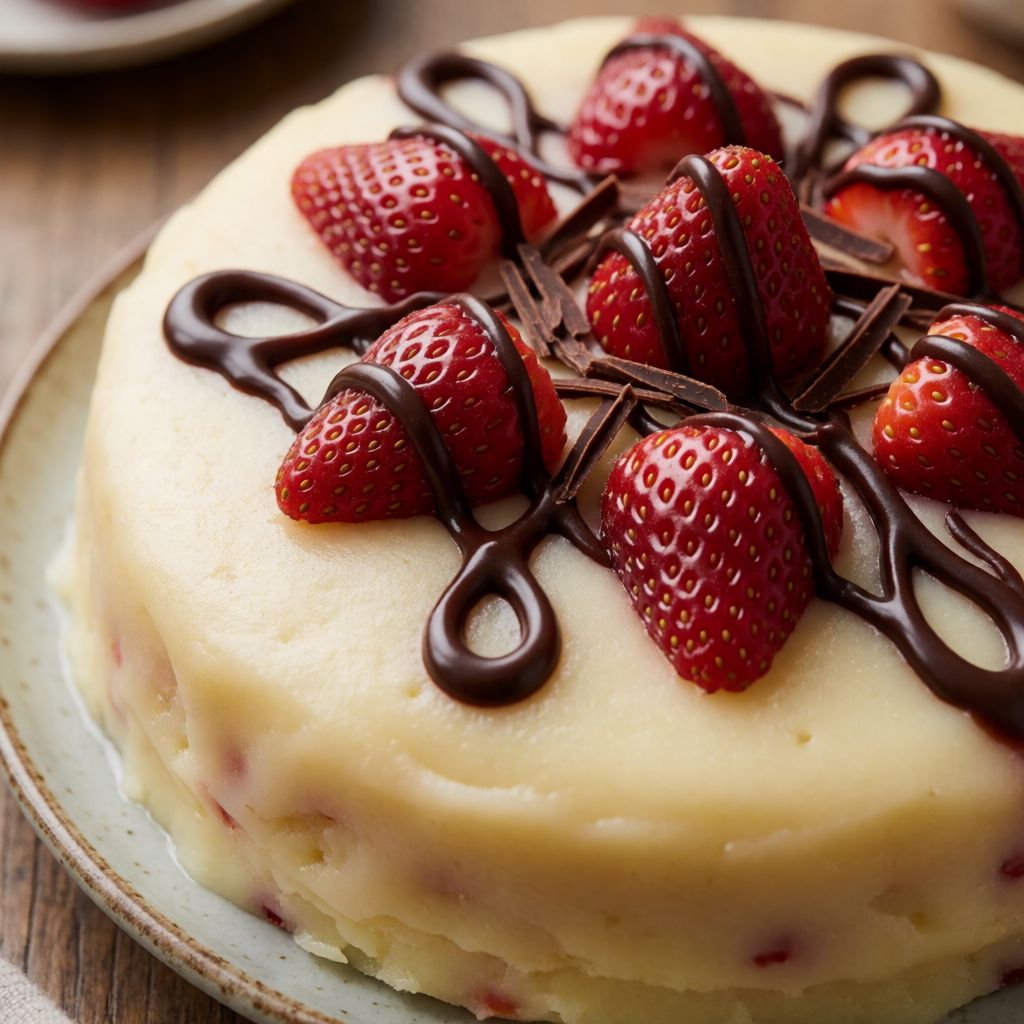
 AI photo
Strawberry Marzipan Cake
A marzipan sponge topped with dark chocolate, vanilla custard cream and fresh strawberries, finished with mint leaves.
Labels are worked out automatically from the ingredients and can be wrong. Check the packaging if it matters to you.
Ingredients
- 200 g Marzipan coarsely grated
- 75 g Caster sugar
- 200 g Butter soft, at room temperature
- 4 pcs Eggs
- 50 g Plain flour
- 100 g Dark chocolate
- 1 pcs Vanilla pod half a pod
- 250 ml Milk
- 3 pcs Egg yolks
- 15 g Cornflour
- 60 g Caster sugar
- 100 ml Double cream
- 400 g Strawberries
- 1 bunch Mint fresh











Steps
Beat the marzipan with the caster sugar until smooth, then beat in the butter, add the eggs one at a time, beating well, and fold in the plain flour until the mixture is smooth and light.
Spoon the batter into a greased 24cm springform tin lined with baking parchment on the base.
Bake the sponge in a preheated fan oven at 175°C for 25–30 minutes.
30 minScatter the dark chocolate over the hot sponge and leave to cool on a wire rack, chilling in the fridge for a quarter of an hour if needed.
15 minSplit the vanilla pod, scrape out the seeds and mix with the sugar, stirring well.
Mix the vanilla sugar, egg yolks and cornflour, pour in the milk and heat to the boil, stirring constantly, until the mixture thickens.
Pour the vanilla cream into a bowl and chill in the fridge until completely cold.
Whip the double cream until light and airy, fold two tablespoons into the vanilla cream, then gently fold in the rest until you have a delicious light, thick cream.
Spread the vanilla cream evenly over the marzipan base, top generously with strawberries and a scattering of small fresh mint leaves.
This isn't really a cake in the sponge-and-rise sense. It's a marzipan paste beaten with butter and eggs into something closer to a dense frangipane, baked flat, married to a chocolate shell, and crowned with proper custard-and-cream and raw strawberries. The thing that decides whether it works is fat. Marzipan is already roughly half sugar and half almond paste holding its own oils, so when you beat 200g of it with 200g of soft butter and four eggs, you're not making a sponge that needs air — you're making something that behaves more like a baked ganache. Overbeat it chasing "fluffy" and you just warm the fats and it weeps in the oven. Beat it enough to go smooth, no more.
The second thing that decides it is the chocolate layer, and people get this backwards. You don't melt the chocolate and pour it — you scatter it in pieces over the sponge the moment it comes out of the oven, hot enough to melt the chocolate on contact but set already enough to hold a surface. That thin seized layer does one job: it waterproofs the marzipan base so the custard cream you spread later doesn't turn the crumb to paste. Skip it, or do it when the sponge has gone cold, and the chocolate sits as a solid disc instead of a bonded skin — looks fine, does nothing.
Marzipan itself is the ingredient to understand first, because everything else is built around what it already contains. Proper marzipan is ground almonds and sugar, nothing more, usually close to a 1:1 or 1:2 ratio, and it's already got oil in it from the almonds. Grating it coarsely before you start isn't fussy technique — it's just surface area. A solid block of cold marzipan dropped into a mixer will sit there in lumps while the sugar and butter go round it; grated, it breaks down into the beating in minutes instead of fighting you for ten. If a packet says "almond paste" rather than marzipan, check the almond percentage — pure almond paste runs higher in nuts and lower in sugar, so cut the added caster sugar back a touch or the result tips sweet rather than nutty.
The butter has to be properly soft, not just "not fridge-cold." This is a beaten-fat cake, not a whisked-egg one — there's no meringue structure doing the lifting, the eggs go in one at a time to emulsify into the fat rather than to aerate it. Cold butter won't take the eggs smoothly; it'll split, you'll get a curdled-looking batter, and that curdling is literally fat and water refusing to mix, which bakes into a greasy, uneven crumb instead of a close one. If your kitchen is cold, a minute in a bowl near a radiator does more good than any amount of extra beating.
Plain flour here is doing almost nothing structurally — fifty grams against 200g of marzipan and four eggs is barely a binder, just enough to stop the thing being a pudding. Don't swap it for self-raising thinking you'll get more lift; there's no lift to be had, the cake's character is dense, not airy, and raising agent would only dry the edges before the middle sets.
For the custard: cornflour is non-negotiable for the reason above, but if you're out, arrowroot does the same gelatinising job and actually clears glossier, though it thins slightly if the custard's reheated — fine here since you chill it once and leave it. Don't reach for plain flour as a swap; it needs several minutes of actual simmering to lose its raw taste, by which point your yolks are long scrambled.
Vanilla pod, split and scraped into the sugar, is there because vanilla's flavour compounds are fat-soluble, not water-soluble — rubbing the seeds into sugar first breaks up the sticky paste and spreads it through the mix instead of leaving black specks clumped in one spoonful. A good vanilla extract (not the artificial essence, which is mostly vanillin and thin by comparison) is a fair substitute, added with the milk rather than the sugar.
Double cream, whipped and folded in two stages — a couple of spoonfuls first, then the rest — is standard practice for a reason: folding a light whipped cream straight into a dense cooled custard in one go means you're forcing air through resistance and you knock half of it straight back out. The first spoonfuls loosen the custard so the second fold meets something closer to its own weight, and more air survives.
Strawberries want to be ripe enough that a knife through them shows no white core, and don't bother refrigerating them beforehand if you can help it — cold straight from the fridge mutes what little scent they have, and scent is most of what strawberry flavour actually is. Mint is for cutting through the cream's richness with something sharp and green; if you haven't got it, a fine zest of lemon over the strawberries does a similar job, though it's a different cake at that point, not a lesser one.
On the tin: a UK 24cm springform with parchment only on the base is right — don't grease and line the sides, this batter is dense enough and fatty enough to release clean, and a lined side just traps steam and gives you a soggy ring where the crumb meets the paper.