
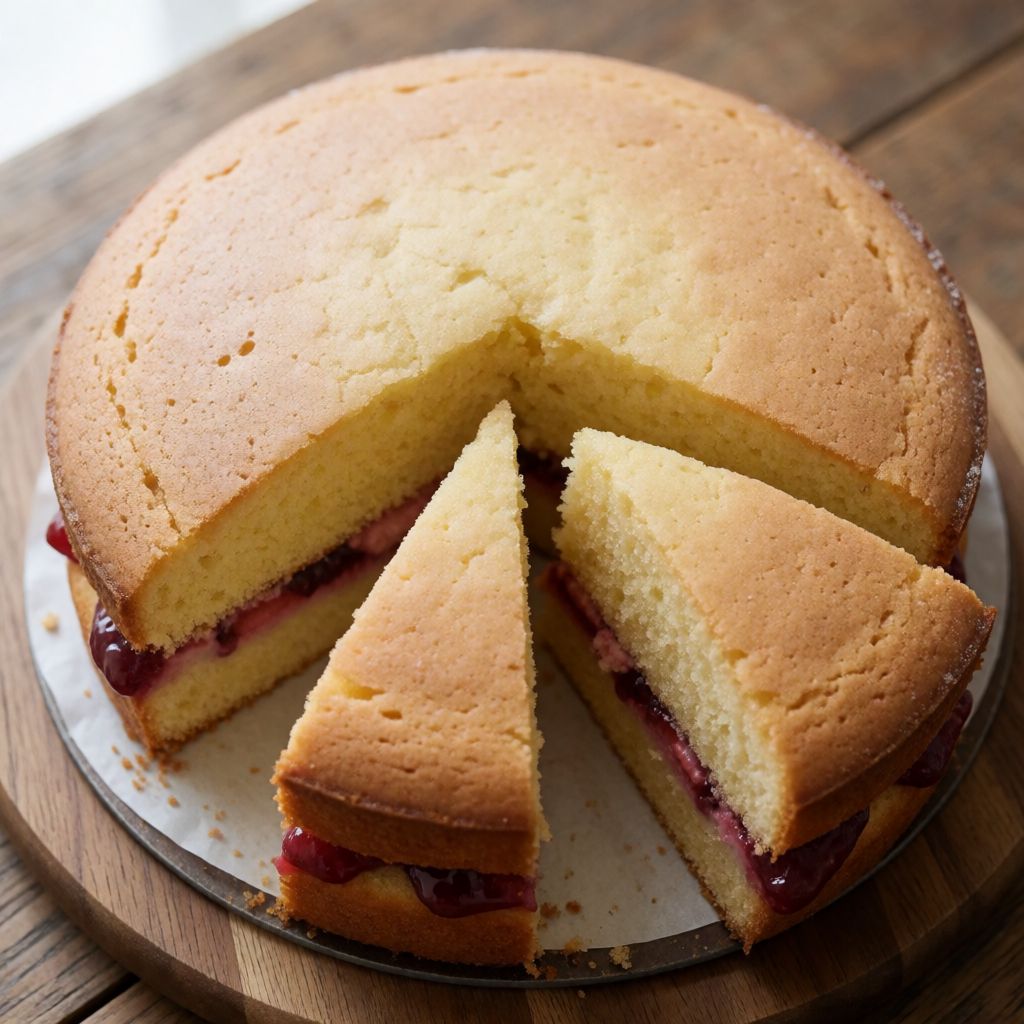
 AI photo
Strawberry Jam Cake
A soft Ukrainian-style sponge cake layered and topped with strawberry jam, baked until golden.
Labels are worked out automatically from the ingredients and can be wrong. Check the packaging if it matters to you.
Ingredients
- 3 pcs Eggs
- 200 g Sugar
- 100 g Butter softened
- 1 tsp Vanilla Extract
- 0.5 pcs Lemon Zest from half a lemon
- 50 g Milk
- 300 g Flour sifted
- 50 g Potato Starch
- 10 g Yeast
- 160 g Strawberry Jam approximately








Steps
In a bowl, combine the eggs and sugar and beat with an electric mixer until light, creamy and well combined.
Gradually add the softened butter in parts, continuing to beat.
Flavour the batter with vanilla extract and lemon zest.
Pour in the milk, then gradually add the sifted dry ingredients: flour, potato starch and yeast. Mix well until smooth.
Transfer about half of the batter into a 20 cm cake tin, greased and dusted with flour.
Spoon over part of the strawberry jam, then pour the remaining batter on top.
Spread a little more strawberry jam over the surface.
Bake in a fan oven at 170°C for 45–50 minutes, or at 180°C for about 60 minutes.
50 min
What was changed
Vanillin was replaced with Vanilla Extract since UK kitchens commonly use vanilla extract instead of powdered vanillin.
This is a one-bowl sponge with a fault line of jam running through the middle and a skin of jam baked onto the top — not a jam-filled layer cake, just a quick family bake that happens to carry fruit instead of nothing. What decides whether it rises properly or sits like a brick has nothing to do with the jam. It's all in the egg foam you build at step one and whether you keep it alive through everything you add after.
You see "Yeast" in the list and the instinct is to think: now I wait, now it proves. No — because there's no resting time anywhere in this recipe, and 10 g going straight into a batter that's baked within the hour isn't biological yeast behaving like yeast. It's acting as a chemical leavener — it meets heat and moisture and lets go of gas once, fast, inside the oven. Real yeast needs time to work and this recipe gives it none. Treat it like baking powder, because that's the job it's doing here.
The actual engine of this cake is the eggs beaten with sugar until pale and thick. That's not decoration — you're whipping air into a liquid and trapping it in a web of egg protein. Everything after that step is either feeding that web (butter, for richness and tenderness) or threatening to collapse it (flour added too fast, batter stirred too hard once the leavener goes in). The potato starch is in there to protect the structure, not strengthen it: it dilutes the gluten in the flour so the crumb stays soft instead of chewy, the same trick behind a classic British sponge getting cornflour added to the mix.
Eggs: three, and if they're cold from the fridge your foam takes longer and holds less air — let them sit out while you measure everything else. There's no real substitute here; this cake's lift depends on egg protein, not on a leavener doing all the work alone.
Sugar: 200 g, and caster sugar dissolves into the eggs faster than coarse granulated, which matters because undissolved sugar grains tear tiny holes in the foam you're building. Any sugar that will dissolve under beating works; it's a solubility question, not a flavour one.
Butter: 100 g, softened — meaning it gives gently under a finger, not melted, not oily. Melted butter has lost the air-trapping structure solid fat has; it'll fold into your foam as a liquid and flatten what you just whipped. Any flavourless solid fat with a similar water content does the same job — a baking margarine, for instance — but an oil won't, because oil can't hold air pockets the way a solid fat can.
Vanilla extract and lemon zest: both pure perfume, no structural role. Zest should come off the lemon in a fine layer, pith left behind, or you get bitterness instead of brightness. Orange zest does the same mechanical job if that's what's in the fruit bowl.
Milk: 50 g, there to loosen the batter so the flour and starch hydrate evenly rather than clumping. Whole milk carries a little fat that helps the crumb stay tender; skimmed or even water will still work, you just lose a bit of richness, not structure.
Flour and potato starch together: 300 g and 50 g. The flour gives you the gluten that holds the cake's shape; the starch gets in the way of too much of that gluten forming, which is what keeps the crumb soft rather than bread-like. Cornflour does exactly the same diluting job if potato starch isn't in your cupboard — it's a starch-for-starch swap, not a flavour one.
Strawberry jam: look for one that holds its shape on a spoon rather than pouring. A thin, runny jam sinks through the raw batter instead of sitting as a seam, and on top it just slides to the rim of the tin and burns there while the centre stays pale. Any thick-set fruit jam behaves the same way strawberry does here — it's about the pectin, not the fruit.
On the oven: a fan setting moves hot air past the cake constantly, stripping away the still layer of cooler air that normally insulates a conventional bake — which is why the fan figure given is lower than the still-air one for roughly the same result. Trust that gap exists in your own oven too, and lean on the skewer test over the clock. And once it's out: let it cool before you cut it. The starch is still setting as it drops in temperature, and a warm slice collapses under its own jam. That wait is part of the method, not dead time.