
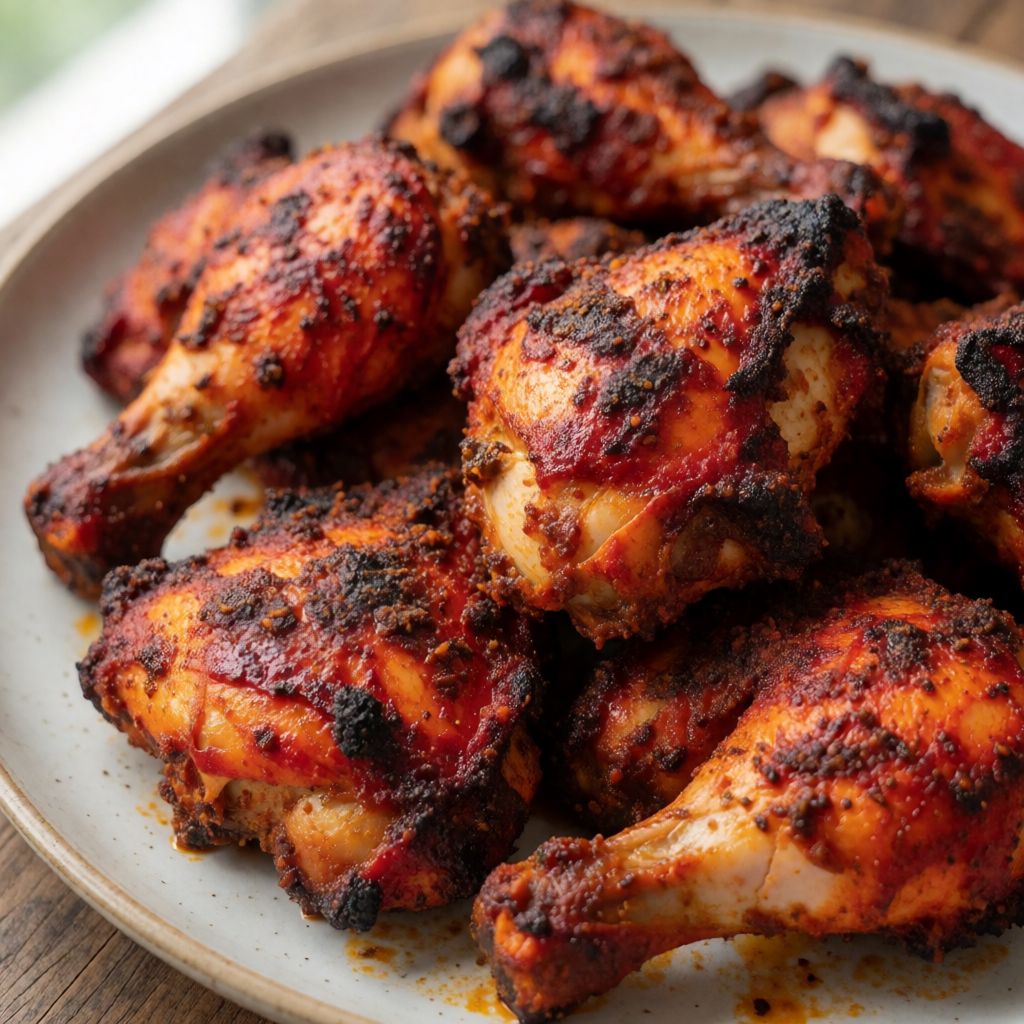
 AI photo
Tandoori Chicken
Tender chicken thighs marinated in warm spices and yoghurt, then roasted until juicy.
Labels are worked out automatically from the ingredients and can be wrong. Check the packaging if it matters to you.
Ingredients
- 1 tsp Cardamom dried
- 1 tsp Cinnamon dried
- 0.5 tsp Cloves dried
- 2 tbsp Cumin dried
- 1 tbsp Ground coriander dried
- 1 tbsp Paprika
- 2 tsp Turmeric dried
- 1 tbsp Ginger
- 300 ml Yoghurt
- 0.25 pcs Lemon juice
- 50 ml Olive oil
- 3 clove Garlic crushed
- 50 g Tomato paste
- 4 pcs Chicken thigh preferably bone-in, skin on
- Salt
- Black pepper freshly ground
- 300 ml Greek yoghurt
- 1 bunch Coriander finely chopped
- 1 bunch Parsley finely chopped
- 2 clove Garlic crushed
- 1 pcs Broccoli broken into florets
- 300 ml Basmati rice cooked according to packet instructions
- 2 pcs Lime cut into wedges
- 1 bunch Coriander fresh leaves






















Steps
Mix all the spices in a bowl with the yoghurt, lemon juice, olive oil, garlic and tomato paste.
Rub the marinade over the chicken pieces. Lift the skin and spread plenty of marinade underneath it too.
Leave the chicken to marinate for 2-3 hours, or overnight.
Place the marinated chicken with the marinade in a greased ovenproof dish and roast for about 40-45 minutes at 175°C.
Put the broccoli in a pan of salted boiling water and cook, covered, for 1 minute.
Drain the broccoli.
Serve the chicken thighs with freshly cooked rice, broccoli, yoghurt sauce, lime wedges and coriander leaves.
For the spicy yoghurt sauce, mix the Greek yoghurt, herbs and garlic, and season well with salt to taste.
Tandoori chicken is named after a clay oven you almost certainly don't own, and that's fine — the dish has already left the tandoor behind. What makes it taste like itself isn't the fire, it's two things working on the meat at the same time: acid and dairy tenderising from the outside in, and a thick coat of ground spice that chars slightly before the chicken is cooked through. In a tandoor that char happens because the oven runs ferociously hot and the chicken hangs close to naked flame. In your oven at 175°C you won't get that same blast, so you trade a little char for a more even, gentler cook — the chicken still comes out deeply flavoured, just less smoky at the edges. That's an honest trade, not a failure.
The marinade is doing real work, not just sitting there for colour. Yoghurt is mildly acidic and full of protein-hungry enzymes and calcium that between them loosen the muscle fibres — this is why tandoori chicken, unlike a dry-rubbed roast bird, stays juicy even on thighs cooked well past "just done." Lemon juice adds a sharper, faster acid on top. Tomato paste isn't for sourness — it's concentrated umami and sugar, and it's what pushes the colour toward that deep brick-red everyone associates with "tandoori" long before any chilli gets involved (there's often very little actual heat in this spice mix — look at the list: cardamom, cinnamon, cloves, cumin, coriander, turmeric — that's a warm, sweet-spiced blend, not a fiery one).
Bone-in, skin-on thigh is the right cut for this, and it's not a sentimental choice. Thigh has more connective tissue and fat than breast, so it tolerates both the long acid bath and the 40–45 minutes in the oven without drying into string — breast would seize up and turn chalky under the same treatment, because it has almost no fat reserve to buy it time. The bone slows heat penetration slightly and keeps the meat near it moister; the skin, even though it won't crisp the way it would on a dry roast, renders some fat into the marinade sitting around it and bastes the meat as it cooks. If all you have is breast, pound it to an even thickness and watch it closely — it'll be done well before 40 minutes, and "well before" is a bend-and-see moment, not a clock moment: when a skewer or knife tip goes to the centre and twists free without resistance, it's done, whatever time you're reading.
The spice mix wants to be fresh-ish and whole where it can be. Ground cumin, coriander, turmeric and paprika all lose their aromatic punch sitting in a jar for a year — if yours smells of not much when you open the tin, it'll taste of not much in the dish too; that's the real reason people buy small jars and use them up, not some rule about purity. Cardamom and cloves you can leave whole and crush yourself right before mixing if you want more lift, but pre-ground is a reasonable, honest substitute — just use it generously, because it's already weaker. Paprika here is for colour and a round, slightly sweet depth, not heat; if you want actual heat, that's a separate decision — add chilli powder or fresh chilli on top of this mix, don't swap it in for the paprika.
Yoghurt should be plain and reasonably thick — full-fat natural yoghurt, not a sweetened or flavoured one. If all you've got is thin yoghurt, drain it through a sieve lined with a paper napkin for half an hour first; thin yoghurt waters down the marinade and slides off the chicken instead of coating it. Olive oil here is doing a carrier job — moving fat-soluble flavour into the meat and keeping the spice paste from scorching into bitterness — so any neutral-tasting oil works; you don't need extra virgin shouting its own flavour over the spices, and in fact a milder oil is arguably more correct for this than a peppery, grassy olive oil would be.
Tomato paste is concentrated for a reason — it's tomato with most of its water cooked out, so it adds colour and savoury depth without loosening the marinade into a liquid that'll run off the meat and pool uselessly in the dish. Don't substitute fresh tomato for it; you'd need to reduce several tomatoes down to get the same effect, and by then you've made tomato paste the hard way.
For the dish around the chicken: the yoghurt-herb sauce is a cooling counterweight, nothing more complicated than that — Greek yoghurt is thicker and holds its shape better than regular yoghurt here, but regular will do if you let a little extra drain off first. The broccoli gets a single minute in boiling water and no more — it's there for colour and a clean, slightly resistant bite against the soft chicken, and a minute past that minute turns it grey and tired, which is the actual reason recipes insist on timing vegetables this briefly rather than just "cooking them through." Rice, lime, coriander leaves — these are plate furniture, there to cut the richness and give you something bright to reach for between forkfuls of chicken. None of it needs reinventing; it needs to be ready at the same moment the chicken comes out, which in a domestic kitchen with one oven and two hobs usually means doing the rice and broccoli in the last fifteen minutes while the chicken finishes, not before.
This feeds four at a normal appetite, one thigh each with sides — if you're feeding people who treat a Sunday roast as a serious commitment, buy a fifth thigh and stretch the marinade a little; it's forgiving enough to cover more meat without losing its balance.