
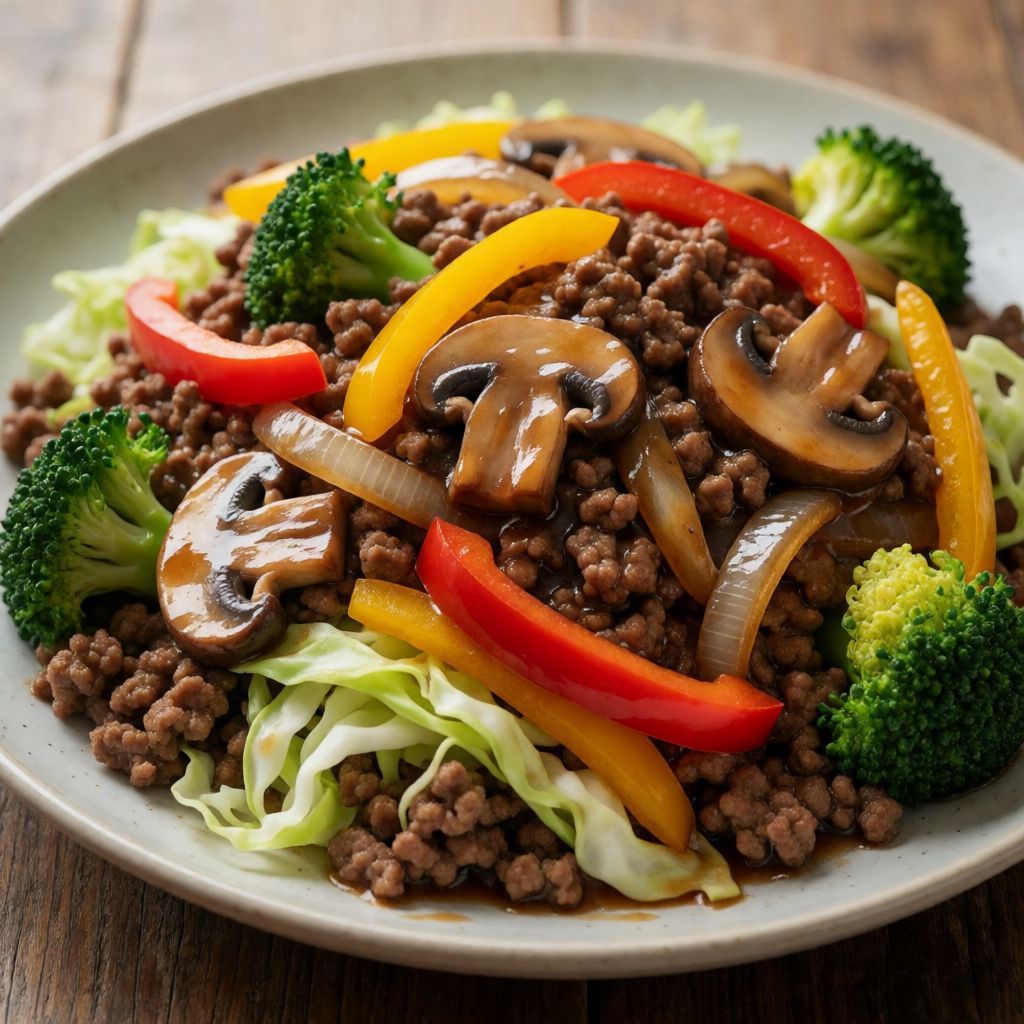
 AI photo
Teriyaki Beef Stir-Fry
A quick beef stir-fry with mushrooms, vegetables and noodles in a homemade teriyaki sauce.
Labels are worked out automatically from the ingredients and can be wrong. Check the packaging if it matters to you.
Ingredients
- 400 g Beef mince
- 200 g Mushrooms sliced
- 1 pcs Onion cut into thin wedges
- 300 g Pointed cabbage finely shredded
- 1 pcs Bell pepper diced
- 300 g Broccoli cut into florets
- 125 g Sugar snap peas sliced
- 200 g Noodles
- 2 tbsp Sesame oil
- 2 tbsp Sesame seeds toasted
- 100 ml Teriyaki sauce
- 2 tbsp Soy sauce
- 2 clove Garlic crushed
- 2 tbsp Brown sugar
- 3 tsp Cornflour
- 2 tsp Ginger freshly grated
- 2 tsp Rice vinegar
- 100 ml Water













Steps
Make the marinade: mix together the teriyaki sauce, soy sauce, garlic, brown sugar, ginger, rice vinegar, water and cornflour.
Heat the oil in a wok and fry the beef over a high heat until nicely browned.
Fry the mushrooms over a high heat until golden-brown.
Return the beef to the wok, add the onion, cabbage, pepper and broccoli, and cook for 3-4 minutes.
4 minMeanwhile, cook the noodles according to the packet instructions.
Pour the teriyaki marinade into the wok and stir-fry over a high heat for 1-2 minutes.
2 minDivide the noodles between bowls, spoon the stir-fry over the top and scatter with sesame seeds.
This is a wok dish pretending to need a wok, which is the first thing to settle in your head before you settle anything in the pan. What actually decides whether it works is sequence and heat, not equipment: meat first and alone, because mince thrown in with vegetables just steams in its own water and goes grey instead of brown. Brown is flavour — the Maillard reaction, sugars and proteins catching at high heat — and it only happens on dry, hot metal with room to breathe. Crowd the pan and you boil, not fry.
So the beef goes in first, in a pan hot enough that it hisses the second it lands, and you leave it alone. Some say stir constantly — no, because every stir drops the pan's temperature and lets the juice pool, and pooled juice is what steams the meat instead of searing it. Let it sit, let it catch, then break it up. Same logic with the mushrooms after: they're mostly water, and they need their own turn in a hot, dry pan to lose that water as steam rather than release it as a puddle everyone else has to swim in.
The vegetables go in together near the end, by design — broccoli and pepper and cabbage all want to stay a little stubborn, with bite left in them, not collapsed. You're not cooking them through, you're warming them past raw and stopping. The marinade goes in last because cornflour thickens on heat, and if you pour it in early it either scorches against hot metal before the vegetables are even in, or thins out from too much time simmering with everything's released water.
Mince is the forgiving choice here — it takes high heat without turning to rubber the way a lean steak strip can if you blink. Any beef with enough fat running through it works the same way; the fat is what keeps it from drying out while it sits getting colour. If you've only got very lean mince, a touch more oil in the pan does the job fat would have done.
Sesame oil earns its place by smell, not by neutrality — it's the one oil in this dish meant to be tasted, so don't swap it for anything flavourless, you'd lose the point of it. If you don't have it, a flavourless oil to cook in plus a spoon of sesame oil stirred through at the very end gets you closer than using a weak substitute throughout — heating sesame oil hard also mutes what makes it worth having, so some cooks hold a little back for after the pan's off the heat.
Cornflour in the marinade is doing one job: thickening the sauce into something that coats rather than runs off the noodles into the bottom of the bowl. Without it you'd have teriyaki-flavoured water. Mixed with a little cold liquid before it meets heat — which is exactly what happens when you stir it into the marinade — it won't clump; thrown straight into a hot pan it would seize into lumps instantly, which is the failure cornflour has a reputation for, when really it's a mixing-order problem, not a cornflour problem.
Teriyaki sauce itself is just soy, sugar and something to thicken it, dressed up with a Japanese name for a method — grilling with a glaze — that long predates the bottled version on UK shelves. Making your own here, rather than relying on shop teriyaki alone, means you control the salt-to-sweet balance instead of trusting a label. Rice vinegar's job is to cut the sugar; if you haven't got it, any vinegar with a light, clean taste stands in — cider vinegar is the nearest thing most kitchens already have, just use less since it's sharper.
Broccoli, sugar snaps, cabbage, pepper — these aren't interchangeable in cooking time, but they're close enough to go in together if you cut them to similar sizes, which is the real trick, not timing each one separately. A vegetable cut thin cooks fast regardless of what it is; that's knife work doing the work people usually blame on the pan.
Noodles cook separately and join at the very end, in the bowl, not the wok — toss them into the stir-fry itself and they'll drink the sauce before it's reduced, leaving you with dry noodles and a thin, disappointing sauce. Patience here is just timing: have the noodles ready and waiting, not the other way round, so the stir-fry doesn't sit cooling while you wait on a pan of water to boil.