
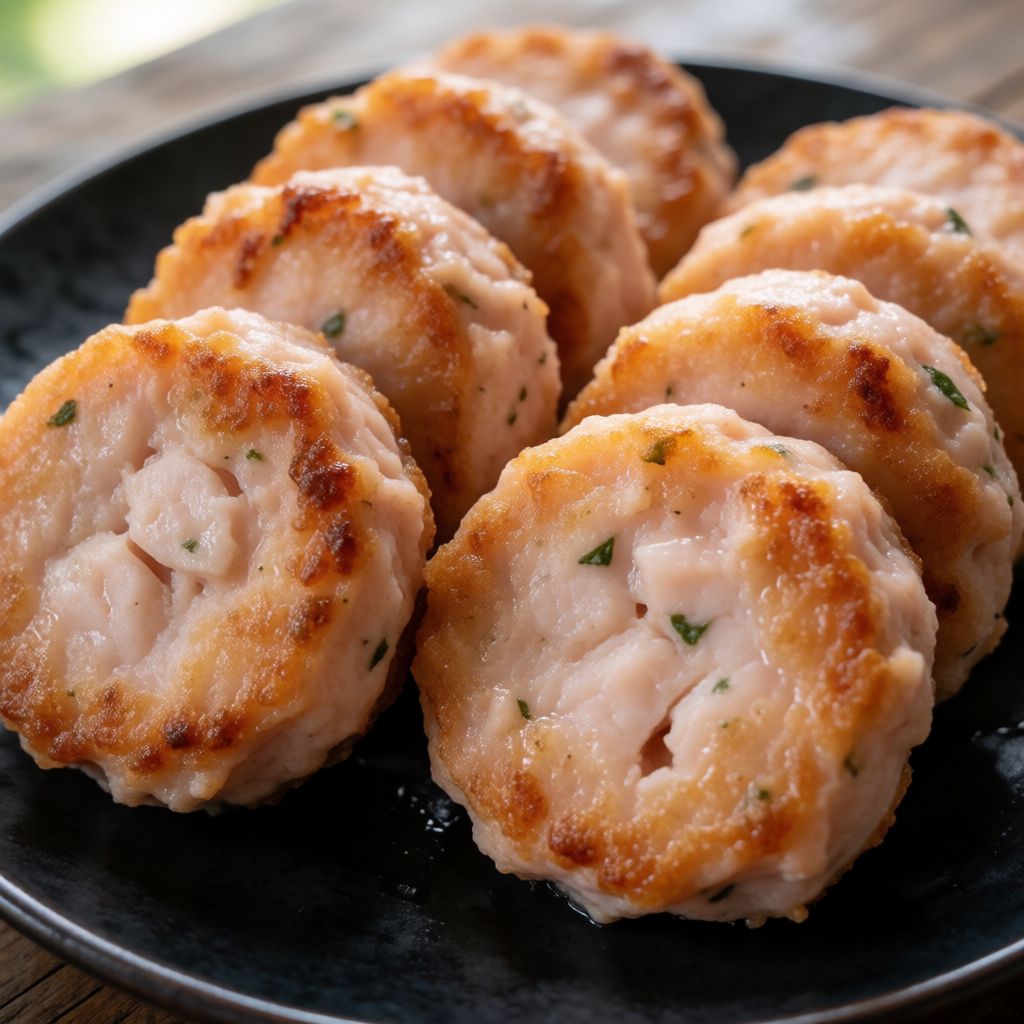
 AI photo
Thai Fish Cakes
Thai-style fish cakes with cod and prawns, served with a sweet-sour dipping sauce.
Labels are worked out automatically from the ingredients and can be wrong. Check the packaging if it matters to you.
Ingredients
- 400 g Cod
- 150 g Prawns thawed
- 0.5 pcs Lemongrass finely grated
- 2 pcs Kaffir Lime Leaves
- 1 tbsp Red Curry Paste or Thai chilli paste
- 1 tsp Ginger finely grated
- 1 clove Garlic crushed
- 3 tbsp Fish Sauce
- 1 pcs Egg
- 1 tbsp Plain Flour
- 1 bunch Coriander finely chopped
- 150 g Green Beans finely chopped
- 2 pcs Spring Onion finely chopped
- Salt
- Black Pepper
- 1 tsp Sugar
















For the Dip
- 50 ml Sesame Oil
- 50 ml Rice Vinegar
- 2 tbsp Fish Sauce
- 1 tbsp Sugar
- 50 ml Water
- 1 pcs Red Chilli finely chopped
- 1 tsp Ginger finely chopped
- 0.25 pcs Cucumber finely diced




Steps
For the dip, mix all the ingredients in a bowl and leave on the kitchen counter, stirring a few times so the sugar dissolves.
5 minFor the fish cakes, put all the ingredients except the spring onion and green beans into a blender or food processor.
Blend until combined but not completely smooth. Stir in the finely chopped green beans and spring onion with a spoon.
2 minShape the mixture into cakes and fry in oil in a hot pan for 5-7 minutes on each side.
7 min
Thai fish cakes — tod mun pla if you want the real name — are not a fish burger. They're a question of bind, bounce, and what you do with raw green beans at the last minute. Cod and prawn go into the blender with everything that gives Thai food its backbone: lemongrass, kaffir lime, red curry paste, ginger, garlic, fish sauce. You're not making a paste that tastes of fish — you're making one that tastes of the aromatics, with fish as the texture underneath.
What decides whether these work isn't the frying, it's the blending. Blend too little and the cakes fall apart in the pan — there's no myosin worked loose to hold them. Blend too long and you get rubber, the texture of a fish ball from a bad dim sum, because the proteins have overworked and tightened into something closer to a sausage casing than a cake. "Until combined but not completely smooth" is the whole trick: you want enough structure to bounce, not so much that it squeaks between your teeth.
Then the green beans and spring onion go in by hand, raw, at the end — not blended. Some recipes blitz everything together and call it done. Don't. A blended green bean turns to green paste and disappears; a hand-folded one stays a bean, gives you something to bite against the soft cake, and that contrast is the entire point of the dish. Without it you've made a fish mousse with chilli in it, which is a different and much duller thing.
Start with the fish. Cod works because it's mild and white and doesn't fight the aromatics — any firm white fish with no taste of its own does the job: haddock, pollock, coley if your fishmonger's cheap that day. What you don't want is anything oily or strongly flavoured — salmon, mackerel — because then you're not making a Thai fish cake, you're making a smoked-salmon pattie with chilli paste stirred in, and the lemongrass loses the argument. The prawns aren't there for prawn flavour so much as for extra bounce — prawn flesh has a different protein structure to fish, firmer, and it tightens the texture when it blends. Frozen and thawed is fine; this isn't sashimi, it's going through a blender and a hot pan.
Lemongrass, kaffir lime leaf, ginger, garlic, red curry paste — these aren't a flavour list you can swap at will, because together they are the dish's identity, but you can be pragmatic about sourcing. Fresh lemongrass bruises and grates easily if you hit the stalk flat with something heavy first — the fibres are tough and a grater alone will fight you. No fresh lemongrass, no fresh kaffir lime leaf — frozen versions of both exist in most UK supermarkets now near the herbs, and frozen is genuinely fine here, you're not eating the leaf raw, you're cooking the aromatic oil out of it. Dried kaffir lime leaf is a last resort — it smells of very little, which rather defeats the purpose.
Fish sauce is salt and umami both — it's doing the job soy sauce does in Chinese cooking, and there's no substitute that does both jobs at once; soy sauce alone will salt the mix but won't give you that particular savoury depth. Three tablespoons in the cakes themselves looks like a lot on the page, but remember this is raw fish, egg, and flour being seasoned before cooking — taste a raw mix for salt and you'll always underestimate, because flavour dulls slightly once it's cooked through. The egg and the tablespoon of flour aren't flavour, they're glue — egg for protein bind, flour to take up a little moisture so the mixture holds its shape in the pan rather than spreading into a puddle, which is the other half of the "why did my fish cake fall apart" problem alongside underblending.
Sugar appears twice — once in the cakes, once in the dip — and in both cases it's not there to make things sweet, it's there to balance the fish sauce's saltiness and the chilli's heat. Thai cooking runs on that four-way tension of salty, sour, sweet, hot, and if you drop the sugar from the dip thinking you're making it "healthier" you'll just get something sharp and one-note. The dip itself — rice vinegar, fish sauce, sugar, water, chilli, ginger, cucumber — wants to be made first and left to sit while you deal with the fish cakes, because sugar needs a few minutes in liquid to actually dissolve rather than sit grainy at the bottom; that's why the recipe tells you to stir it a few times rather than trust it to dissolve on its own.
On your hob: a wide frying pan, not a wok balanced awkwardly on one ring — you want even contact, because these cakes are thick enough that if the pan heats unevenly you'll get one side caramelised black before the middle's cooked through. Shallow-fry rather than deep-fry; there's no need for a vat of oil and a thermometer here. The cue for turning isn't a clock, it's the edge of the cake — when it's gone from pale translucent to a solid matte colour and the underside has a proper crust you can see creeping up the side, that's when it flips. Patience here matters twice over: once while the dip sits and softens its sugar, and once while you resist the urge to press down on the cakes in the pan, which just forces moisture out and gives you a dry centre.