
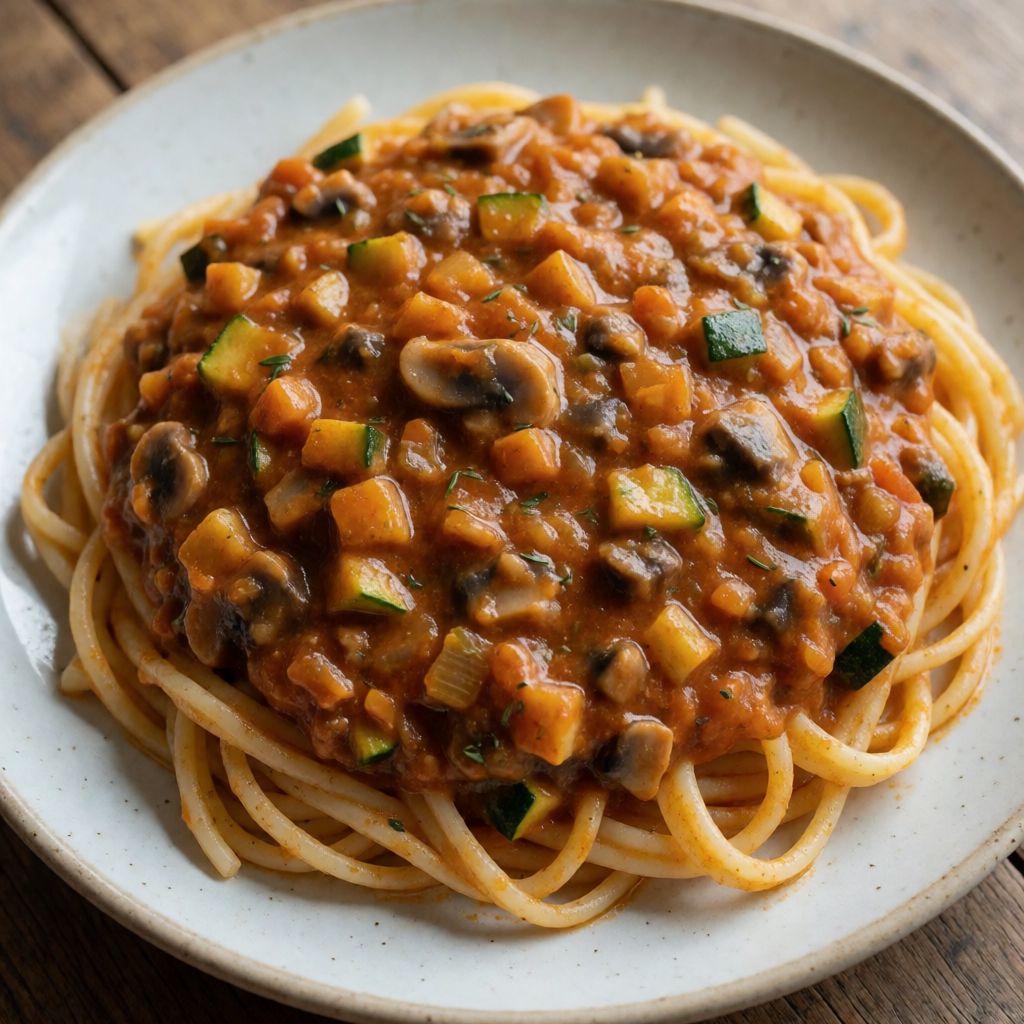
 AI photo
Vegetarian Bolognese
A hearty, meat-free take on bolognese with mushrooms, lentils and sun-dried tomatoes.
Labels are worked out automatically from the ingredients and can be wrong. Check the packaging if it matters to you.
Ingredients
- 1 pcs Onion finely chopped
- 2 clove Garlic finely chopped
- 250 g Mushrooms finely chopped
- 1 tsp Dried thyme
- 1 tsp Smoked paprika
- 1 pcs Courgette coarsely grated
- 3 pcs Celery coarsely grated
- 75 g Sun-dried tomatoes
- 400 g Tinned chopped tomatoes
- 2 tbsp Balsamic vinegar
- 50 g Red lentils
- 100 ml Wine
- 1 tbsp Rosemary finely chopped, fresh
- Salt
- Black pepper freshly ground
- 1 tsp Olive oil for frying
- 400 g Pasta
- 2 tbsp Thyme fresh
- 50 g Mature cheddar



















Steps
Sauté the onion and garlic in a saucepan with the olive oil over medium heat until softened.
Turn up the heat and add the finely chopped mushrooms, stir well, then add the remaining ingredients.
Lower the heat and let the sauce simmer for 20 minutes, until the lentils are tender.
20 minSeason the sauce with salt and freshly ground pepper to taste.
Serve with hot spaghetti, freshly grated mature cheddar and a little fresh thyme.
What was changed
Vesterhavsost cheese was swapped for Mature cheddar, a cheese UK shoppers can easily buy.
Call this Bolognese and someone will ask where the meat went. Ignore them — the dish isn't pretending to be a meat sauce with the meat removed, it's a different mechanism for getting the same result: a deep, savoury, slow-tasting sauce built from things that bring their own umami to the table instead of relying on browned mince to supply it.
Mushrooms are the engine here, not a vegetable garnish. Finely chopped and fried hot, they lose water fast and start to brown — that's the Maillard reaction, the same one that makes seared meat taste like more than boiled meat. If you chop them coarse or crowd a small pan, they steam in their own juice instead of browning, and you get grey rubbery mushroom rather than something with any savoury depth. So: fine chop, hot pan, give them room.
The red lentils are doing the job mince usually does for texture — bulk and a slight bite that disappears into the sauce as it cooks. Sun-dried tomatoes and balsamic vinegar bring concentrated sweetness and acid that a plain tin of tomatoes can't on its own; this is what stands in for the long hours a meat ragù spends reducing. Twenty minutes isn't long by ragù standards, and it isn't trying to be — it's long enough for lentils to soften and for the vegetables to give up their water into the pan, not long enough to build the layers a three-hour simmer builds. That's an honest trade, not a shortcut pretending otherwise.
What decides whether it works: the browning at the start, and whether the lentils are actually tender at the end, not just warm. Bite one before you call it done.
Onion and garlic first, on heat gentle enough that the onion turns translucent and sweetens rather than catches — this is the base every savoury sauce in every cuisine starts with, and the reason is simple: raw onion is sharp and sulphurous, cooked onion is sweet. You're not softening it for texture, you're changing its chemistry. A splash of water if it threatens to catch on a thin domestic pan is a legitimate rescue, not a cheat.
Mushrooms: any firm variety works — chestnut mushrooms give more flavour than button for the same price, which in a UK supermarket is usually true without even trying hard. The point of the fine chop is surface area: more cut edges touching hot metal means more browning, means more flavour released before the vegetables' water hits the pan and turns frying into stewing.
Courgette and celery are grated coarse, not chopped — grating opens up far more surface than a knife would in the same time, so they break down into the sauce rather than sitting in it as chunks. This is bulk and a faint vegetal sweetness, not a flavour you're meant to taste on its own. If you've only got a food processor grater attachment gathering dust, this is the job it was bought for.
Sun-dried tomatoes plus balsamic vinegar replace the long reduction time a proper ragù gets — concentrated sweetness from the dried tomato, sharpness from the vinegar, together doing in one step what hours of simmering do for a meat sauce. Tinned chopped tomatoes are the liquid base; any tin will do, there's no criterion here beyond "not watery," which you can tell by tipping one and watching how much juice runs ahead of the flesh.
Red lentils need checking by feel, not clock — press one between finger and thumb, it should give, not crunch. If they're still gritty at 20 minutes, they want more time and probably a splash more liquid; lentils that haven't had enough water to absorb will sit hard in a sauce no matter how long you wait.
Wine deglazes and adds acidity — any dry wine, red or white, works; what you're avoiding is anything sweet, which would fight the balsamic. If you don't keep wine in for cooking, a splash of extra vinegar and water does the acid job, just without the wine's own flavour layered in.
Thyme and rosemary, fresh where the recipe says fresh — dried herbs have had their volatile oils driven off by drying and reheating; a tired jar from the back of the cupboard will add nothing you can taste. Smoked paprika is doing some of the "meaty" work by proxy — it brings a smoke note that reads as savoury-roasted even though nothing here was roasted.
Mature cheddar at the end instead of Parmesan is the one properly British move in this dish, and it's not a compromise — a good strong cheddar has enough sharpness and salt to do exactly the job Parmesan does on a real Bolognese, finishing the plate rather than just sitting on top of it. Grate it yourself; the pre-grated bags lose moisture and bite sitting in their packet.