
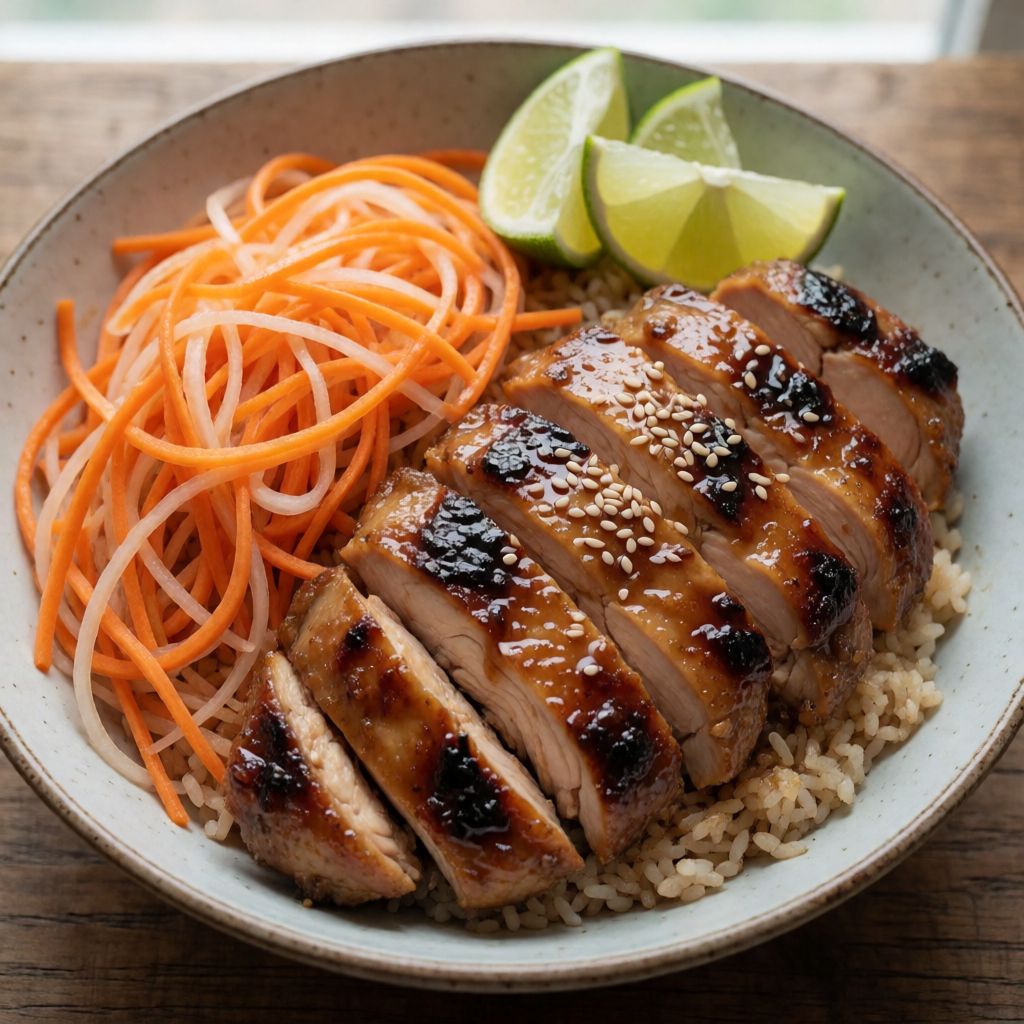
 AI photo
Vietnamese-Style Chicken Bowl with Pickled Carrots
A Vietnamese-style bowl with marinated chicken, pickled carrots, ginger-garlic rice and a creamy Asian dressing.
Labels are worked out automatically from the ingredients and can be wrong. Check the packaging if it matters to you.
Ingredients
- 400 g Chicken breast diced
- 2 tbsp Soy sauce
- 2 tbsp Fish sauce
- 1 tbsp Sugar
- 1 pcs Lime juiced
- 3 tbsp Sesame oil or another oil for frying
- 100 ml Water
- 100 ml Rice vinegar
- 30 g Sugar
- 200 g Pointed cabbage finely shredded
- 1 pcs Cucumber sliced
- 1 pcs Avocado sliced
- 1 bunch Coriander fresh, roughly chopped
- 1 tsp Chilli flakes to taste
- 1 tbsp Sesame seeds













Pickled carrots
- 4 pcs Carrot cut into matchsticks

Ginger-garlic rice
- 1 tsp Olive oil for frying
- 1 tbsp Ginger
- 2 clove Garlic crushed
- 150 ml Basmati rice
- 250 ml Water
- 0.5 tsp Salt





Asian mayo dressing
- 75 g Mayonnaise
- 1 tsp Fish sauce
- 1 clove Garlic crushed
- 1 tsp Ginger finely grated
- 1 pcs Lime organic, finely grated zest
- pinch Black pepper freshly ground, to taste


Steps
Mix the marinade for the chicken and coat the chicken pieces well in it. Leave to marinate for at least a quarter of an hour.
15 minFry the chicken in a hot pan with oil, stirring, until browned. Add the marinade and cook through.
15 minFor the pickled carrots: bring the water, sugar and rice vinegar to the boil, put the carrots in the hot pickle and leave to cool.
10 minHeat the oil and fry the ginger and garlic until fragrant, then add the water, basmati rice and salt. Cover and simmer on a low heat.
10 minLeave the rice to stand, covered, off the heat for 10 minutes.
10 minMix the mayonnaise with the fish sauce, garlic, ginger, lime zest and pepper until smooth.
2 minDivide the rice, chicken, pickled carrots, cabbage, cucumber and avocado between bowls. Drizzle with the dressing and sprinkle with coriander, chilli flakes and sesame seeds.
5 min
This is a bowl built on contrast, not on one big flavour. You've got hot sweet-salty chicken, cold sharp pickled carrot, creamy avocado, crunchy raw cabbage, and a fish-sauce mayonnaise tying it together. Nothing here is Vietnamese in the strict sense — it's a British flat's idea of a Vietnamese bowl, built from a supermarket shelf, and there's nothing wrong with that. What decides whether it works isn't any single component, it's balance: enough acid to cut the fat of chicken skin and mayonnaise, enough heat on the pickle to actually pull sugar and vinegar into the carrot rather than just coating it.
The chicken is the easy part. Diced breast in a hot pan with oil browns in minutes because breast meat is lean — there's no fat rendering out to slow you down, so if your pan isn't properly hot before the chicken goes in, you get grey simmered meat instead of browned, and that's a texture problem, not a seasoning one. You want the surface of the pan audibly sizzling before anything touches it, and you want to leave the pieces alone for the first minute rather than stirring constantly — contact time is what gives you colour, fidgeting gives you steam.
The marinade is soy, fish sauce, sugar and lime juice — salt, more salt (fish sauce brings a savoury depth soy doesn't), sweetness, and acid to brighten the whole thing and start very lightly breaking down the surface of the meat. Fifteen minutes won't transform the chicken, it just lets the surface take up flavour before the pan does the rest of the work. If you don't have fish sauce, don't substitute more soy and call it done — you'll get salt but lose the savoury backbone, so a pinch of anchovy or even a dash of Worcestershire gets you closer to the actual job fish sauce is doing.
For the oil, sesame oil is listed first but the note "or another oil for frying" is honest — sesame oil has a low smoke point and a strong flavour of its own, so if you want a hot pan and clean browning rather than a faintly scorched nutty taste, any neutral oil with no smell of its own does the actual frying job better: sunflower, groundnut, light olive oil. Save a few drops of toasted sesame oil, if you want that flavour, for right at the end, off the heat, where it won't burn.
The rice step — frying ginger and garlic in oil before the water and rice go in — isn't decoration, it's about where flavour dissolves. Ginger and garlic release their aromatic oils into fat far more readily than into water, so a brief fry blooms them before the liquid dilutes everything. Basmati itself is a long-grain rice that stays separate rather than clumping, which matters in a bowl where you want distinct components you can pick through with a fork, not a sticky mass. Covering it to simmer on a gentle heat — the kind where the water barely trembles rather than rattles the lid — stops it scorching on the bottom before the grains have absorbed what they need; then the ten minutes off the heat, lid still on, lets residual steam finish the job without the base catching. Some say lifting the lid to check doesn't matter — it does, because every lift lets steam escape that you were relying on for that final cooking.
The dressing is mayonnaise loosened and complicated by fish sauce, garlic, ginger, lime zest and pepper — essentially taking something rich and British-shelf-standard and giving it the savoury-sour backbone of the rest of the bowl, so it reads as part of the dish rather than a dollop of something foreign to it. Zest, not juice, from the lime here, because zest carries the aromatic oils without the acid unbalancing a mayonnaise base.
Everything else — cabbage, cucumber, avocado, coriander, chilli, sesame seeds — is raw and assembled, not cooked, and that's deliberate: this dish needs textural contrast against the hot chicken and soft rice, and anything you cooked here would just soften into sameness. Pointed cabbage shreds finer and stays more tender-crisp than a round white cabbage, which matters when you're eating it raw rather than braising it, but a wedge of any cabbage you shred thin will do if that's what's in the fridge.
For four people this is one pan, one small pot for rice, one pot for the pickle — in a flat kitchen with a single hob and a couple of rings, do the pickle first since it just sits and cools while you're occupied elsewhere, then rice, then chicken last so it's hot when it hits the bowl. No kazan, no special kit — a wide frying pan and a lid substitute (a plate over the rice pot works, or foil pressed down, if your pot doesn't have one) get you through all of it.