
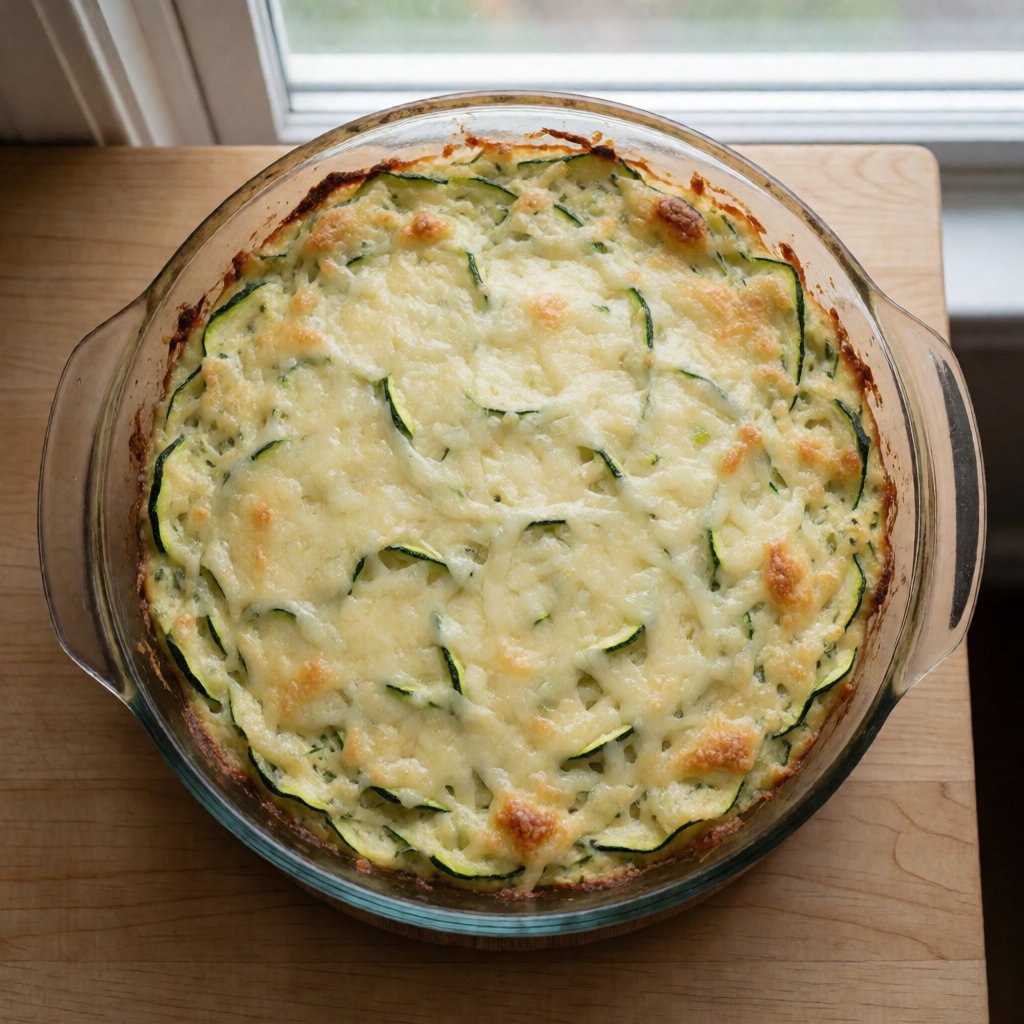
 AI photo
Courgette and Cheese Bake
A simple courgette and cheese bake, easy to prepare for a quick family dinner.
Labels are worked out automatically from the ingredients and can be wrong. Check the packaging if it matters to you.
Ingredients






Steps
Mix the courgette with the eggs, flour, garlic, salt and half of the cheddar.
Transfer to a greased baking dish, topping with the remaining cheddar.
Put the dish in the oven at 200°C for 30 minutes.
30 minTake the dish out of the oven.
What was changed
We replaced Cheddar with the cheddar most commonly bought in UK kitchens.
This is a savoury courgette flan, not really a "bake" in the gratin sense — egg and flour do the holding, not cream or breadcrumbs stacked in layers. What you're making is a watery vegetable turned into something that holds a slice without falling apart on the fork.
The step that decides everything isn't even in the method — it's squeezing the courgette, which the recipe mentions almost in passing. Courgette is close to 95% water, locked inside the cell walls. Salt and pressure rupture those walls and pull the water out before it ever meets the egg. Skip this, or do it half-heartedly, and the egg simply can't set against that much liquid — you end up with wet rubble under a crisp cheese lid, looking cooked on top and soup underneath.
The oven does two jobs at once. At 200°C the egg proteins coagulate — the mixture stops being batter and becomes solid, the way a quiche sets. At the same time any moisture you didn't squeeze out earlier turns to steam and needs to escape, which is why a shallow dish works and a deep one doesn't: steam trapped under a thick mass keeps the middle wet no matter how long it sits in the oven. Doneness here isn't a clock number, it's a push with your finger — the centre resists instead of giving like custard, the cheese on top has gone from pale yellow to a freckled gold-brown, no longer shiny with its own fat.
Two eggs for 400g of courgette is the working ratio — eggs are the glue, and that's roughly as little glue as you can get away with and still get a bake that slices rather than spoons. If you've got slightly more courgette on the scale, don't add a third egg blind; squeeze it drier instead, since more egg without more drying just dilutes the set.
Flour is doing clean-up duty — it mops up whatever moisture the squeezing missed and gives the mix a bit of structure before the egg has even started to set. Two tablespoons for this amount is a light hand; if your courgette felt heavier in the hand after squeezing, a third spoon costs you nothing. No flour in the cupboard — cornflour works in half the quantity, or dry breadcrumbs, though breadcrumbs change the texture toward dumpling rather than flan.
The cheddar is split for a reason — half inside carries fat and salt through the whole mixture so no mouthful tastes of plain courgette; half on top is there purely to brown. Cheese browns by two routes at once: the proteins and sugars caramelise (the same Maillard business as a crust on bread), and the fat renders out and fries the surface slightly from above. Any hard cheese that melts without turning to oil works — a mature cheddar, a Lancashire, even a Gruyère if that's what's open in the fridge. A fresh, wet cheese like mozzarella will melt but won't brown the same way; it hasn't got the fat-to-moisture balance for it.
Garlic here is raw, folded straight into the mix, which only works because it's one clove among 400g of vegetable — enough to perfume, not enough to bite. If you reach for onion instead, don't put it in raw; onion holds more water than garlic does and releases it as it cooks, which undoes all the squeezing you just did. Cook it down first, or leave it out.
Salt does double duty, as already said — flavour, and the engine that pulls water out of the courgette. Salt it, leave it a few minutes in a sieve or on a cloth, then squeeze with your hands until no more water comes. That waiting is not dead time, it's the recipe working; rushing it just moves the problem from the colander to the oven, where it's much harder to fix.
On a British domestic oven: 200°C on the dial and 200°C in the middle of the dish are two different things, since most home ovens run a little hotter or cooler than they claim and don't heat evenly. A shallow gratin dish or a small roasting tin, the kind that sees a Sunday roast's vegetables more often than a cake, is the right shape — wide enough that the mixture sits two to three centimetres deep, so the steam from inside has a short way to travel out. Stack the same mixture into a narrow loaf tin instead and you'll get a browned top sitting over a soft, undercooked middle, however long you leave it in.
·