
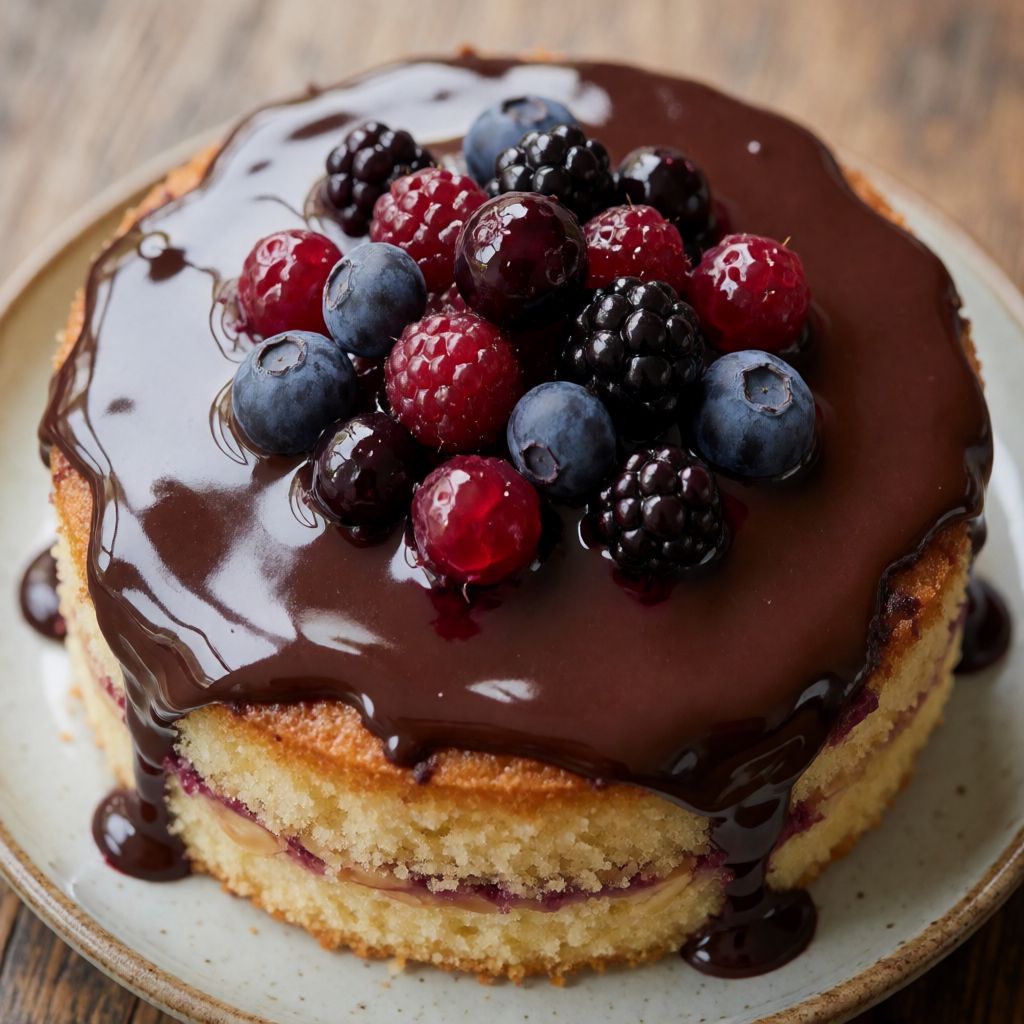
 AI photo
Almond Cake with Berries
A rich almond cake layered with dark chocolate, vanilla pastry cream and fresh berries.
Labels are worked out automatically from the ingredients and can be wrong. Check the packaging if it matters to you.
Ingredients
- 200 g Marzipan coarsely grated
- 75 g Caster sugar
- 200 g Butter room temperature
- 4 pcs Eggs
- 50 g Plain flour
- 75 g Dark chocolate finely chopped
- 1 pcs Vanilla pod
- 60 g Caster sugar
- 3 pcs Egg yolks
- 15 g Cornflour
- 250 ml Milk
- 100 ml Double cream for whipping
- 200 g Strawberries
- 100 g Blueberries
- 75 g Raspberries
- 0.5 bunch Mint fresh













Steps
Beat the marzipan with the caster sugar until smooth.
Add the butter, cut into cubes, and beat until the mixture is light and fluffy.
Beat in the eggs one at a time, then fold in the flour at the end.
Spoon the batter into a greased 20 cm springform tin lined with baking paper on the base.
Bake in a preheated fan oven at 175°C for about 30 minutes, until golden and cooked through.
Let the cake cool for a few minutes, then scatter the dark chocolate over the still-warm cake.
Remove the cake from the tin and leave to cool on a wire rack.
Split the vanilla pod and scrape out the seeds. Rub the seeds into the sugar.
Whisk the vanilla sugar, egg yolks and cornflour together in a saucepan.
Pour in the milk, whisking, and heat gently to a simmer, stirring constantly, until the custard thickens nicely.
Let the custard simmer gently for a few minutes, stirring, then pour the vanilla cream into a bowl and cover the surface with cling film.
Whip the double cream to soft peaks and fold it into the vanilla cream to make a light, luscious pastry cream.
Spread the pastry cream over the cake.
Top with the strawberries, raspberries and blueberries, along with a little fresh mint to decorate.
This is a marzipan cake with no flour to speak of — 50 grams for a whole cake is barely a binder — so what you're really making is an almond paste that sets. Marzipan is sugar and ground almonds already worked together, and when you beat it with butter and eggs it behaves less like flour-based batter and more like a very rich, dense frangipane. That's the whole mechanism: there's not enough gluten in this to go wrong, so your risk isn't a tough cake, it's an underbeaten one that refuses to hold air.
What decides whether this works is the marzipan going in at room temperature, grated, not cubed. Grated, it has surface area to catch sugar and butter fat evenly; in one block it just sits there sulking at the bottom of the bowl while you beat air into everything around it. Some say you can just chop marzipan small with a knife — no, because knife-cut pieces stay denser and don't break down the same way under the beater; a grater shears it into fine shreds that melt into the butter almost like it was never solid.
The chocolate scattered on the warm cake isn't decoration, it's technique: warmth melts it into a thin seal before the pastry cream goes anywhere near the crumb. Skip that step or let the cake go fully cold first, and your pastry cream will soak straight into the sponge and you'll be eating wet cake with no texture contrast — that's the actual job this step does.
Marzipan itself deserves a word, because in Britain it's mostly known wrapped round a Christmas cake under royal icing, treated as a formality rather than an ingredient you'd want to taste. Here it's the main structure of the sponge, so buy a decent one — look for almond content on the pack, not just "marzipan," because the cheap stuff is mostly sugar stretched with almond flavouring and it won't give you the depth this cake needs. If you make your own from ground almonds and icing sugar, that's even better; you control the ratio and it'll be softer, which actually helps at the grating stage.
Butter at room temperature is non-negotiable and this is where UK kitchens often lose a cake before it starts, because "room temperature" in a cool British kitchen in winter is not the same as in a warm one in August. You need it soft enough to dent with a finger without melting — cold butter won't trap air when beaten, warm butter won't hold the air it traps. If your kitchen's cold, cube it and leave it near the oven as it preheats rather than fighting it with a microwave, which half-melts the outside before the inside catches up.
Eggs one at a time, not all at once — this is the same air-holding logic as the butter. Add them together and the mixture can split, fat and liquid refusing to combine smoothly, and once split, no amount of beating gets that lightness back; you fold in flour at the end precisely because flour is the thing that would stop this fat-and-egg emulsion from happening if it went in too early, coating the fat and blocking it from taking up the egg.
The dark chocolate wants to be good eating chococolate, 70% or whatever genuinely tastes of cocoa to you rather than sugar with brown colouring, because here it isn't melted into anything to hide behind — it sits as its own layer between sponge and cream, so every flaw in it is tasted straight.
For the pastry cream, cornflour is doing a specific job and you can't really swap it for plain flour in the same quantity — plain flour needs longer, gentler cooking to lose its raw taste and will dull the custard's shine, where cornflour thickens cleanly and stays glossy. If you've only got custard powder in the cupboard, that already contains cornflour and colouring, so it'll work, just drop the vanilla pod and taste before you add more sugar.
Whole milk, not semi-skimmed stretched with a splash of double cream to compensate — the fat in milk is what gives body here, and the separate double cream folded in afterwards is for air and lightness, not for fat you're missing from the milk.
On the berries: any soft fruit genuinely in season works to the same logic even if strawberries, blueberries and raspberries aren't what you have — the point is fruit with no cooking needed and some acidity to cut the richness of marzipan, butter and custard, three heavy things stacked on top of each other. A cake this rich without sharp fruit on top would sit like a stone after Sunday lunch.
And patience belongs on the ingredient list here as much as the marzipan does — don't rush the cake off the rack while it's still warm in the middle, don't rush pastry cream onto crumb that hasn't had its chocolate seal set, and don't rush the custard off the heat before it's actually thickened, because "thickened nicely" is a thing you feel against the back of a spoon, not a number of minutes on a clock.