
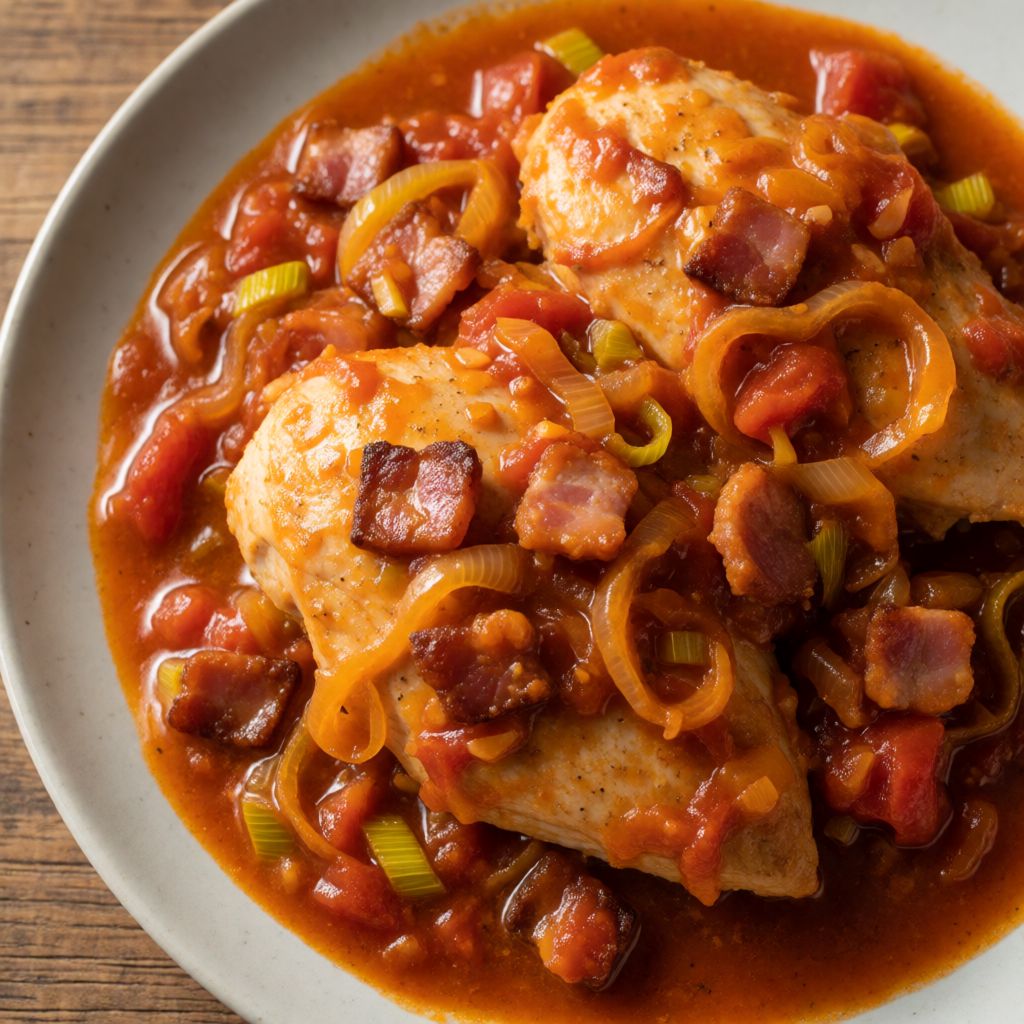
 AI photo
Oven-Baked Chicken with Vegetables in a Tangy Sauce
A warming oven-baked chicken with vegetables in a creamy tangy tomato sauce, served with rice.
Labels are worked out automatically from the ingredients and can be wrong. Check the packaging if it matters to you.
Ingredients
- 2 pcs Chicken breast diced
- 5 pcs Bacon rashers
- 2 pcs Onion finely chopped
- 3 clove Garlic finely chopped
- 3 pcs Leek sliced into rings
- 400 g Tinned chopped tomatoes
- 1 tbsp Tomato purée
- 2 pcs Red pepper sliced into strips or small cubes
- 1 tsp Dried thyme
- 100 g Cream cheese full-fat, soft
- 100 ml Double cream
- 2 tbsp Olive oil plus a little extra for frying (optional)
- Salt
- Black pepper freshly ground
- ½ bunch Parsley
- ½ bunch Thyme fresh
- 300 ml Basmati rice cooked according to packet instructions
















Steps
Fry the bacon in a hot pan with a little oil until crisp, then set aside on kitchen paper.
5 minSeason the chicken pieces with salt and pepper and fry in a pan with a little oil and the bacon fat until golden.
8 minTransfer the chicken and bacon into a greased oven-proof dish.
2 minIn the same pan, fry the onion, garlic and leek over medium heat until the onion softens.
5 minAdd the chopped tomatoes, tomato purée, red pepper, thyme, cream cheese and double cream, and mix well.
3 minSeason the sauce with salt and pepper to taste.
1 minPour the sauce over the chicken in the dish and bake in an oven preheated to 175°C for 20 minutes.
20 minBefore serving, generously sprinkle with chopped parsley and thyme, and serve with rice.
2 min
This is a one-dish compromise: a casserole that wants to be a roast and a sauce that wants to be a pasta bake, meeting in the middle in an ovenproof dish. What decides whether it works is heat sequencing, not seasoning — everything that goes into the dish has already been browned or cooked on the hob, and the oven's only job is to let the flavours marry and the sauce thicken a touch. Treat the oven as a finishing step, not a cooking one, and this stops being a mystery.
The chicken and bacon go in first because browned meat and raw meat behave completely differently in a sauce. Browning builds a crust via the Maillard reaction — sugars and proteins reacting under dry, fierce heat — and that crust is where the savoury depth comes from. Drop raw diced chicken straight into tomato and cream, bake it, and you get pale, boiled-tasting chunks swimming in sauce, because wet heat at 175°C never gets hot enough at the meat's surface to brown anything. Some say you can skip the frying pan step and "let the oven do it all" — no, because the oven dish is full of liquid from the moment you pour the sauce in, and liquid caps the surface temperature at roughly its own boiling point, well under what browning needs.
Chicken breast, diced small, is the right cut here precisely because it has so little fat of its own — it needs the bacon fat and the cream sauce to carry flavour and moisture it can't supply itself. If you'd rather not dice breast at all, thigh fillet does the same job with more forgiveness, since thigh has enough fat to survive a slightly longer bake without drying out. Dice it roughly to a thumbnail's size or bigger; smaller pieces cook through faster in the frying pan but also dry out faster in the oven's remaining 20 minutes, since they've got less mass to hold heat and moisture.
Bacon is there for salt, smoke and fat, in that order of importance. Streaky rashers render more fat than back bacon, which matters because that fat is what you fry the chicken in — if your bacon is lean, add a slick of olive oil to the pan so the chicken still gets something to brown in rather than sticking and tearing. Any smoked cured pork works as a substitute; pancetta is the obvious one if you have it, lardons if you want to skip slicing it yourself.
Onion, garlic and leek are the sauce's backbone, not its flavour — they're there to be cooked down until sweet, not to be tasted as themselves. "Medium heat" only means something if you know what you're watching for: the onion going from sharp white-pink to soft and faintly golden, translucent at the edges. Garlic goes in with or just after the onion, never first, because garlic burns in roughly a minute at frying temperatures and burnt garlic turns bitter in a way nothing in the sauce can mask afterwards.
Tinned chopped tomatoes plus a spoon of tomato purée is doing two different jobs — the tinned tomato gives bulk and a fresher acidity, the purée is concentrated and gives colour and a deeper, almost roasted tomato note without adding more liquid. If you only have whole tinned tomatoes, crush them by hand in the pan; don't blend them unless you want a perfectly smooth sauce, since a bit of texture holds its own against the cream.
Cream cheese and double cream together are what make this "tangy" rather than just creamy — cream cheese brings a mild lactic sharpness, double cream brings richness and the fat that stops the sauce looking thin once it's baked. Full-fat cream cheese is worth specifying because the reduced-fat versions split more readily under heat, precisely the curdling risk already flagged. If you've only got crème fraîche, it's a reasonable swap for the double cream and brings its own tang along for free; soured cream works too but is thinner, so expect a slightly looser sauce.
Red pepper goes in raw-ish, sliced, because a 20-minute bake at 175°C is enough to soften it without turning it to mush — this is one place where "until it bends, not snaps" matters more than any clock. Thyme, dried in the sauce and fresh at the end, is doing two jobs: dried thyme is more concentrated and survives cooking, fresh thyme scattered at serving gives a brighter, grassier top note that cooking would have cooked away. Parsley at the end is for the same reason — colour and a clean, uncooked herbal lift against all that cream.
Basmati rice cooked separately and served alongside, not stirred in, keeps two textures distinct: a sauce you can mop with a spoon, and rice that stays separate grains rather than turning to porridge in the dish. This isn't tradition for its own sake — it's simply that rice cooked inside a wet sauce in an oven absorbs unevenly, since the liquid at the bottom of the dish and the liquid at the top aren't at quite the same temperature, and you'd end up with some grains swollen and some still hard. Patience here isn't really about watching a clock — it's giving the onions their full softening time on the hob and giving the sauce in the oven its full 20 minutes to let the flavours settle into each other, rather than pulling it out the moment it looks "done enough."