
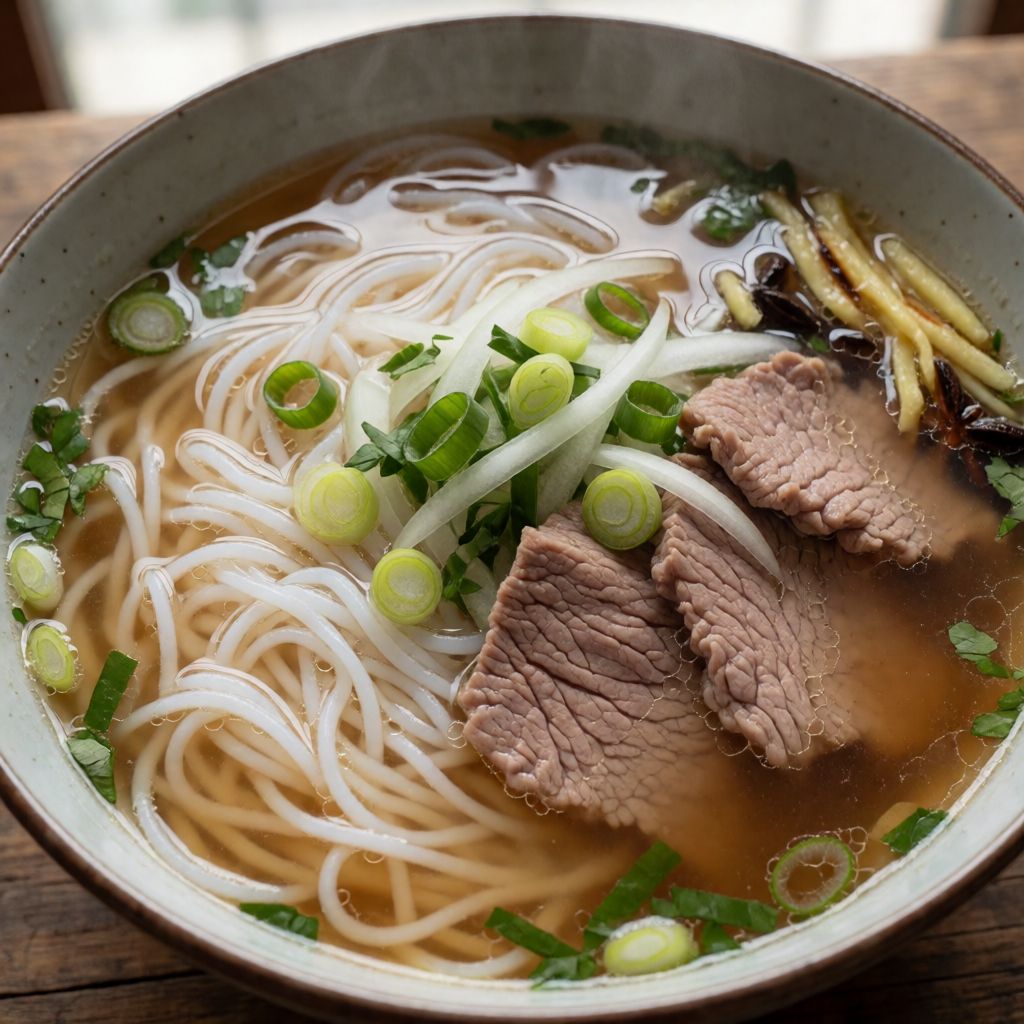
 AI photo
Beef Pho Noodle Soup
A fragrant Vietnamese-style beef noodle soup with ginger, garlic and fresh herbs, finished with a squeeze of lime.
Labels are worked out automatically from the ingredients and can be wrong. Check the packaging if it matters to you.
Ingredients
- 1 l Vegetable Stock
- 500 ml Beef Stock
- 1 tsp Five Spice
- 1 tsp Ginger freshly grated
- 2 clove Garlic crushed
- 2 tbsp Fish Sauce
- 1 tbsp Rice Vinegar
- 400 g Beef Steak
- 250 g Noodles
- 10 g Butter for frying
- 2 tbsp Sesame Oil for frying
- Black Pepper freshly ground
- 4 pcs Spring Onion finely chopped
- 150 g Bean Sprouts
- 1 bunch Mint fresh
- 1 bunch Coriander fresh
- 1 pcs Red Chilli sliced into rings
- 1 pcs Lime to serve
- Salt to taste















Steps
Pour the vegetable and beef stock into a pot, add the five-spice mix, ginger, garlic, fish sauce, rice vinegar and freshly ground pepper. Bring to the boil.
5 minReduce the heat to low and cover with a lid. Keep the soup on a gentle simmer while you cook the meat.
10 minHeat a frying pan with oil and sear the steaks, rubbed with salt and pepper, over high heat for 1 minute on each side.
2 minReduce the heat, add the butter and fry the steaks for a further 1.5 minutes on each side until medium.
3 minRemove the steaks from the heat and let rest for 2 minutes, then slice thinly.
2 minTaste the soup, adjusting with salt and fish sauce as needed, and bring back to the boil.
1 minCook the noodles in the boiling soup according to the pack instructions.
4 minDivide the hot soup and noodles among bowls, top with sliced steak, bean sprouts, spring onion, herbs and chilli, and serve lime wedges on the side.
1 min
Pho gets called a soup, but think of it more like a broth you build twice: once slow, in the pot, and once fast, in the pan, and the two only meet at the last minute. That's the whole mechanism. The stock simmers low and lidded so the five-spice, ginger and garlic actually dissolve into the liquid instead of just floating on top smelling nice and doing nothing. Meanwhile the steak gets seared hard and fast somewhere else entirely, so it keeps its own character — a crust, a pink centre — rather than turning into boiled beef shreds the way it would if you just dropped raw meat into the broth to cook through.
What decides whether this works is restraint in two places. First: don't let the broth boil hard once the aromatics are in — a rolling boil knocks the fat out of suspension and your clear, fragrant stock turns cloudy and a bit flat-tasting, which is a textural problem as much as a flavour one. Second: the steak has to rest before it's sliced. Cut it straight off the heat and the juice runs out onto the board instead of staying in the meat — you'll see it, a red puddle, and that's flavour you've just thrown away.
Everything else — noodles, sprouts, herbs, chilli — goes in raw or barely cooked at the very end, in the bowl, not the pot. That's not fussiness. It's the only way bean sprouts keep their crunch and mint stays mint instead of turning into dull green rag by the time it reaches the table.
The two stocks together are doing a job neither does alone. Beef stock gives weight and savour; vegetable stock dilutes it so the soup doesn't sit heavy and lets the spice and ginger come through instead of getting buried. If you've only got one or the other, use it alone and just season a touch harder with fish sauce to bring back the depth — don't panic and go hunting for the "correct" ratio, there isn't one, only balance.
Five-spice is standing in for a whole spice-infusion step that a proper pho does with whole star anise, cinnamon bark, cloves toasted dry first to wake them up. Ground five-spice skips the toasting, which is the trade-off: less complexity, more convenience, straight out of the jar and into the pot. If you have the whole spices and five minutes, toast two or three star anise and a cinnamon stick in a dry pan till they smell loud, then simmer them in the stock instead — better, but not required.
Fish sauce and rice vinegar are the backbone flavour, salt and acid, and this is the point to taste and adjust, not at the table with extra salt shaken on top. Any pale vinegar with a clean sourness will stand in for rice vinegar — cider vinegar, even a squeeze of extra lime — but keep it light, pho is not meant to taste sour, just lifted.
For the steak, any oil with a high smoke point and no flavour of its own will do for the first hard sear — a flavourless vegetable or sunflower oil, not your good olive oil, which will just burn and turn bitter at that heat. The butter goes in second, once the pan's cooled slightly, because butter alone from cold would burn before the steak ever got a crust — that's the actual reason for searing in oil first and finishing in butter, not tradition, just chemistry. Any well-marbled steak works; cut matters less here than letting it rest.
Noodles: rice noodles are standard for pho and cook fast and starchless enough not to cloud the broth, but if it's egg noodles in the cupboard, use them — just don't let them sit in the hot broth once cooked, serve straightaway or they'll turn soft and swell up drinking all your broth.
The fresh toppings — mint, coriander, bean sprouts, spring onion, chilli, lime — are not garnish in the decorative sense, they're the texture and brightness the long-simmered broth can't give itself. Leave any one of them out and the bowl still works; leave out all of them and you've basically made beef and noodle soup, which is a fine thing, just not this thing.
This feeds four as a full bowl each, and it rewards patience more than skill — the ten minutes the broth spends quietly absorbing spice while you're not touching it is doing more work than any stirring you could add.