
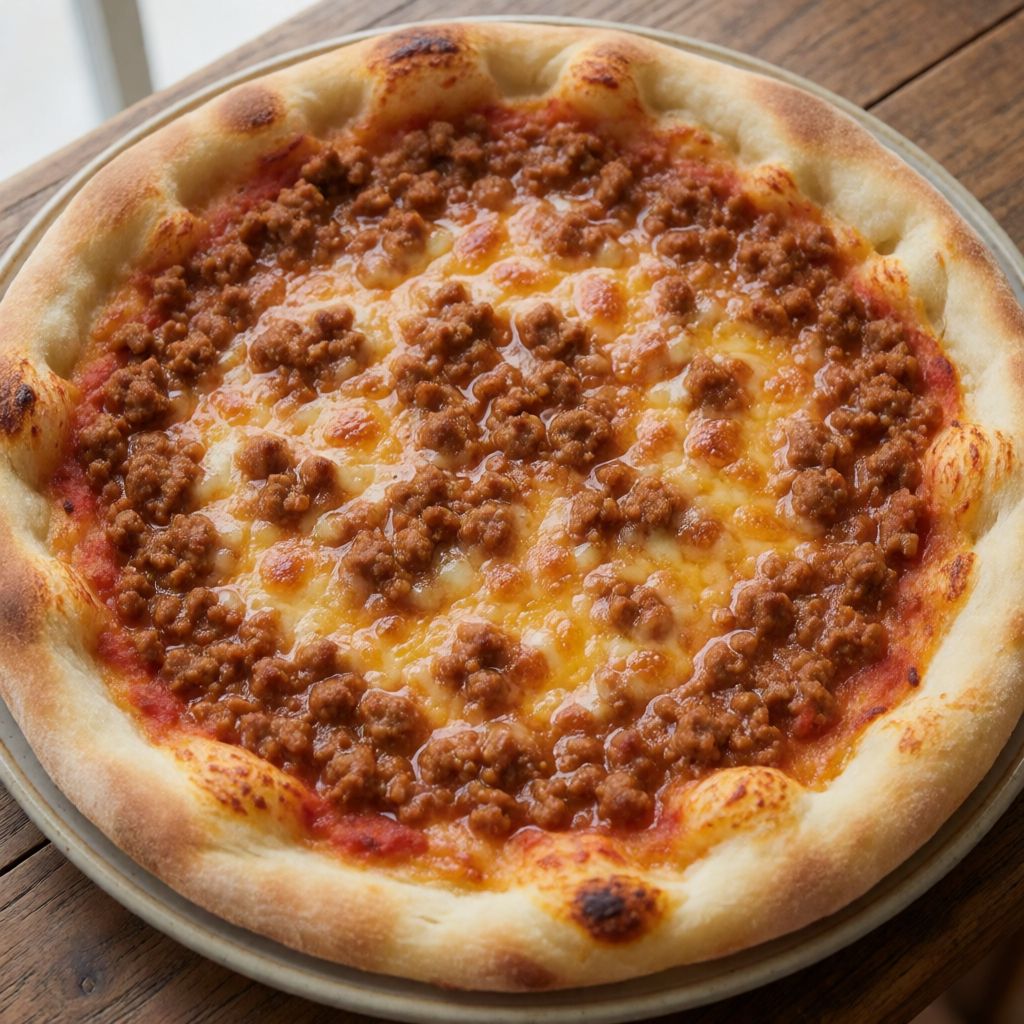
 AI photo
Pizza with Bolognese Sauce
A homemade pizza topped with a slow-cooked beef and bacon Bolognese sauce, mozzarella and parmesan.
Labels are worked out automatically from the ingredients and can be wrong. Check the packaging if it matters to you.
Ingredients
- 10 g Yeast
- 250 ml Water
- 3 tbsp Olive oil
- 1 tsp Salt
- 500 g Plain flour
- 1 tbsp Olive oil for the bowl
- 50 g Bacon
- 1 pcs Onion finely chopped
- 2 clove Garlic crushed
- 2 tsp Dried thyme
- 1 tsp Dried rosemary
- 300 g Minced beef
- 100 ml Stock
- 75 g Sun-dried tomatoes
- 2 tbsp Balsamic vinegar
- 400 g Canned chopped tomatoes
- Salt to taste
- 250 g Mozzarella drained
- 50 g Parmesan
- 5 pcs Thyme sprigs
















Steps
Dissolve the yeast in a bowl with room-temperature water. Add a third of the flour, the olive oil and salt, and mix until smooth.
Gradually add the rest of the flour, stirring as you go.
Dust the worktop with flour and knead the dough by hand until elastic.
Grease a clean bowl with olive oil, place the dough in it and turn it so it is coated with oil.
Let the dough rise for 45 minutes at room temperature, then refrigerate until the next day.
45 minFry the bacon in olive oil in a heavy-bottomed pan over medium heat.
Remove the bacon, drain the fat on a paper towel, then chop finely.
Add the onion, garlic, thyme and dried rosemary to the pan with the bacon fat and fry, stirring, until the onion softens.
Add the meat, raise the heat and brown it well.
Add the stock, sun-dried tomatoes, balsamic vinegar, chopped tomatoes and the finely chopped bacon.
Cover and simmer the Bolognese for about 1 hour over low heat, stirring occasionally.
60 minRemove the lid and reduce the sauce until creamy and rich.
Refrigerate the sauce until the next day.
The next day, dust the worktop with flour. Divide the dough and shape round pizza bases.
Preheat the oven to 250°C with a steel baking plate on the rack.
Spread the Bolognese and roughly chopped mozzarella on the bases and bake on the steel baking plate for about 6–10 minutes, or until the base is crisp.
8 minGrate over a little parmesan and sprinkle with fresh thyme before serving.
This is a two-day pizza, and that's not a flourish — it's the whole point. You make a Bolognese that's had a chance to turn from "meat in tomato" into something darker and rounder, you let a dough sulk in the fridge overnight so it develops flavour instead of just bulk, and then on day two you do five minutes of assembly and six minutes of fierce heat. The cooking happened yesterday. Today is just delivery.
What decides whether it works is restraint in two places: how far you reduce the sauce, and how hot your oven actually gets. The sauce has to go past "nice ragù" into something thick enough to sit on dough without drowning it — if it's still soupy, your base goes soggy no matter what you do afterwards. And the base needs violent heat, hotter than any domestic oven's dial admits to, or you get bread with toppings instead of pizza.
Some say a pizza needs a wood-fired oven to be "real" pizza. No — what it needs is heat fast enough to crisp the crust before the toppings turn the centre to mush. A wood oven just happens to be the easiest way to get there; a steel plate cranked to the oven's ceiling is your flat's version of the same trick.
Start with the dough, because its whole life is slower than you'd expect. Yeast dissolved in water that's just room temperature — not warm, not hot, because yeast is a living thing and you're not trying to shock it awake, you're asking it to work steadily for a day and a half. Flour goes in gradually, not all at once, because you're judging how much the dough wants, not following a number: wetter flours, humid kitchens, they all shift how much it'll take. Kneading by hand until it's elastic is the actual test — the dough stops tearing and starts stretching, and that's gluten doing its job, not a stopwatch telling you ten minutes are up.
The overnight rest in the fridge isn't about letting it get bigger. A fast, warm rise gives you volume and not much else; a long cold one gives the yeast time to produce the compounds that actually taste of something — faint sourness, a bit of depth — the difference between bread and flavourless padding. This is patience as an ingredient, plain and simple. You're not doing anything to the dough overnight. It's doing something to itself.
The sauce is built the way most good ragùs are: fat first, then aromatics in that fat, then meat browned hard before any liquid goes near it. Frying the bacon first and cooking the onion and garlic in its rendered fat is the same logic as a Sunday roast's gravy — you don't waste fat that's already carrying flavour, you build on it. Browning the meat properly, not just greying it, is where a lot of Bolognese goes wrong at the start and never recovers — meat that's merely heated through tastes of nothing; meat that's caught colour against a hot pan tastes of itself. Any minced beef with a reasonable bit of fat in it works; too lean and the sauce turns dry and chalky no matter how long you simmer it.
Sun-dried tomatoes and balsamic vinegar are doing a job that plain tinned tomatoes can't: concentrated sweetness and a sharp acid edge, standing in for the long, slow caramelisation a proper Italian ragù gets from hours over low heat in a pot nobody's watching. You're compressing that time with ingredients that already carry some of the work done. The long simmer, uncovered at the end, is about water leaving the pan — reduce it until the sauce holds its shape on a spoon rather than sliding off, because that's the difference between a topping and a sauce that's going to seep into your base and make the crust give up halfway through baking.
Mozzarella drained, not straight from its liquid, for the same reason: wet cheese adds water you've spent an hour reducing out. Any firm, meltable cheese with low moisture will do if mozzarella's not to hand — a mild cheddar melts fine, just expect more colour and less stretch. Parmesan at the end rather than baked in is about keeping its flavour sharp instead of letting heat flatten it into background salt; fresh thyme on top of dried thyme in the sauce gives you two different thyme flavours, the bright top note and the cooked-in base note, which is a cheap trick and a good one.
On an ordinary hob and oven, the steel plate is doing the heavy lifting that a kazan or a wood oven would do elsewhere — it's thermal mass, something that holds heat and dumps it fast into the base the moment the dough touches it, instead of the dough sitting in merely hot air. If you haven't got one, a heavy baking tray preheated empty in the oven gets you some of the way there; a cold tray with raw dough plonked on it will just steam the bottom instead of crisping it. Crank the oven as high as it'll genuinely go — 250°C is a floor, not a ceiling, if your oven can manage more. Watch the base, not the clock: it should look dry and faintly blistered at the edge, not pale and bendy, and that tells you more than any timer will.