
 AI photo
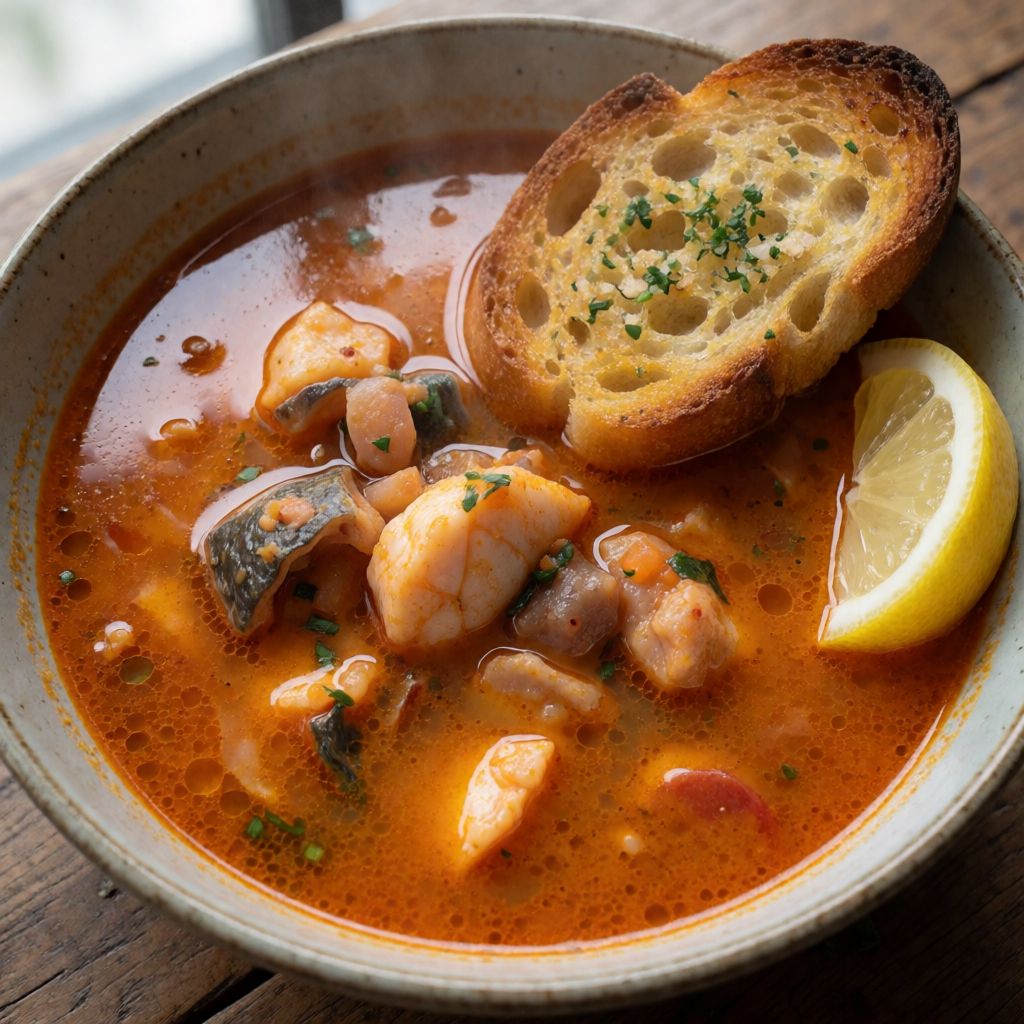
Bouillabaisse
A classic French-style fish stew with a saffron rouille, white fish, shellfish and potatoes, finished with crusty bread.
Labels are worked out automatically from the ingredients and can be wrong. Check the packaging if it matters to you.
Ingredients
- 300 ml White wine
- 200 g Mussels blue mussels
- 2 pcs Onion finely chopped
- 2 clove Garlic finely chopped
- 1 pcs Leek finely chopped
- 1 pcs Fennel finely chopped
- 1 pcs Celery stick, finely chopped
- 3 pcs Thyme sprigs, fresh
- 1 tsp Black pepper
- 1 pinch Saffron ground
- 500 g Fish bones and shellfish shells if available
- 1 l Stock
- 2 tbsp Tomato paste
- 400 g Potato diced
- 300 g Haddock or another good white fish
- 4 pcs Langoustine tails
- 100 g Prawns
- 8 pcs Scallops
- 1 pcs Lemon finely grated zest and juice
- Salt flaky, to season
- 1 tbsp Olive oil
- 1 tbsp Baguette sliced, for frying
- 1 pcs Bread loaf, to serve
- 1 bunch Parsley fresh




















Rouille
- 2 pcs Bread white, sliced
- 1 pinch Cayenne pepper
- 1 pinch Saffron ground
- 0.5 tsp Smoked paprika
- 2 clove Garlic crushed
- 0.5 pcs Lemon finely grated zest and juice
- 100 ml Olive oil
- Salt


Steps
For the rouille: blitz the diced bread with the cayenne pepper, saffron, smoked paprika and garlic in a food processor until fine. Add the lemon zest and a little lemon juice. Gradually pour in the olive oil until you have a smooth, creamy dressing.
Season with salt and add more lemon juice if needed.
Clean all the seafood, keeping the shells for the fish stock and the flesh for later cooking.
Scrub and clean all the mussels. Tap them to make sure they close, and discard any that don't. Put the mussels in a pan with the white wine and steam, covered, for about 5 minutes until they open. Discard any that don't open.
5 minSet a sieve over a large bowl and strain the mussels. Keep the wine liquid from the mussels too — you'll need it for the soup.
Chill the cooked mussels in their shells until ready to serve.
15 minPut the onion, garlic, leek, fennel and celery in a large pot and sauté in olive oil over medium heat until the vegetables are soft and translucent.
10 minAdd the thyme, saffron, peppercorns, fish bones and shellfish shells to the pot and heat through, stirring, for a few minutes.
Add the fish stock and the mussel wine liquid, along with the tomato paste. Simmer for about 20 minutes, skimming off the foam occasionally. Let the soup cool slightly in the pot, then strain through a clean cloth until completely clear.
20 minDiscard the solids and pour the strained soup into a clean pot. Reheat it, add the diced potatoes, and cook for 10 minutes until the potatoes are almost done. Season the soup with lemon juice, finely grated lemon zest, salt and pepper.
10 minMeanwhile, sear the scallops for 1 minute on each side in a hot pan with butter until a nice crust forms, then season with salt and pepper.
2 minReduce the heat under the soup to just below a simmer and gently cook the haddock and langoustines in it for about 3 minutes. At the end, add the cooked mussels and prawns just to warm through.
3 minDivide the potatoes, fish, shellfish, langoustines and scallops between deep bowls, then ladle over the hot soup. Sprinkle with parsley and serve with bread and the rouille.
Bouillabaisse is not a seafood stew, it's a method for turning bones and shells into something that tastes like the sea concentrated. The soup itself — the thing in the ladle — is built once, from waste: fish bones, shrimp shells, the liquor the mussels steamed in. Everything expensive you buy — the haddock, the langoustines, the scallops — only touches that liquid in the last few minutes, to borrow its flavour, not to make it. Get the base wrong and no amount of good fish rescues the bowl. Get it right and you could serve it with nothing in it but potato and still have people asking what's in it.
What decides whether it works is restraint at two ends. At the start: don't rush the vegetable sauté, don't rush the simmer-and-strain — that's where the depth comes from, and it has a real cost in time, about half an hour of simmering and patient skimming before you've even added a single piece of fish. At the end: the opposite problem — don't let the fish and shellfish sit in that hot liquid a second longer than it takes to cook through, because shellfish toughens on a curve that only goes one way. Scallops seared separately, mussels merely rewarmed — these aren't fussiness, they're the two different things "cooked" means for two different textures.
Start with the stock, because the stock is the whole dish disguised as a side task. Fish bones and shellfish shells aren't a garnish for flavour, they're the entire source of it — collagen and marine fat rendering out into the liquid over that twenty-minute simmer. Ask your fishmonger for bones when you buy the haddock; most will hand them over for nothing, because to them it's trim. If you can't get bones, a good shop-bought fish stock plus a few extra shrimp shells saved in the freezer gets you most of the way there — just don't expect the same body, since bones carry gelatine that pure stock usually doesn't.
The vegetable base — onion, leek, fennel, celery, garlic — is cooked gently until soft and translucent, not browned. This isn't aesthetics. Browning here would mean caramelised sugars fighting with the delicate saffron and seafood notes later; translucent means the vegetables have given up their water and sharpness without adding a competing flavour of their own. On a domestic hob that's a lowish flame and a lid ajar, long enough that a piece of fennel bends rather than crunches when you press it — that's your real signal, not a clock.
Saffron earns its reputation honestly, not mystically: it's the stamens of a crocus, hand-picked, three per flower, which is why it costs what it does and why a pinch is genuinely enough — more turns the soup medicinal rather than golden. If you don't have it, don't try to fake the colour with turmeric and call it the same dish; turmeric brings an earthy bitterness saffron doesn't have. Better to leave it out and let smoked paprika in the rouille carry the warmth and colour instead.
Straining through a clean cloth at the end is the unglamorous step people skip, and it's the one that separates a rustic bisque from an actual bouillabaisse. Those bones and shells, once they've given their flavour, are now just debris — tiny splinters you don't want in a spoon. A clean tea towel or a few layers of muslin over a sieve does the job; the stock should come out properly clear, almost like a consommé, not cloudy. Patience here isn't optional, it's the ingredient that makes the difference between a soup and a stock with bits in it.
The seafood itself is chosen for contrast of texture more than tradition: mussels for brine and bite, haddock (or any firm white fish — cod, hake, pollock all work, the only real criterion is flesh that holds together in simmering liquid rather than flaking apart) for substance, langoustines and prawns for sweetness, scallops for that seared crust you can't get any other way but a dry hot pan. None of this is fixed by law despite what some purists in Marseille will tell you — the dish was built on whatever the boats brought in that morning, which by definition changed daily. What doesn't change is the order of cooking: the firmest things go in the simmering soup first, mussels and prawns (already cooked) go in last just to warm through, and the scallops never go in the soup at all, because a hot liquid bath would turn that seared crust straight back to rubbery sponge.
Olive oil appears twice and means two different things each time — in the rouille it's the body of an emulsion, so use one with a flavour you actually like, since it's a third of what you're tasting; in the sauté it's just a cooking medium for vegetables, so there any neutral oil with no smell of its own does the job, sunflower or a mild rapeseed included. Don't spend your good oil frying onions.
Serve it the way it was handed out at the dock, ladle first, protein and potato dropped in afterwards, with toasted baguette slicked in rouille either floated on top or eaten alongside. Flaky salt at the very end, on the warm fish, not stirred into the pot — salt added early just seasons the liquid, added at the end it seasons what's actually going in your mouth, which is a different thing entirely.